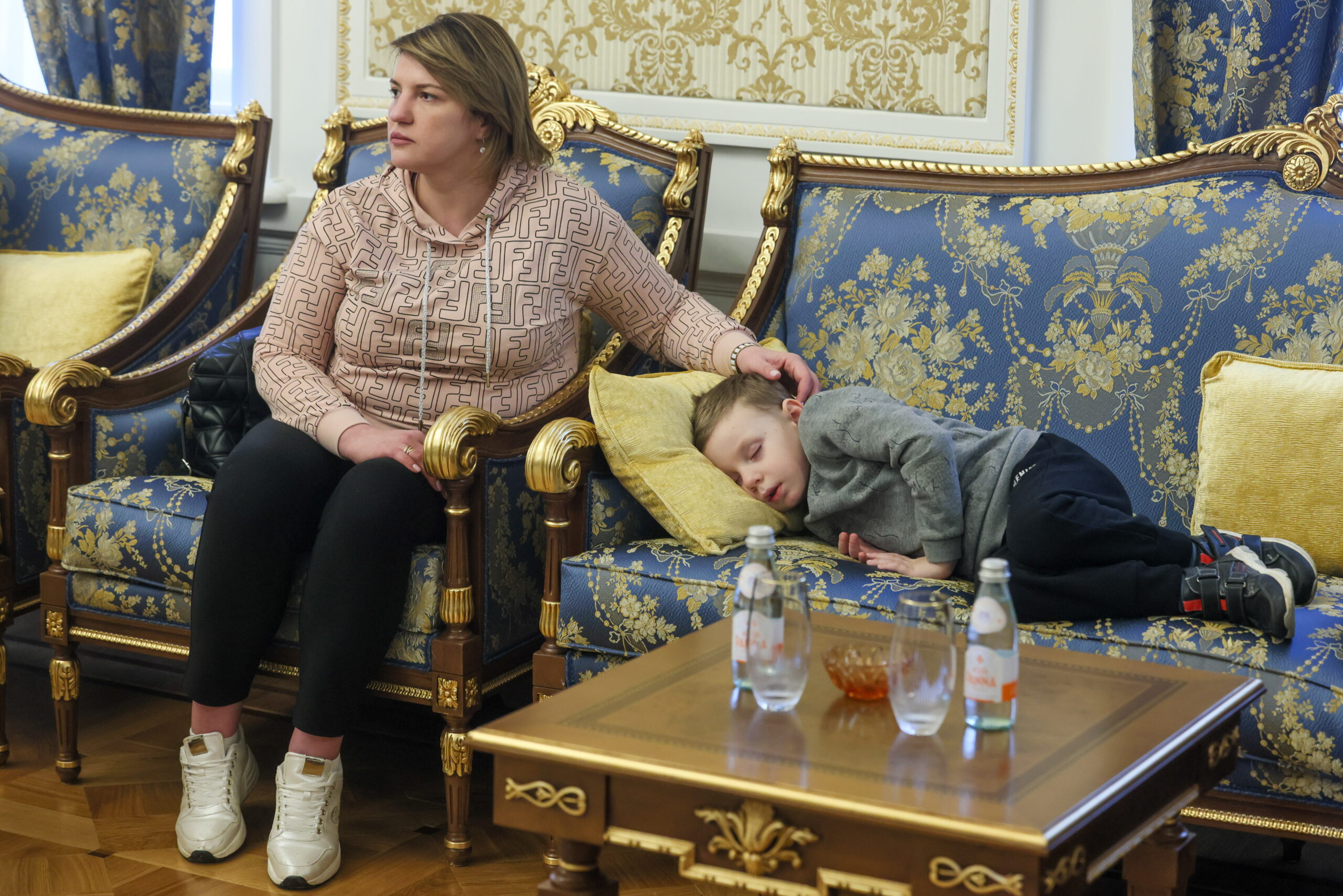
Brussels – According to the Ukrainian authorities, more than 20,000 Ukrainian children have been deported to Russia and the occupied territories since the invasion of Ukraine began in 2022. This is an issue to which the European Union has paid close attention from the outset, and today (21 April) has announced that, together with Canada and Ukraine, it will host a high-level meeting of the International Coalition for the Return of Ukrainian Children in Brussels on 11 May. “Russia’s war of aggression against Ukraine has not only cost territories and human lives: it has robbed many children of their childhood,” said the President of the European Commission, Ursula von der Leyen.
The meeting will be co-chaired by the EU High Representative for Foreign Affairs and Security Policy, Kaja Kallas; the Commissioner for Enlargement, Marta Kos; the Ukrainian Minister for Foreign Affairs, Andrii Sybiha; and the Canadian Minister of Foreign Affairs, Anita Anand. The aim will be to support Ukraine’s efforts to trace abducted children and bring them home, and to ensure that “those responsible face the consequences,” added von der Leyen.
The International Coalition for the Return of Ukrainian Children was established in Kyiv on 2 February 2024 and is co-chaired by Ukraine and Canada. It brings together forty-seven members, comprising countries and international organisations, and serves as a platform for coordinating the diplomatic, humanitarian, and legal initiatives of those working to prevent the deportation of children. The EU became a full member in September 2025, and at the May meeting, participants will also address coordinated actions and measures against those responsible for such crimes. “On 11 May, together with Ukraine and Canada, we will bring the world together to demand justice,” von der Leyen emphasised.
Meanwhile, the ONU highlights that “the war in Ukraine is having a devastating impact on the country’s 7.5 million children,” with “humanitarian conditions” that “continue to deteriorate.” Of the at least 20,000 Ukrainian children deported since 2022, Kyiv has so far managed to repatriate just over 1,850. Meanwhile, as of October 2024, around 1.6 million Ukrainian children aged between 0 and 18 were living in areas of Ukraine currently under predominantly Russian control, and almost one in five school-age children were attending school in these territories.
More broadly, according to the United Nations High Commissioner for Refugees (UNHCR), by the end of July 2024, there were no fewer than 6.168 million registered Ukrainian refugees across Europe—the “largest population displacement crisis since the Second World War, with almost a third of the population forced to flee their homes.” A further 571,000 Ukrainians are in exile outside Europe, bringing the global total of this community to 6.74 million people. Furthermore, according to the United Nations, 3.7 million people are internally displaced within Ukraine’s borders. In 2021, before the war, Ukraine had a population of 43.5 million. It now has only 37.9 million. According to the United Nations Office of the High Commissioner for Human Rights (OHCHR), the conflict has caused the deaths of 11,662 civilians between 24 February 2022 and mid-August 2024. The victims include 639 children. In addition, 24,207 civilians were injured, including 1,577 children.
On 30 April, civil society, together with the expert community, will meet in Kyiv to draft recommendations on the deportation of children, which will then be discussed at the May meeting. “Russia has committed numerous heinous crimes in its war against Ukraine, but the abduction of Ukrainian children is one of the most serious,” Kallas wrote on her X profile. This, combined with Russia’s systematic efforts to conceal their identities and whereabouts, requires sustained international support, which the EU intends to provide. “Our aim is to bring them home and hold those responsible to account,” concluded the High Representative.
English version by the Translation Service of Withub