
![I partner dell'Ue chiedono meno debito. Posizioni che riaccendono il dibattito sulla riforma del patto di stabilità [foto: imagoeconomica]](https://www.eunews.it/wp-content/uploads/2023/02/Imagoeconomica_1556290-scaled.jpg)
Brussels – Italy’s public debt rose more than expected. Figures released today (22 April) by Eurostat, the European Union’s statistical office, indicate that at the end of 2025 the debt-to-GDP ratio stood at 137.1 percent, a full 0.7 percentage points higher than the European Commission’s Autumn 2025 European Economic Forecast announced in November (136.4 percent). The updated estimates for the public finances of the European Union and the eurozone are not favorable to the Meloni government, which is now required to restore public accounts from a trajectory that runs counter to the common budget rules.
The figures released by the European statistics office do little to help the ruling parties in their call for the suspension of the Stability Pact, renewed as recently as yesterday (21 April), by the Deputy Prime Minister and Foreign Minister, Antonio Tajani. With Italy’s finances in this state, further relaxing spending limits would prove difficult at the EU level. Above all, the Eurostat data puts the spotlight on Italy and the possibility that, as early as the end of 2026, public debt could exceed that of Greece, which is on a downward trend (from 177.8 percent of GDP in 2022 to 146.1 percent by the end of 2025).
It is not within Eurostat’s mandate or role to make forecasts; those will be produced by the European Commission in mid‑May. That is when it will become clear what is expected from Italy. Meanwhile, the International Monetary Fund has already predicted that Italy will be overtaken by the end of 2026: according to IMF estimates, Italy’s debt-to-GDP ratio is set to reach 138.4 percent, compared to 136.9 percent for Greece. Not exactly a flattering picture for Italy and the Meloni government, which finds itself lagging behind the euro‑area country that became both the symbol of the economic crisis and of its solution.
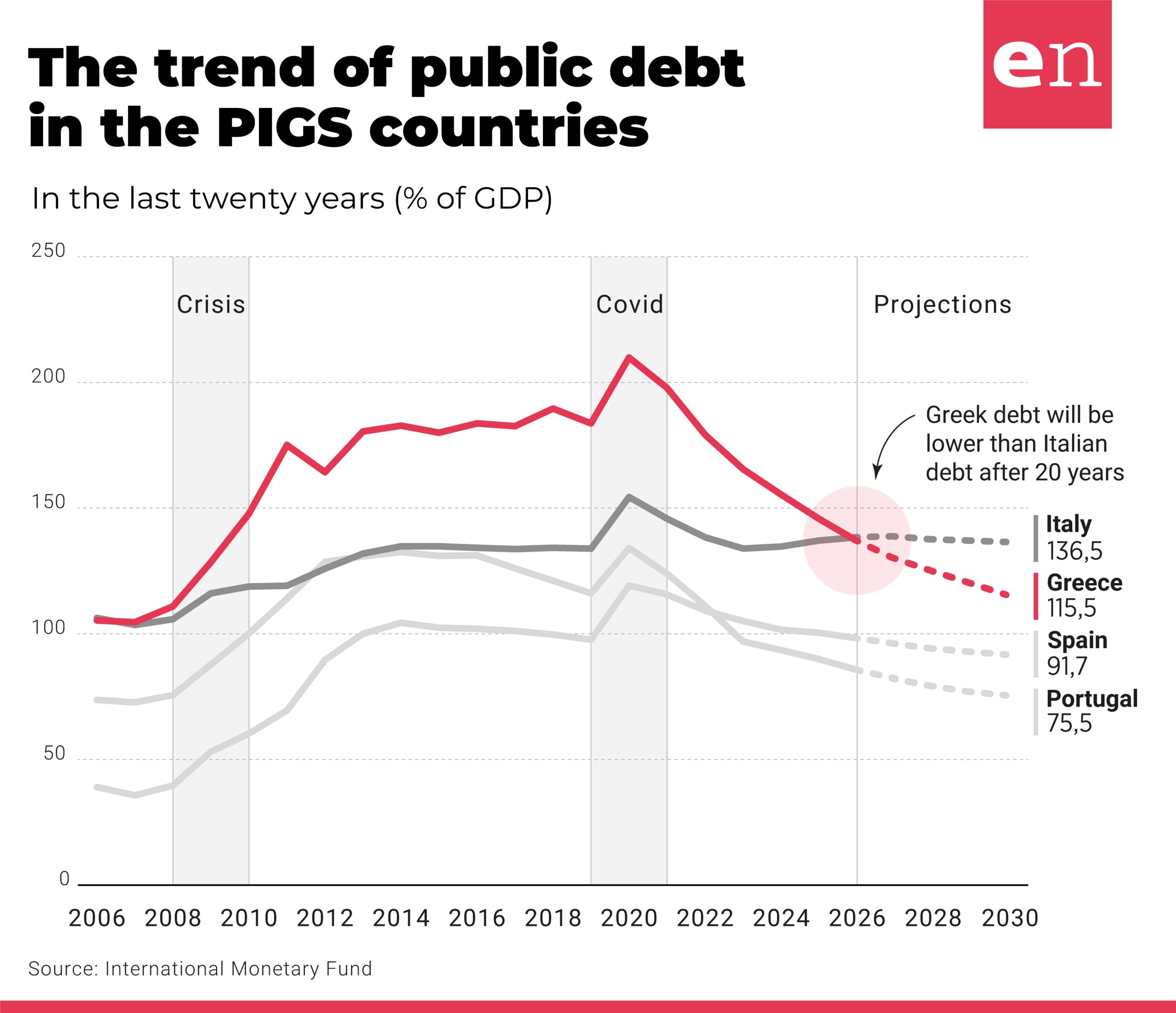
It will therefore be up to the spring economic forecasts to determine whether the EU will also officially recognize that Italy’s debt is rising to ever-higher, unprecedented levels. Certainly, the figures do not look promising. As regards the deficit too, Eurostat’s figures confirm Italy’s inability to return to within the 3 percent GDP threshold, as stipulated by the Treaties and the Stability Pact as a benchmark for public finances. Here too, the European Commission had forecast 3 percent by the end of 2025, but Eurostat puts the figure at 3.1 percent. A setback for Italy.
English version by the Translation Service of Withub
![Il ministro dell'Economia, Giancarlo Giorgetti, torna a Roma con i compiti per il governo impartiti dall'Ue [Bruxelles, 21 gennaio 2025. Foto: European Council]](https://www.eunews.it/wp-content/uploads/2025/01/giorgetti-250121-350x250.jpg)