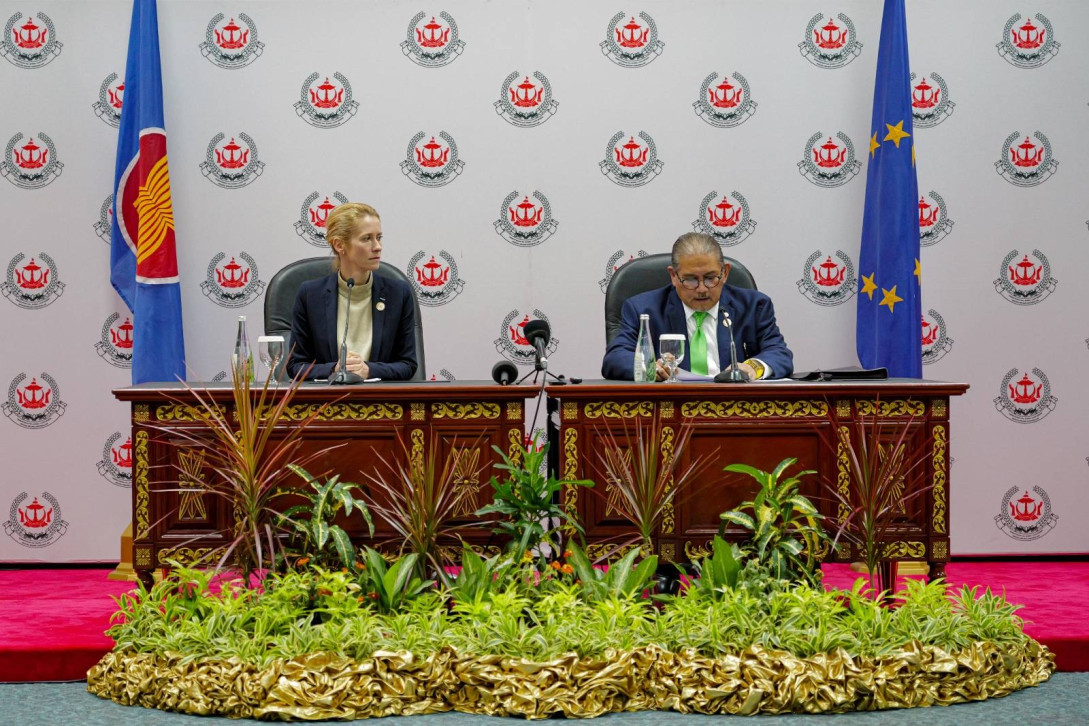
Brussels – “We want wars to end. We want peace, and then we do not have these kinds of problems. So, that is why we are advocating for diversifying resources and finding them elsewhere, not from Russia.” This is the direct message that the High Representative of the European Union for Foreign Affairs and Security Policy, Kaja Kallas, is delivering in Brunei during the press conference following the 25th ministerial meeting between the EU and the ASEAN countries (a bloc comprising Brunei, Cambodia, the Philippines, Indonesia, Laos, Malaysia, Myanmar, Singapore, Thailand, and Vietnam). Kallas’s remarks, made before the press, were in response to a question about the interest shown by some ASEAN countries in purchasing Russian oil. “Of course, there is an energy crisis right now in the world,” Kallas noted. “And unfortunately, this energy crisis is benefiting Russia. Just let me remind you that the oil revenues are the revenues that Russia is using to fund this war,” the former Estonian prime minister clarified. “We have an interest that this war stops. And wars end when aggressors run out of money to finance them, and that is why it is in our interest that the revenues from the Russian oil are actually shrinking. And that is also our message to our partners everywhere in the world that seek stability,” she added.
The meeting, held on 27 and 28 April 2026 in Bandar Seri Begawan, also reaffirmed the central importance of economic relations between the two regions. “Trade is a solid foundation for the EU-ASEAN relationship,” Kallas stressed, while warning that “we must go further and focus on security because wars and threats do not respect borders.”
A dialogue that has lasted for almost five decades and is based on a constantly growing economic partnership. “The strongest foundation is our growing economic partnership,” the High Representative noted, highlighting how bilateral trade reached “almost 400 billion euros” in 2024. These figures make ASEAN the EU’s third-largest trading partner outside Europe, while the EU ranks third among the Association’s global partners. In terms of agreements, Kallas referred to “two free trade agreements in force, with Singapore and Vietnam, the recent trade agreement with Indonesia, and good progress in talks with the Philippines, Thailand, and Malaysia.”
However, according to the parties, cooperation based solely on trade is no longer sufficient. “Today’s discussion focused on how we can deepen our cooperation even further. Areas where this makes most sense are, for example, maritime security, counterterrorism, and cyber defence. We can do more together with full respect for ASEAN’s principles of neutrality and consensus,” Kallas explained, speaking alongside Brunei Darussalam’s Second Minister of Foreign Affairs, Dato Erywan Pehin Yusof, in his capacity as national coordinator for ASEAN-EU dialogue relations.
In an increasingly complex geopolitical context, the European Union is increasingly turning its attention toward South-East Asia, building on “a common interest in regional stability and a rules-based international order.” And, “in such difficult times for both of us, our discussions at the EU-ASEAN ministerial meeting highlight why greater cooperation and stronger partnerships represent the best way forward,” the High Representative added.
During the meeting, the ministers reaffirmed their commitment “to international law, including the Charter of the United Nations and UNCLOS, the United Nations Convention on the Law of the Sea”, and emphasized the importance of maintaining “peace, stability and freedom of navigation in the South China Sea.” The EU and ASEAN also recognized that safeguarding critical maritime security requires “a concerted and coordinated effort” and, in a joint statement on the sidelines of the two-day meetings, they encouraged “enhanced cooperation based on the sharing of best practices, in accordance with international law.”
Finally, Brussels provided updates on the Global Gateway, the 2021 program to develop infrastructure in developing countries, highlighting investments in sustainable infrastructure, clean energy, and digital connectivity in Southeast Asia. ASEAN welcomed these initiatives, viewing them as a “contribution to the region’s inclusive and long-term growth.
English version by the Translation Service of Withub![[Credits: AgainErick/Wikimedia Commons]](https://www.eunews.it/wp-content/uploads/2026/02/containers-350x250.jpg)
![Il presidente ucraino, Volodymyr Zelensky, al vertice del Consiglio europeo [Bruxelles, 23 ottobre 2025. Foto: European Council]](https://www.eunews.it/wp-content/uploads/2025/10/zelensky-251023-350x250.jpg)