![Il commissario per l'Economia, Valdis Dombrovskis, al Brussels Economic Forum [Bruxelles, 7 maggio 2026]](https://www.eunews.it/wp-content/uploads/2026/05/dombro-bef.png)

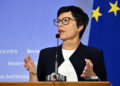
Brussels – “Europe is in the race for leadership in the field of artificial intelligence,” the Commissioner for the Economy, Valdis Dombrovskis, wants to reassure everyone. He is speaking to the audience at the Brussels Economic Forum, but is addressing businesses and investors in particular. He wants to convince them that the EU can emerge as a winner from the competition “that will define the 21st century,” because while it is true that the twelve-star club does not have the financial resources of players such as the United States, he is keen to point out that “the good news is that Europe’s scientific talent, industrial capacity, and manufacturing know-how offer us some fundamental advantages.”
The EU is not starting from scratch. On the contrary, when it comes to new technologies and artificial intelligence, the European Union already has a clearer vision than one might imagine. “You might be surprised to learn that the EU produces 22 per cent of the scientific articles published globally in artificial intelligence research journals, compared to 17 per cent produced by US researchers,” Dombrovskis noted. One in five articles is the result of a European researcher’s work. In addition, “global chip manufacturers rely on ASML’s ultraviolet lithography systems, which are made right here in Europe.”
The groundwork is there. What comes next is politics. As the Commissioner for the Economy explains, “the challenge for European policymakers now is to determine the role we can play to compete effectively in the artificial intelligence leadership race, maximise the benefits of this transition, and minimise its negative effects.” Indeed, because there is a risk involved, particularly in terms of employment.
“We are concerned about the job losses the transition could cause“, Dombrovskis admitted. This means that the question raised in Brussels two European Commissions ago has still not been answered. In 2018, the Commissioner for Growth and Investments, Jyrki Katainen, admitted that he did not know what the impact of new technologies on jobs might be. There is only awareness that “we live in an age where every dependency represents a vulnerability and every advantage is exploited,” and Dombrovskis wants to stress this.
The EU cannot afford to lose the robotics and artificial intelligence race and fall behind the United States and China, and the focus is entirely on this issue. “Allowing an ‘AI gap’ to emerge with our international competitors and rivals would have serious consequences for our prosperity and security,” Commissioner for the Economy warned, urging people not to be afraid: “We must manage this transition appropriately. If done well, we will reap great benefits.”
English version by the Translation Service of Withub