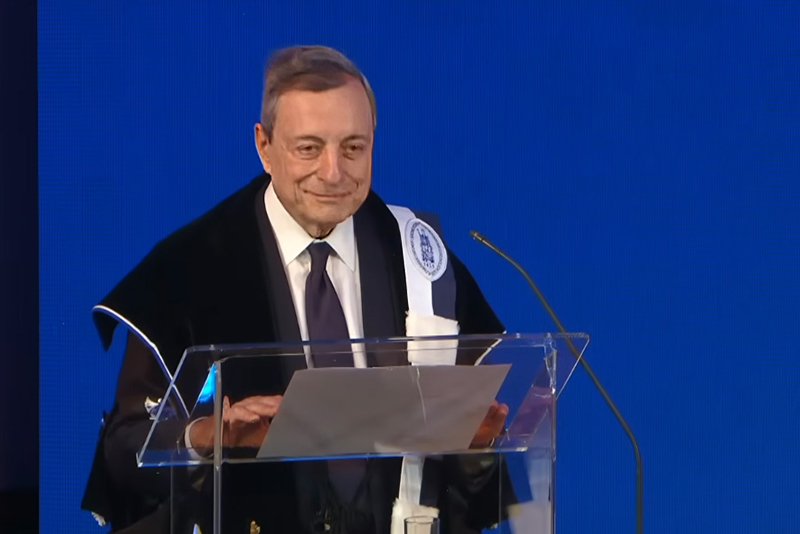

Brussels – The European Union is at a crossroads: either it carries on as it has done so far and succumbs to history, or it finds the courage to revitalise and reform itself, starting by moving beyond the requirement for unanimous decisions that paralyse Europe. Mario Draghi urges EU heads of state and government to act, effectively trying to back them into a corner: “The world that once contributed to Europe’s prosperity no longer exists,” he says in his speech delivered on the occasion of the Presentation of the Charlemagne Prize. In this new world, he warns, “for the first time in living memory, we are truly alone together.”
In the East as in the West, “Europe must manage increasingly complex dependencies on both the United States and China.” While Beijing has never been a true partner in the East, relations with Washington in the West are probably the real existential dilemma facing the European Union today. Meanwhile, Draghi warns, “on the other side of the Atlantic, we can no longer take it for granted that the guardians of the post-war order are still committed to preserving it.” But it is not just a question of defence, which is nonetheless seen as an “opportunity” to revitalise the European sector. “An alliance in which Europe depends on the United States for its defence is an alliance in which dependence on security can have repercussions on every other negotiation: trade, technology, energy”, exactly what the current Trump administration has begun to do. That is why, according to the author of the EU’s new competitiveness report, “the shift in the US position on European security should not be seen merely as a danger. It is also a necessary wake-up call.”
This awakening, invoked by Draghi, hinges on completing the European project, meaning an entirely new way of making the decisions that are now required. It is the decision-making process that comes under fire: “The problem is not a lack of ambition among leaders, but what happens after that ambition enters the system.” Agreements and deals are drawn up through committees that “water them down and delay them, until the final result bears almost no resemblance to the original intentions.” The result is action that may prove “so inadequate in relation to the scale of the challenge as to be worse than inaction.” Here is the key passage from a lengthy speech designed to pave the way for the bombshell proposal: to circumvent unanimity and proceed by variable majorities.
“The countries feeling the most weight of this moment, and which understand that the window of opportunity to act will not remain open indefinitely, must be free to proceed.” This is the cornerstone of the shift in pace that the new world demands. “This is what I have called ‘pragmatic federalism‘”, which means, in practice, that “countries willing to act should step up cooperation in specific areas.” Of course, Draghi acknowledges, “this approach will necessarily be experimental,” but it cannot be otherwise. “Some initiatives will work, others will not: that is why it is pragmatic. But it is also federalism, because the experiments are not random.” On the contrary, he emphasises, “they are guided by a common goal: the conviction that Europeans must learn to exercise power together if they wish to preserve their values.“
English version by the Translation Service of Withub