
Brussels – Imagine if your spine were entirely controlled by someone else: your movements would depend entirely on their will, your freedom of choice would be severely restricted and, ultimately, that invisible hand might even end up breaking you for good. This is precisely the metaphor that can be used to describe the relationship between Europe and China when it comes to critical raw materials, a topic at the heart of the latest report by the study of the European Union Institute for Security Studies (EUISS), the European Union’s official think tank on foreign and security policy.
In the report published last Tuesday (12 May) and entitled “Beijing’s critical raw materials weapon and how to dismantle it”, EUISS analyst Joris Teer demonstrates how, by 2025, Beijing will have transformed its “near-monopolistic” control over these materials—described as “the backbone of the global economy”—into a veritable geopolitical weapon. By holding 70 per cent of global extraction and refining capacity for as many as 17 of the 34 materials the EU considers “critical”, the Dragon is exerting increasing leverage over Brussels: destabilising supply chains, driving up production costs, and bending the will of alliances and governments. A weapon that Chinese President Xi Jinping himself has described, in no uncertain terms, as an “assassin’s mace“.
Critical raw materials: what they are and why they are so crucial
They are not gold or oil, yet without them the economy of the Old Continent (and beyond) would grind to a halt. Critical raw materials (CRMs) are minerals and materials that the EU classifies as such precisely because they combine extremely high economic and strategic importance with a high risk of supply disruption.
In short, there is a great need for them, but securing them is very complicated.
Rare earths, gallium, germanium, graphite, manganese, cobalt: names often unknown to the general public but essential for the production of semiconductors, wind turbines, batteries, electric vehicles, drones, missiles, smartphones, and even advanced medical equipment. They are the invisible building blocks of the green transition and European security. And this is where Europe’s structural problem emerges: while Brussels has, in recent years, constructed an ambitious narrative of strategic autonomy in such crucial areas, the industrial reality reveals a profound dependence on China.
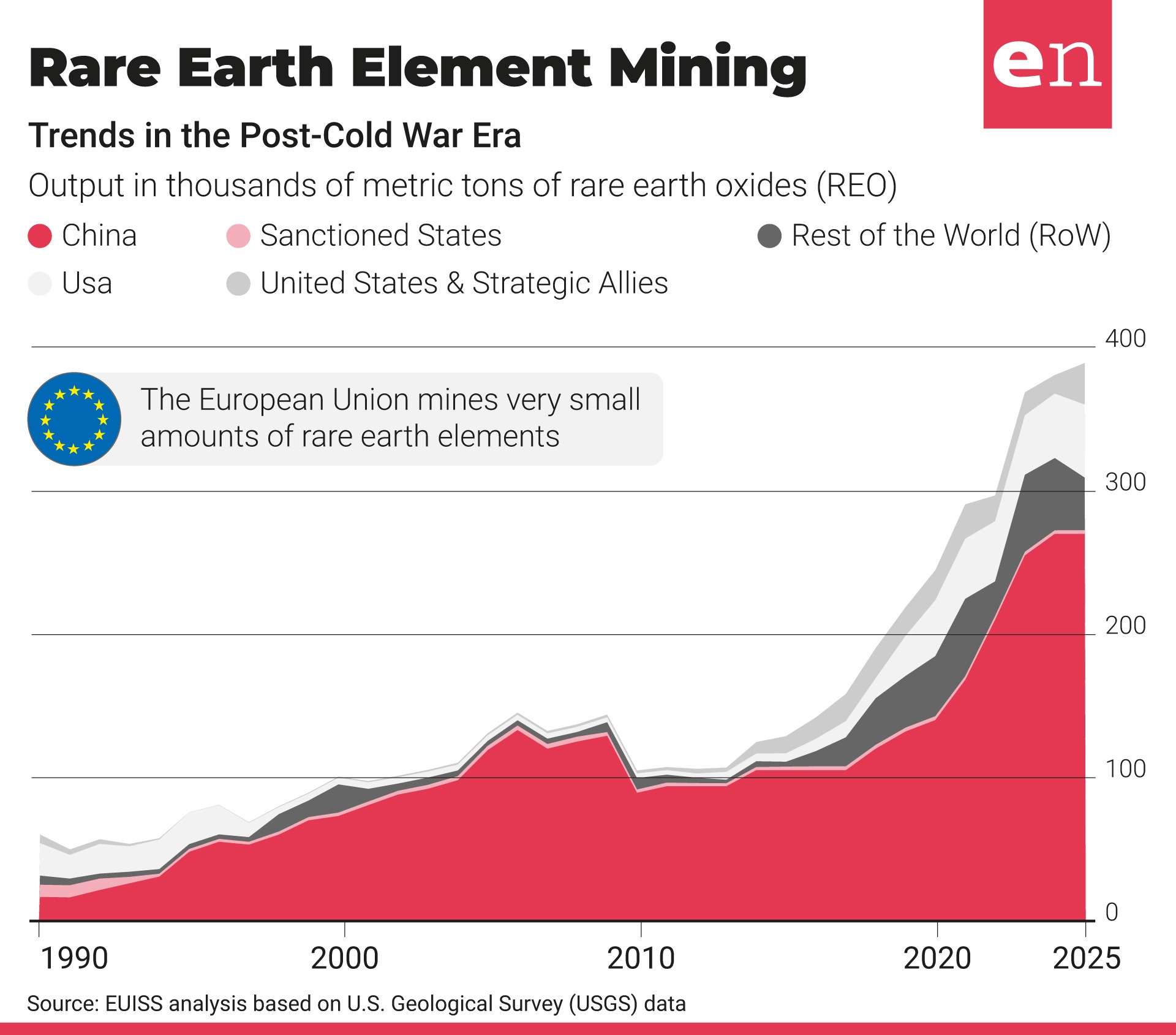
The real issue is not just mining but, above all, refining and industrial processing. To cite just a few figures from Teer’s study, Beijing controls around 95 per cent of manganese refining, 87 per cent of silicon metal refining, and around 85 per cent of light- and heavy-rare-earth processing. According to the EUISS report, China controls over 70 per cent of the global extraction or refining of at least nine other strategic materials.
Over the years, this dominance has not been built by chance. Through massive state subsidies, low-cost energy, less stringent environmental standards and an aggressive industrial policy, China has gradually eliminated Western competition. Among the various case studies presented by Teer in this regard, the most illustrative is the one relating to the gallium market, one of the cornerstones of the ecological transition targeted by Brussels: Chinese overproduction between the 1990s and 2000s caused global prices to plummet, forcing European and American producers out of the market. Once it had secured a monopoly, Beijing was able to turn that dependence into a strategic lever.
And the problem—warns Teer—is no longer confined to raw materials. The same pattern is being repeated in permanent magnets, batteries, semiconductor wafers, and industrial chemicals.
Beijing’s blackmail
According to the EUISS report, 2025 was the year in which the Dragon finally laid its cards on the table, clarifying its strategy and how it intends to pursue it: through the shift from mere “dependence” to what Teer terms the “weaponisation” of supply chains. In other words, Xi Jinping has officially pulled the “assassin’s mace” out of his hat, beginning to use the dependence of (literally) half the world on his critical raw materials as a tool of geopolitical coercion.
How? Through a drastic reduction in exports of a range of critical materials. Initially, the target was solely the United States, and the measure took the form of a “simple” retaliation following the imposition of Trump’s tariffs and technological restrictions on semiconductors. But it didn’t take long for the message to become much broader, and numerous Asian partners found themselves caught in Beijing’s grip (above all, Japan, after Prime Minister Takaichi had floated the idea of sending Japanese troops to Taiwan in the event of a Chinese invasion) and Europe. It is a form of pressure less spectacular than aircraft carriers in the Taiwan Strait, but potentially just as effective. Because it directly affects the production capacity of rival countries.
Teer’s interpretation of Xi Jinping’s reasoning is straightforward: if Europe fears that political or trade action against Beijing could lead to a cut-off of supplies of critical materials, then it will inevitably be less inclined to challenge China on issues such as Taiwan, the export of dual-use technologies to Russia or tensions in the South China Sea.
The worst-case scenario outlined in the report is particularly alarming: a complete suspension of Chinese exports of rare earths and permanent magnets could cost the European economy up to $1.5 trillion a year. It is therefore not surprising that there is a growing sense in European chancelleries that they are facing the same dead end in the energy sector following Russia’s invasion of Ukraine: a dependence justified in the name of economic efficiency that now risks backfiring as a political weapon.
Solutions: between self-sufficiency and new alliances
If a response is inevitable, the question remains how to go about it. According to Teer, a purely European approach will not be enough. The idea of total EU self-sufficiency is described as unrealistic: the continent has few reserves, expensive energy, strict environmental regulations and bureaucratic procedures that are incompatible with the current geopolitical urgency.
The proposed solution is therefore a grand industrial coalition between the main “victims” of the “assassin’s mace”: the EU, the United States, Japan, South Korea, Australia, Canada, and the United Kingdom. Not only to increase the supply of raw materials as an alternative to China, but above all to create a genuine protected market that bypasses Beijing. In practice: coordinated subsidies, joint public investment, guaranteed minimum prices, trade restrictions, and European content requirements in public procurement.
In this regard, Brussels already has a model to draw inspiration from: the recently approved Critical Medicines Act, designed to boost industrial competitiveness in the pharmaceutical sector and break free from dependence on non-EU suppliers such as India and—who would have thought?—China.
However, in keeping with a typical leitmotif of Brussels politics, all this is easier said than done. For behind a picture painted in particularly bold strokes, there are in fact numerous shades of grey. To name but a few: will it really be possible for the EU to reduce its dependence on China without this leading to a radical breakdown in economic relations with what is its second-largest trading partner globally? And furthermore, how can we avoid the risk of replacing dependence on one “rogue element” with another (read: the United States and Donald Trump)? Will Europe really have the courage to distance itself as much from Beijing as from Washington and stake everything on more reliable partners who, however, play a supporting role in the international system, such as Japan, Canada, or Australia?
Questions that Teer leaves hanging, while the time to find an answer may well be running out.