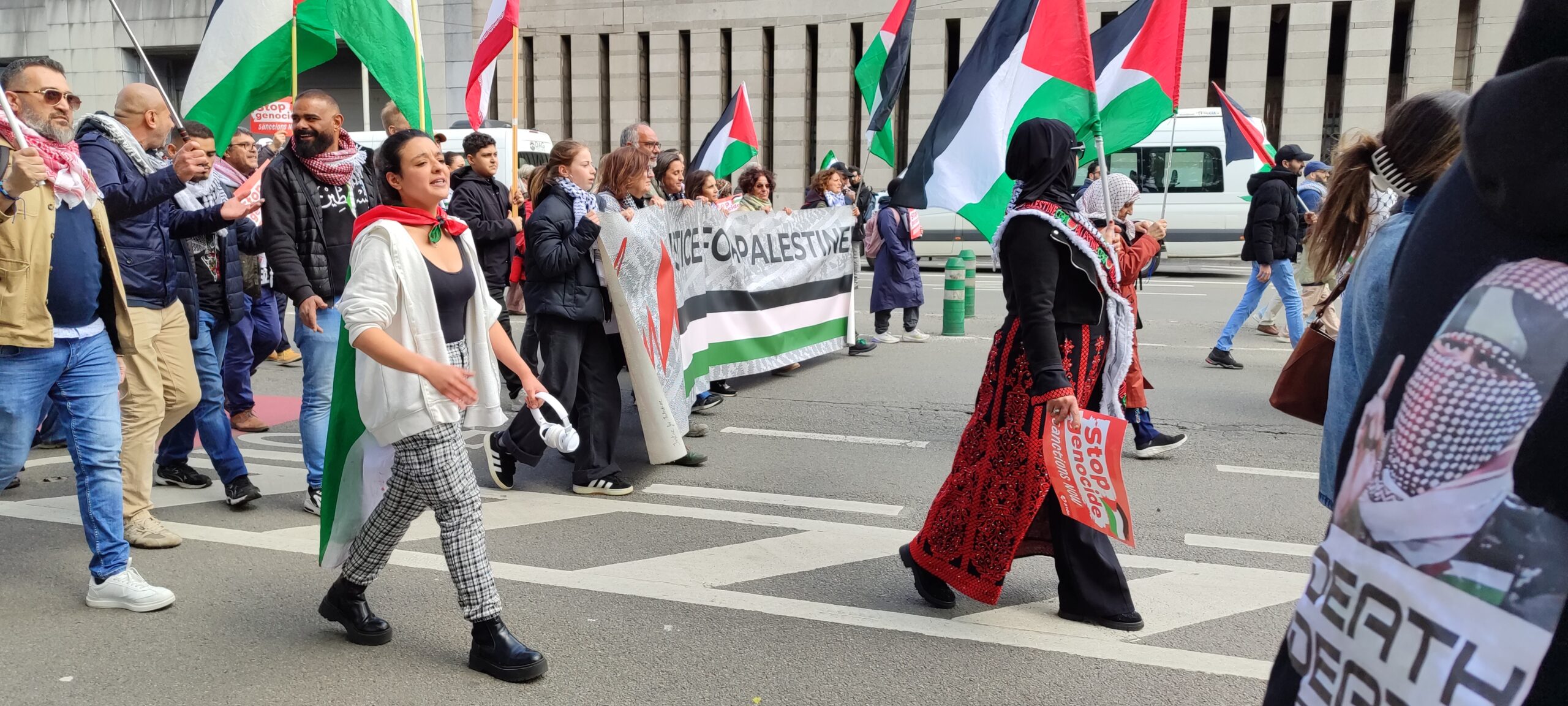
“EU, shame on you, your hands are bloody too”. Despite the rain, last Sunday (17 May), 12,000 people took to the streets of Brussels once again to commemorate the tragedy experienced by the Palestinians 78 years ago, the Nakba, and to protest against the genocide they are enduring today. But above all, to vent an anger that is becoming ever clearer, and to which the European Union remains blind, deaf, and mute: anger at the inaction and complicity of Western governments, European politicians, and institutional leaders towards their ally Tel Aviv. That is why this slogan—“Shame on you, EU, your hands are bloody too”—was chanted repeatedly by the marchers. Brussels is the EU capital, but it is also a city of rich diversity that took to the streets almost immediately to protest against Israeli actions following 7 October 2023. Palestinian flags in windows, stickers in support of Gaza in the metro or on road signs, as well as keffiyehs draped over shoulders or around necks and various graffiti on walls denouncing European silence—one piece of graffiti right in the heart of the European quarter, which President Ursula von der Leyen might even see from her window at the Berlaymont Building, reads “EU Accomplice” above a Palestinian flag—have been a constant feature for over two and a half years now. Yet the institutions and their politicians, with the exception of the EU Staff for Peace group, who were also out on the streets last Sunday, see nothing, hear nothing, say nothing. They remain what they are: a bubble detached from reality, detached from the pain that a city has been feeling and expressing consistently for thirty months.
And to think that all it would take is to put into practice what we claim to uphold: the principles of the United Nations and the values enshrined in the EU Treaties. Without giving it too much thought, apply them in every case and everywhere, without distinction. It would be enough to start answering journalists’ questions in the press room not with the usual stonewalling, but with a modicum of human dignity, even before professional decorum. It would be enough to start adding, to every brief press release issued in response to yet another green light for yet another Israeli settlement, not only that the occupation is illegal under international law, but also that the EU will take real and concrete action, such as restrictive measures, because that is how it is, and it is not up for debate. I’m not even suggesting stepping out of the bubble to try the food at one of Brussels’ many restaurants serving Lebanese, Syrian, or Palestinian cuisine, and experiencing first-hand, by talking to chefs and waiters, what it means to have family members who are in hiding, who are fleeing, who are in a hospital or in some mass grave thousands of kilometres away. But now, with the experience of the Flotilla slapping us in the face with the full extent of the complicity and futility of European governments and EU institutions, it would suffice to look at the faces of these citizens, European and otherwise, who are shouldering the dignity of a part of the West and of Europe, and for this are suffering torture and derision at the hands of a government whose hands have shaken, and continue to shake, those of all our leaders.What gets lost is the meaning of the words, and we say it so often that we no longer even notice. “Pro-Pal” is the label much of the press likes to apply to those who demonstrate against genocide, and it serves to create a caricature, to belittle the people taking to the streets and putting themselves on the line. But what if we tried writing “Pro-International Law”, “Pro-Respect for the Law”, “Pro-Respect for the laws we adopted after the Holocaust”? What would happen then? Because no leader in Brussels would feel truly free to say with impunity that international law is a burden or a joke. We have seen for the past thirty months that, for European leaders, international law is only valid up to a point—that is, until the Israeli government says otherwise. The fact is that this is not the case for European societies, and the anger is also, and above all, directed at their own representatives precisely because of this attitude, which, if not complicity, is then uselessness. That is why the question starts in Gaza, extends to Palestine, Lebanon, Syria, Iran, and Venezuela, and reaches us and the very fabric of our societies.
We have known for several decades that representative democracy is in crisis. But what democratic value does an institution hold today if it fails to provide answers, refuses to take a stand, and takes no action in the face of the crimes committed on a daily basis and the demands for justice rising from the streets? What value does an institution have that does nothing against genocide or the abductions of its own citizens in international waters? That is not ashamed to remain a bubble and, moreover, to adopt an attitude reminiscent of the Ancien Régime, claiming a position of superiority in ethics, morals, and democratic values? How can it fail to realise that it is useless, if not complicit?
English version by the Translation Service of Withub










![[credits: Dietmar Rabich / Wikimedia Commons / “Münster, Stadtweinhaus, Beflaggung Ukraine und EU -- 2022 -- 0219” / CC BY-SA 4.0]](https://www.eunews.it/wp-content/uploads/2026/03/ue-ucraina-120x86.jpg)