

Brussels – Italy‘s economic performance is now becoming a problem. In 2026, the country will stay afloat, but in 2027, it will rank last in growth and first in public debt, with no further investment incentives due to the expiry of the Recovery Plan (NRRP). The European Commission’s spring economic forecasts confirm all of the country’s problems, starting with what the International Monetary Fund had already anticipated: the Republic of Italy is set to become the country with the highest debt level.
The EU executive has revised its forecasts downwards, but this is not the main issue for the Meloni government: it is a general trend that has led Brussels to revise everyone’s forecasts downwards, due to a war in Iran that has driven up energy prices, holding back consumption and growth. “The EU economy will continue to grow, but at a slower pace,” the Commission’s experts note.
Slower growth: Italy second from bottom in 2026 and bottom in 2027
In 2026 and 2027, Italy’s gross domestic product is set to grow by 0.5 per cent and 0.6 per cent, respectively. Compared with autumn forecasts, the Commission has cut its growth forecast for the current year by 0.3 percentage points and for next year by 0.2 percentage points. While Italy will rank second-to-last in terms of growth at the end of 2026 (surpassed only by Romania at +0.1 per cent), in 2027, no other country will fare worse than Italy.
Public finances: debt spiralling, deficit under scrutiny
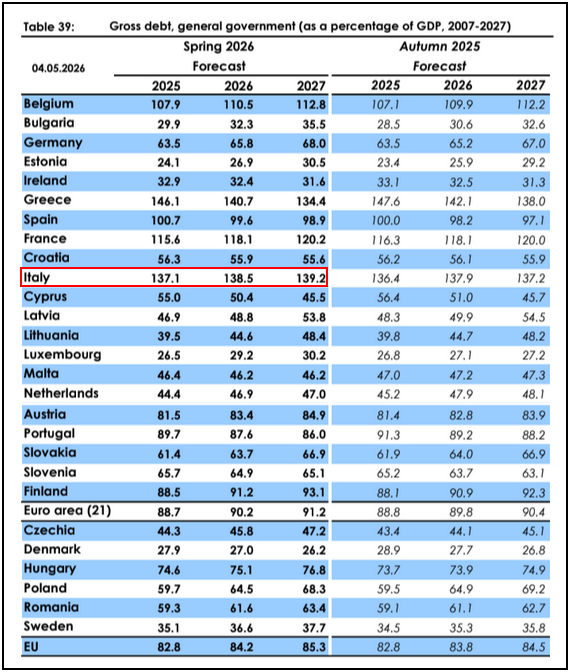 eece is on a downward trajectory, with the debt-to-GDP ratio set to fall from 147.6 per cent to 134.4 per cent between 2025 and 2027, Italy is on an upward trajectory, with the ratio rising to 139.2 per cent by the end of 2027. Greece is therefore overtaking Italy, and politically this figure is bound to weigh heavily on the current governing majority, as Italy becomes the country with the highest debt levels in the EU and the eurozone during the FdI-Lega-FI coalition government.
The situation is looking better as regards the deficit-to-GDP ratio. The Commission confirms that Italy will fall below the 3 per cent threshold this year (2.9 per cent) and will remain there next year too (stable at 2.9 per cent), which means the excessive deficit procedure will be closed. There is, however, a caveat to this figure: “The deficit is expected to remain stable in 2027, assuming no changes in economic policies.” This is a warning to Meloni: the final months of her term and the election campaign must not be used as a pretext to upend the government’s work with measures – and above all expenditure – that would undermine what has been achieved so far.
Energy: Italy criticised for systemic choices
The bad news for the Meloni government does not end there, as this substantial document includes a box to assess how Member States are affected by the energy crisis, depending on each country’s nature. Essentially, it highlights that “The relationship between gas and electricity prices varies significantly across Member States, reflecting differences in generation mixes and infrastructure constraints.” In this regard, Italy is cited as an extreme case. “In the Iberian Peninsula, where renewable penetration is highest, gas influences prices in a minority of market hours. Conversely, in Italy, where the system remains more gas-dependent, gas sets the price in the majority of hours.” Compared to these two examples, “Germany and the Netherlands fall between these two extremes.”
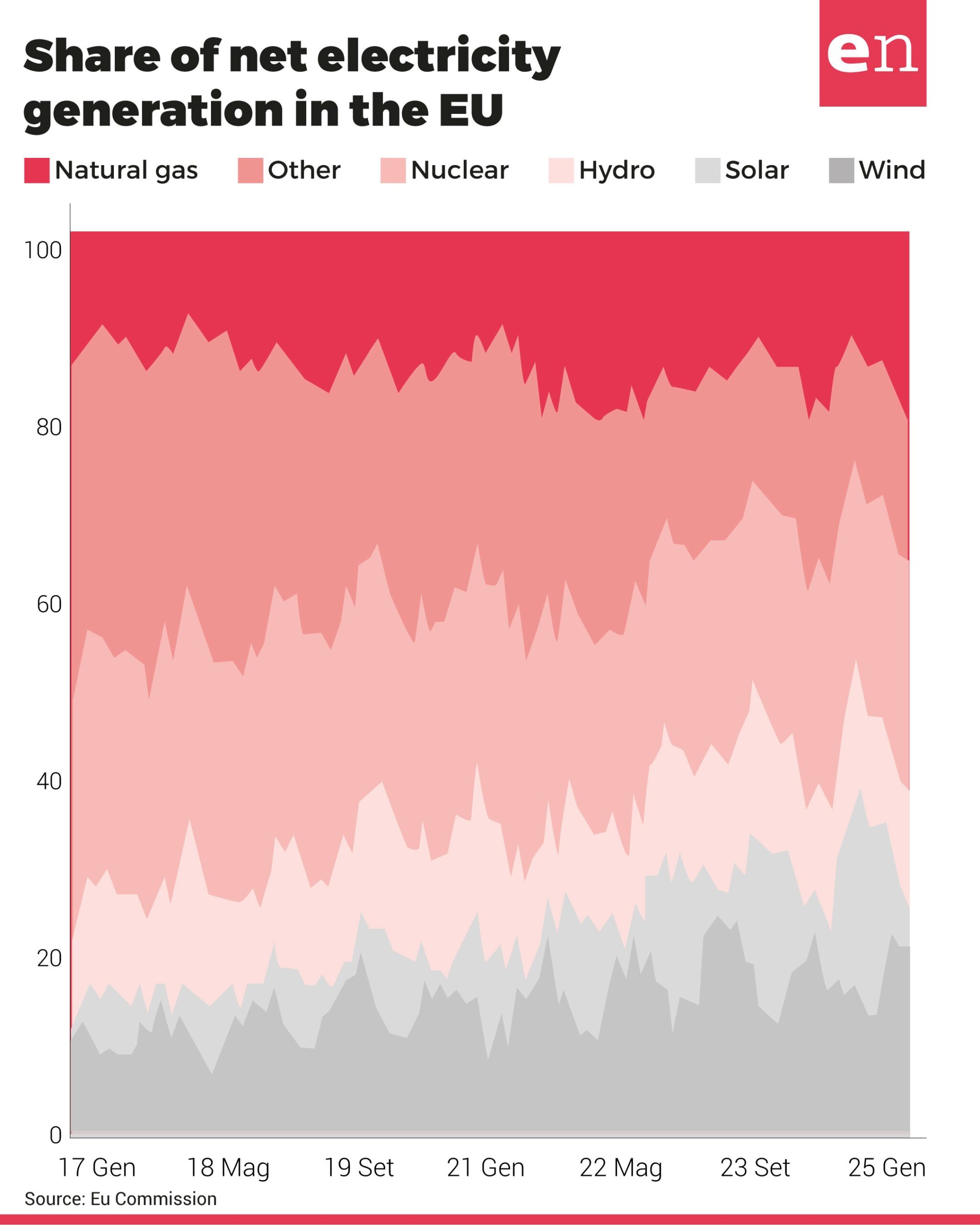
Italy is therefore an extreme case of heavy reliance on fossil fuels, and with this analytical box embedded in the spring economic forecasts, the European Commission is in effect responding politely and indirectly to the Meloni government’s requests to ease the stability pact rules to address rising energy prices, with a message that, between the lines, is essentially this: Italy is paying the price for the choices it has made historically, which have led to a well-known and by no means exceptional situation. The message, therefore, becomes: invest in renewables.
All the Rome government managed to secure were tentative overtures, with the EU executive expressing a willingness to consider possible “policy options” to address the widespread energy crisis. “We are assessing the flexibility tools within the framework of our budget rules,” is all the Commissioner for the Economy, Valdis Dombrovskis, will say, though he remains non-committal about what might happen to address Italy’s concerns. He even issued a warning to the government: “Compared to the past, we have more limited room for manoeuvre on spending, and so we must act with caution. This applies above all to countries with higher debt levels.” And with Italy set to become the EU’s leading public‑debt holder, Dombrovskis’s words sound all the more forceful.
The doubts ahead: without the Recovery Fund, little stimulus
Slower growth, higher debt, and structural problems relating to energy and energy prices: The outlook for Italy is not the best, and the Commission adds further observations that are far from encouraging. “The lagged effects of higher inflation are expected to push up current expenditure, particularly on pensions, while the phase-out of RRF-related projects will lead to lower capital expenditure.” In essence, the emphasis is once again on pension reform, and Italy is warned that it will no longer be able to rely on the investment boost from the NRRP, funded by the Recovery Fund.
The European Commission notes that, for Italy, “output is set to grow by 0.6%, supported by a recovery in global trade and price normalisation.” This summary assessment lacks any reference to reforms: in Brussels, there is no sign of a push for productivity on the reform agenda. A missing piece that does not work in the government’s favour.
English version by the Translation Service of Withub