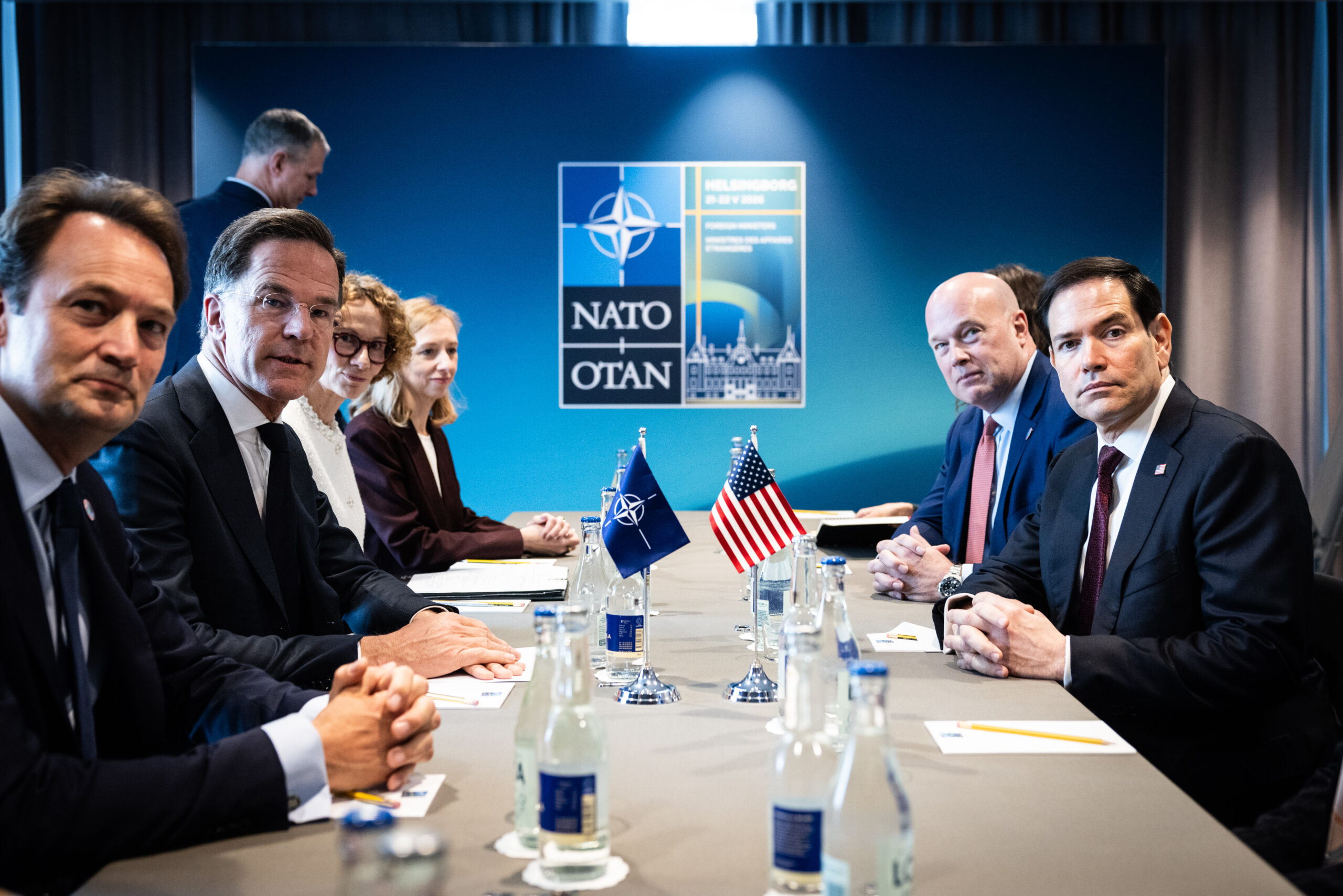

Brussels – Gradual, structured, and not punitive, but the United States’ withdrawal from Europe is inevitable. And European allies will have to respond by increasing their defence spending so as to “have a stronger Europe and a stronger NATO.” This was the message from NATO Secretary General, Mark Rutte, at the conclusion of the meeting of the Atlantic Alliance’s foreign ministers in Helsingborg, Sweden. “The threats we face are real,” Rutte noted at the end of the meeting, and the commitment to Article 5 of the Washington Treaty (which obliges Alliance members to intervene in defence of an ally under attack) is “unwavering.” “If anyone were foolish enough to attack us, the response would be devastating,” he emphasised.
But maintaining standards requires resources and commitment, according to the head of the North Atlantic Treaty Organisation. This is particularly true following the discontent and public statements by US President Donald Trump regarding America’s disengagement. Defence spending and industrial capacity are therefore at the heart of the ministerial meeting’s agenda. By 2025, investment “by European allies and Canada has grown by 20 per cent”, explained the Secretary General, but industries are not keeping pace. “We must produce faster and on a larger scale on both sides of the Atlantic,” said Rutte, identifying this as one of the key issues for the upcoming Ankara summit on 7–8 July. “Increased investment is essential, but it is not an end in itself. They are a means by which we become more capable, so that we can further strengthen our armed forces and ensure they have the necessary equipment to deter any adversary and defend every Ally,” Rutte clarified, emphasising that “the prerequisite is, and this is exactly what the United States wants: that Europeans remain strongly committed to NATO.”
A crucial development in light of the news from Washington. Yesterday (21 May), Trump stated that the United States will send 5,000 soldiers to Poland. The announcement, however, appeared to contradict Tuesday’s (19 May) decision, announced by the Pentagon, to reduce the number of combat brigades based in Europe from four to three. A point on which Secretary of State Marco Rubio remained unperturbed today. The review of deployments “is not a punitive measure,” he assured at a press briefing with Rutte upon his arrival at the ministers’ meeting. Rather, it is a process that is “ongoing and pre-existing” relative to recent tensions and will proceed “constructively” with the allies. Regarding the 5,000 troops expected to arrive in Poland, Rubio merely stated that they would come from the US, but that the details would be provided by the Pentagon. Then, he admitted that “Trump’s disappointment with certain allies who have not supported US operations in the Middle East will have to be addressed,” but not today, because “it is something to be discussed at the leadership level.” So, the ball is now in the court of the Summit to be held in Ankara, Turkey, on 7 and 8 July.
On the subject of US troops in Europe, when asked about possible reductions in Italy and Spain, Rutte made it clear that this was “an American decision” and described the redeployment as a “structured and inevitable” process. “Step by step,” he said at the press conference, “the US will shift its focus more towards other theatres,” while stressing, however, that “deterrence and overall defence in Europe must remain the same, because we are facing the Russian threat.” When asked whether Europeans should prepare to defend themselves without the US, he answered clearly: “We are not preparing for that.”
At his press conference following the meeting, Marco Rubio explained that he understood “that NATO is valuable to Europe and must also be valuable to the United States.” But “I believe we need to pay some attention to how much progress has been made a year on from the meeting in The Hague in terms of increasing contributions” because “there are some countries that have doubled their defence spending in recent years, while others are still lagging behind.” Meanwhile, specifically regarding Iran, he stated that he had emphasised the need “to have a Plan B if an agreement cannot be reached with Iran.” According to Rubio, the US “must start thinking about what to do if, in a few weeks’ time, Iran decides to keep the Strait of Hormuz closed.” Specifically: “I don’t know if it would necessarily be a NATO mission, but it would certainly be NATO countries that could contribute to it,” he noted.
Sweden’s first time
This is the first time Sweden has hosted a NATO ministerial meeting since it joined the Alliance in March 2024. Maria Malmer Stenergard, Sweden’s Foreign Minister, said during the press conference that “NATO is currently facing a shift that will require Europe to take on much greater responsibility for its own security” and that “Sweden is ready to shoulder its responsibilities as part of this shift.” Furthermore, she made it clear that the country is committed to “the 5 per cent target and intends to achieve it by 2030, ahead of schedule.” The Swedish minister finally emphasised military support for Ukraine, seen as “a direct investment in the security of the alliance and the security of future European generations.” On the sidelines, the minister held bilateral talks with Rubio alongside Prime Minister Ulf Kristersson. She emerged from the meeting highlighting the “excellent relations and strong cooperation on defence and new technologies.” Sweden has also become the first EU country to sign a bilateral agreement with Washington on technological cooperation, the Technology Prosperity Deal, covering artificial intelligence, connectivity, defence, innovation, and space.