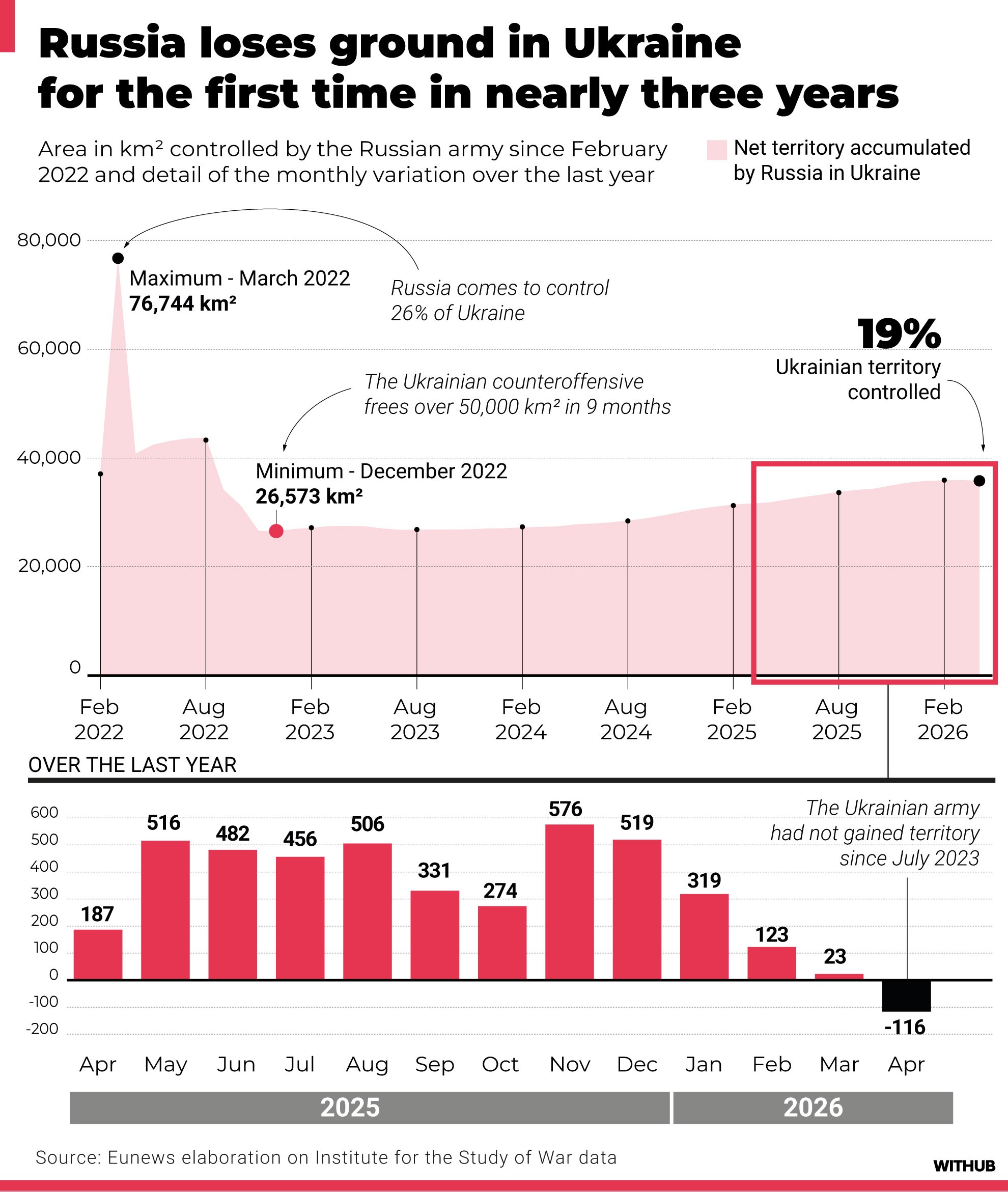
Brussels – In April 2026, the Russian army lost 116 km² to Ukraine, the first negative monthly change recorded by the Institute for the Study of War since the summer of 2023, when the territory controlled by Moscow hit its lowest point ever at 26,573 km² following the Ukrainian counter-offensive. Since then, Russia has steadily regained ground, taking back control of around 19 per cent of Ukrainian territory – corresponding to over 36,000 km² – with monthly gains exceeding 500 km² between November and December 2025. The slowdown, however, was already visible in the preceding months: from 319 km² captured in January 2026, the figure had fallen to 123 in February and just 23 in March, before the reversal in April. Data analysis by ISW reveals that the pace of Russia’s advance across the entire front has been steadily declining since November 2025, due to continuous Ukrainian ground counter-offensives, Ukrainian medium-range missiles, the ban imposed in February 2026 on the use of Starlink terminals by Russian forces in Ukraine, and the Kremlin’s crackdown on Telegram – factors that have exacerbated the existing critical issues within the Russian army.

ISW uses three categories to measure the territory under Russian control. The first is controlled territory: an area falls into this category only when Russian forces exercise a stable physical influence over it, sufficient to prevent its use by the enemy or to ensure the conditions for their own operations. This is a precise doctrinal definition borrowed from US military manuals and does not include areas merely traversed or contested. The second category is that of advances: areas where Russian forces have operated or launched attacks, but over which they have not yet established effective control. These correspond roughly to the zones lying within the line of contact – that is, the boundary between the opposing forces – but which have not yet been consolidated. There is a third category not included in the count: Russian infiltration. These are missions in which Russian units penetrate Ukrainian positions without establishing lasting control of the terrain. These areas are mapped separately because the level of control exercised is significantly lower than in the territory that has been conquered. If we take these situations into account, Russia does not show any net territorial losses — but it must be noted that these are operations designed to give the impression of territorial control, even though, in reality, they are missions carried out in “grey zones”.
English version by the Translation Service of Withub