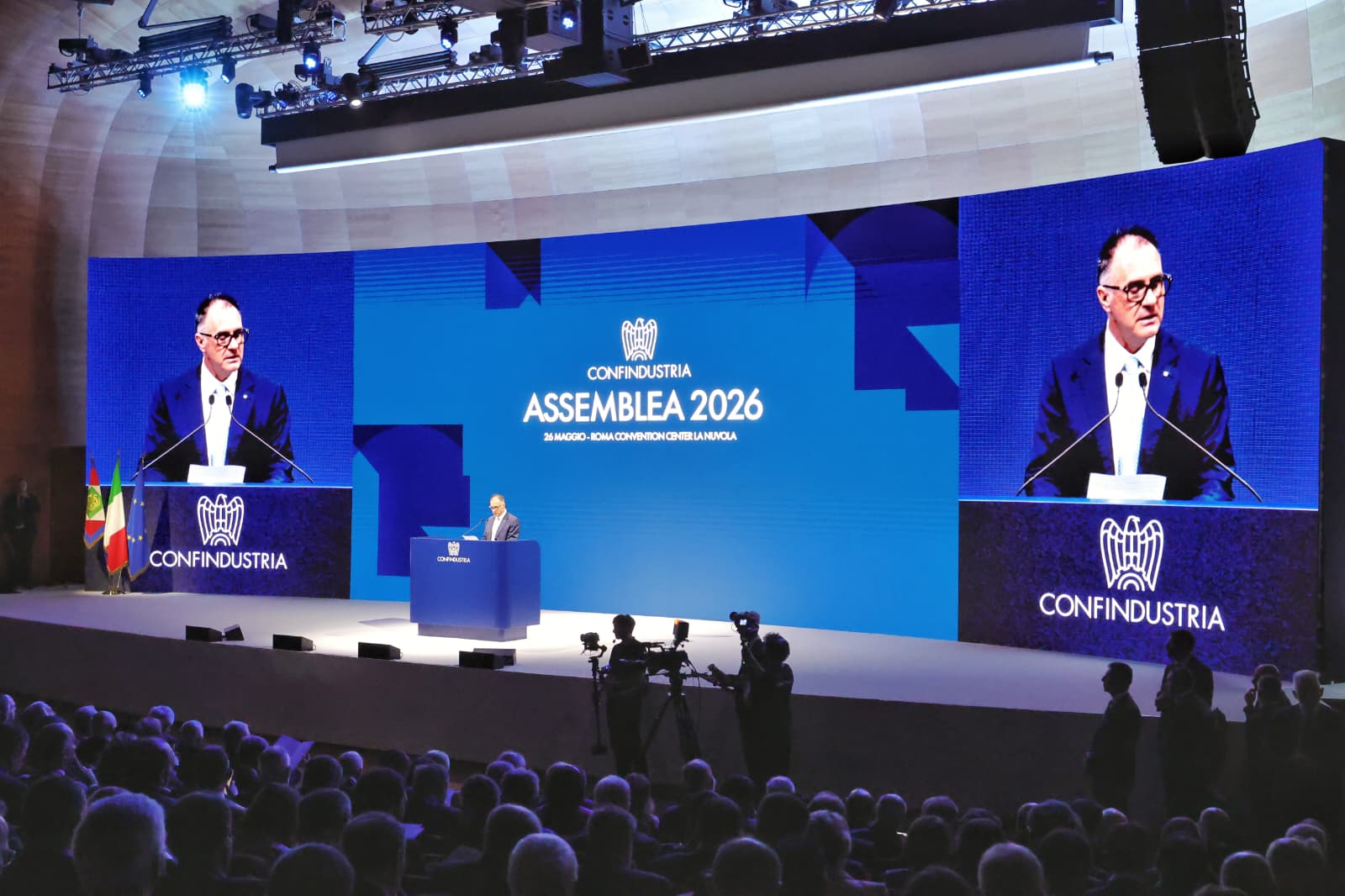

Rome – Europe must change course or face industrial decline. At the annual assembly, in the presence of the President of the Republic, Sergio Mattarella, the Prime Minister, Giorgia Meloni, and the government, the president of Confindustria, Emanuele Orsini, lambasts Brussels, but also warns Rome: no Member State has the political and economic resources to “tackle alone the challenges facing us—geopolitical, technological, climatic and demographic.” The United States and China, he points out, are tackling them with “massive public and private investment, including in the military sphere, and with protectionist policies.”
For industrialists, only the European dimension can weather the storm. Provided it recognises the importance of competitiveness. The president of the industrialists’ association denounces a veritable “collapse of the industrial system” over the last two years: “High energy costs, a lack of investment and excessive regulations have stifled entrepreneurial initiative and eroded employment levels, throwing our markets wide open to Chinese products. We are suffocated by a lack of competitiveness and by fragilities that are growing by the day.” Chinese (unfair) competition is a problem. Over 25 years, the EU’s share of global GDP has fallen by around 7 percentage points: keeping its share of global GDP constant, Europe “has lost over €7 trillion in GDP, most of which has gone to Chinese industry.” Beijing remains “the only true industrial superpower.” It alone accounts for 35 per cent of global manufacturing output, more than the other eight major industrialised nations combined: “But China plays by distorted rules and exports its own imbalances—namely deflation and a lack of domestic demand—to the rest of the world,” Orsini makes clear. China is “colonising our markets; if the EU does not immediately support our industries, we will be forced into an industrial wasteland,” says the entrepreneur. Europe must therefore act and react, focusing on three priority areas: “A genuine single energy market; a genuine single market for capital and savings; shared debt to finance a genuine European industrial policy.”
For the confederation, the first step is to suspend the ETS, as a review would take too long. “Today, the cleanest continent has the highest CO₂ price in the world: a cost that inflates citizens’ bills and impacts industrial processes, pushing us out of the market,” emphasises Orsini, who, to illustrate just how self-destructive this is, cites the automotive sector as an example, “with European manufacturers forced to buy CO2 emission certificates that enrich their American and Chinese competitors. It’s absolute madness!” he thunders. The number one priority remains tackling energy prices, a genuine “existential threat” to businesses. In Italian factories, energy costs more than in the rest of Europe. This is down to “decisions made in the past to abandon nuclear power,” or to the regions’ current choices regarding renewables: the market is “completely out of proportion.”
The proposal is to return energy to the “exclusive remit of the State.” The call to all political parties is to release suitable sites for large-scale solar and wind power plants (131 gigawatts are awaiting authorisation) and to give their full support to the bill on sustainable nuclear power, which has now reached the chamber. “We need the continuous, zero-emission power supply that renewables, while necessary, cannot guarantee. To keep claiming that nuclear power is useless because it takes 10–15 years to bring it online is false. Every year, every month that is lost is a waste,” insists Orsini. He calls for trust and courage: “Let us use it to continue building development, competitiveness, and opportunities. This is the only path capable of generating a future, social cohesion and widespread well-being.” The solution, according to Confindustria, is to make choices that will return Italy to 2 per cent annual growth, “growth that we consider not only necessary, but possible.”
In collaboration with
Agenzia Gea.