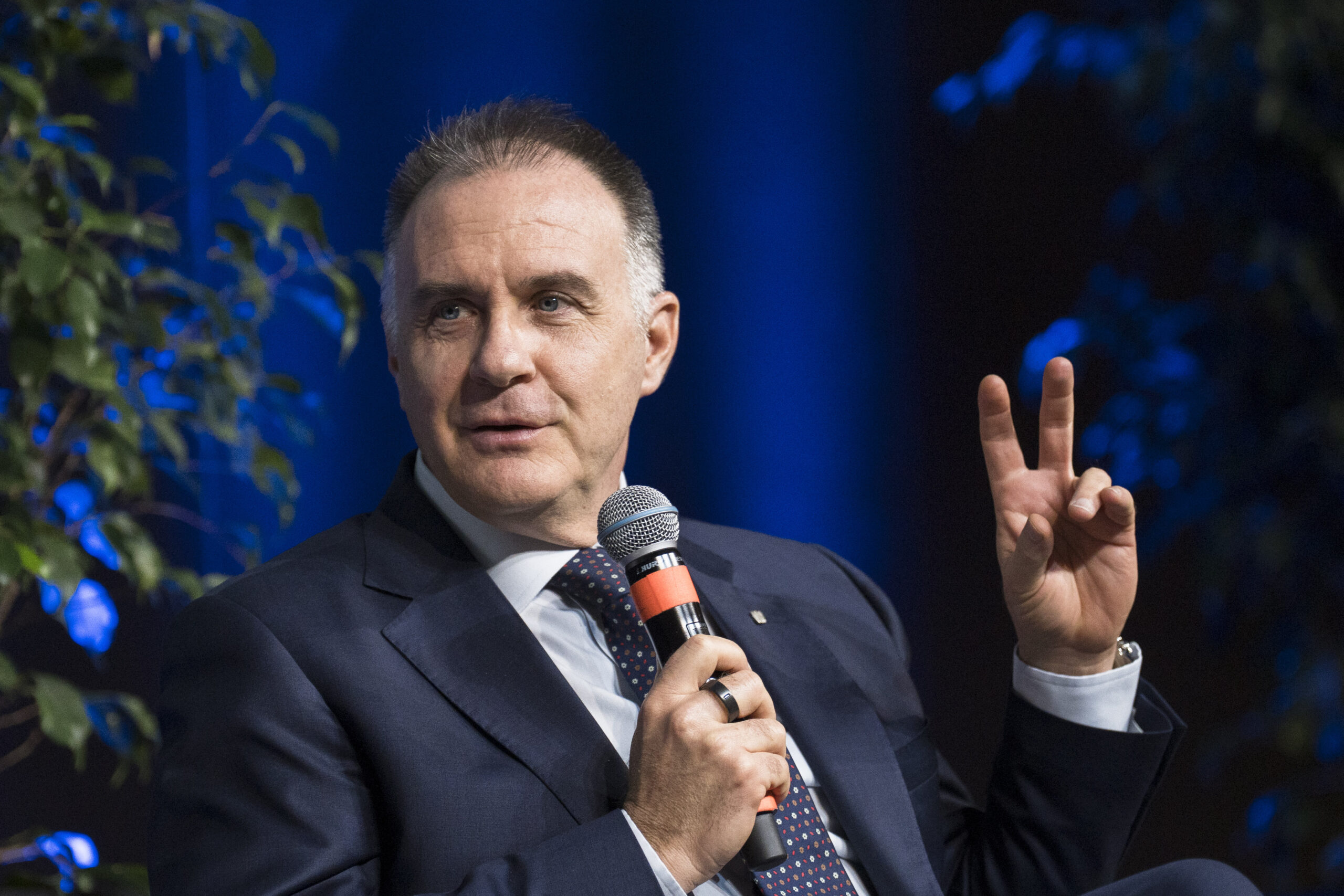
Brussels – “This is a wake-up call: Italian industry does not have six months to wait” for a response on the ETS, said Confindustria president, Emanuele Orsini, during a press briefing in Brussels, while just a few hundred metres away the European Council was in session to decide, among other things, on the future of the ETS emissions control mechanism. A summit of the packed agenda, on which – he emphasised – “the future of 83 per cent of Italy’s welfare” will depend.
According to Orsini, the ETS system in place in the European Union since 2005 “should be suspended,” at least in the current context. “We do not expect the conflict to end in the coming days, nor do we expect gas or petrol prices to fall,” he explained, reiterating that energy was already one of the main concerns at the start of his term in 2024 and is even more so today. “Before the conflict, the price was 106 euros per megawatt hour; today it stands at 160: a 60 per cent increase. We already had the highest price in Europe, whilst other countries are taking action, partly thanks to greater fiscal capacity.”
In a European comparison, Orsini mentioned the measures adopted by other Member States. Germany has “amended its Constitution to allocate 200 billion to energy investments and has set aside 26 billion a year to reduce costs”. France has “introduced a cap of 70 euros per megawatt hour”, while in Spain, the average price “stands at around 40 euros.” “How can we possibly compete and maintain our industry when energy is now the biggest production cost?” he asked.
Looking to the medium term, the president of Confindustria highlighted the need to expand energy storage capacity and to build a balanced energy mix at the European level, with a particular focus on accelerating the roll-out of renewables. In Italy, he noted, around 130 gigawatts of capacity remains to be developed, hampered in part by delays in obtaining local planning permission. “We must commission as much wind, solar, and hydroelectric power as possible, but also immediately embark on the path towards nuclear micro-reactors, which will take at least ten years. Only a healthy energy mix can bring prices down.”
In the event of a prolonged conflict, Orsini also called for the European Union to take a step towards “common debt” to “support member states”. “We cannot rely solely on state aid, because that would widen the gap between Italy and other countries,” he said, issuing “a call for responsibility” and pointing out that behind every business that closes or relocates “there are hundreds and thousands of jobs.” “If we want a united Europe,” he added, “we need joint projects, and common debt can be a tool for cohesion.”
BusinessEurope, the association of European businesses, takes a different stance. In a letter to EU leaders ahead of the summit, it identified as a priority “stronger” measures to reduce energy costs, while maintaining “a central role for the ETS,” and called for greater flexibility to manage volatility. “The war in the Middle East is heightening concerns about political and economic stability,” reads the document signed by Director General Markus J. Beyrer and President Fredrik Persson. Among other requests, the association calls for boosting investment to restore European technological leadership, completing the Savings and Investment Union, diversifying trade partnerships, and guaranteeing secure access to the energy market. The letter also urges the European Parliament to “conclude the process of implementing the EU-US agreement on tariffs.”
English version by the Translation Service of Withub
![Il ministro dell'Ambiente e della transizione ecologica, Gilberto Pichetto Fratin [Bruxelles, 18 settembre 2025. Foto: European Council]](https://www.eunews.it/wp-content/uploads/2025/09/pichetto-250918-350x250.jpg)

![[Copyright: European Union]](https://www.eunews.it/wp-content/uploads/2026/10/euco-261015-120x86.png)