
Brussels – European Union citizens are becoming increasingly concerned about their current and, above all, future economic situation. In particular, they view with fear the sharp rise in energy and fuel prices, a consequence of the closure of the Strait of Hormuz triggered by the outbreak of war in Iran. And it is precisely because of the economic and financial repercussions of the Middle East conflict that the vast majority of Europeans continue to hold an extremely negative view of the military operation launched by the United States and Israel against Tehran on 28 February.
These are the main findings of the latest survey by Polling Europe Euroscope – a Brussels-based market research and polling institute, the result of a joint venture between SWG and OpinionWay – previewed exclusively by Eunews.
The economic situation: 62 per cent of those surveyed believe things are heading “in the wrong direction”
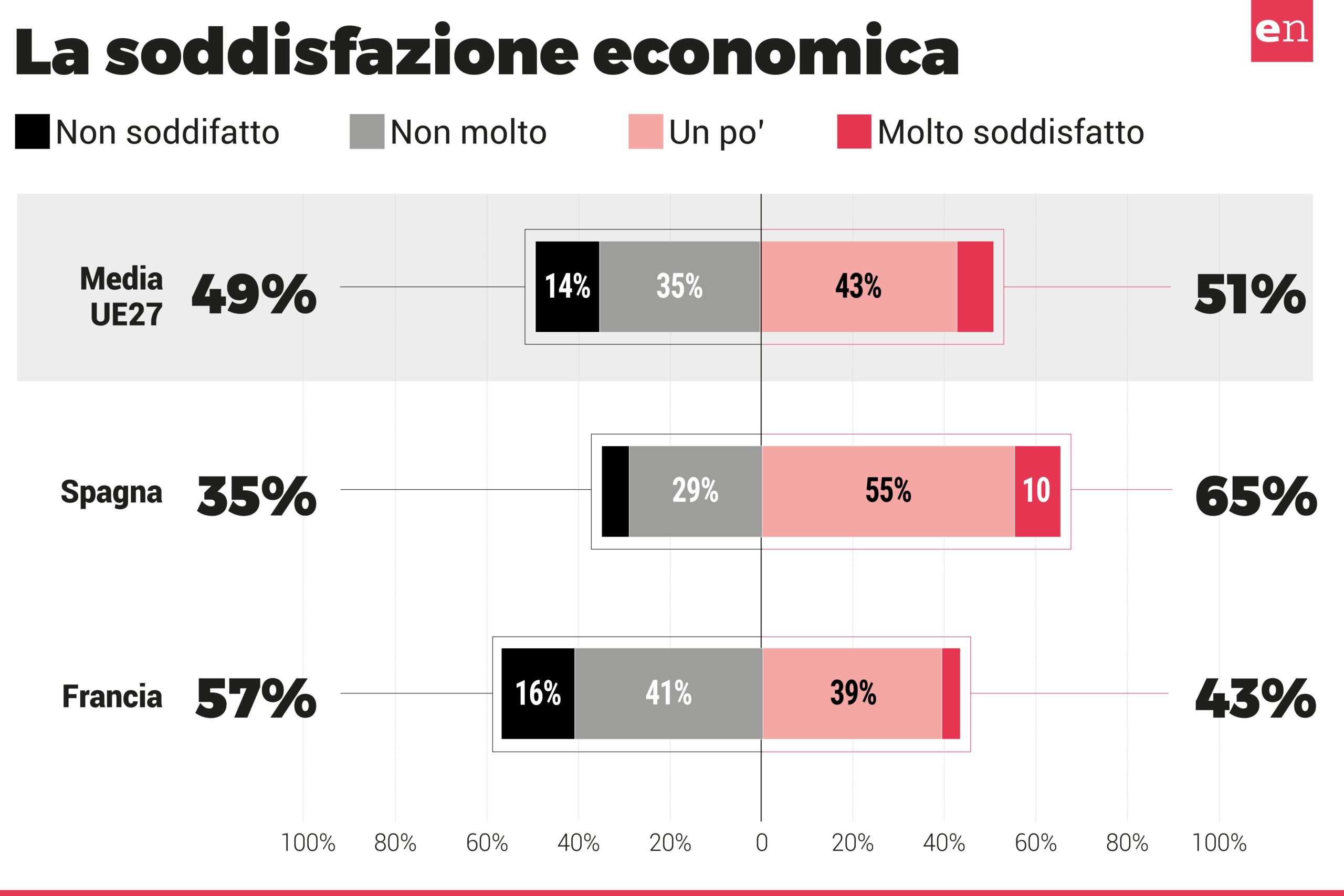
Focusing on the present, respondents are broadly split down the middle, with 51 per cent describing themselves as “satisfied” with their current financial situation and 49 per cent as “dissatisfied.” More specifically, 8 per cent of the sample say they are “very satisfied,” 43 per cent describe themselves as “fairly satisfied,” 35 per cent choose the “not very satisfied” option, and the remaining 14 per cent consider themselves “completely dissatisfied.”
However, the picture changes when looking at the figures for individual Member States, particularly those of the five most populous countries, for which Polling Europe provides a specific analysis: Spain, Poland, France, Germany, and Italy. If Spain and Poland are the only two countries where the share of satisfied citizens clearly dominates (65 per cent of Spaniards and 60 per cent of Poles), the picture flips in what are supposed to be the three ‘growth engines’ of the EU economy. Among Italians, the dissatisfied account for 53 per cent of the sample and the satisfied for 47 per cent. In Germany and France, things are even worse: 54 per cent versus 46 per cent among Germans and 57 per cent versus 43 per cent among our neighbours across the Alps.
When respondents are broken down by their preferred European party, a fairly marked divide emerges between the so-called mainstream parties and the forces at the two extremes of the political spectrum. The proportion of satisfied voters is highest among the centre-right electorate of the European People’s Party (EPP, 62 per cent), among the liberals of Renew Europe (61 per cent), the Greens (60 per cent), the Conservatives and Reformists (ECR, 57 per cent) and the Socialists and Democrats (S&D, 56 per cent). Negative responses, however, prevail among voters for The Left (60 per cent) and those of the two far-right groups: Sovereign Europe of Nations (ESN, 61 per cent) and Patriots for Europe (PfE, 54 per cent).
The already widespread pessimism becomes even more pervasive when Europeans are asked to look to the near future. For 62 per cent of those surveyed, things in their own country are heading “in the wrong direction” economically speaking, while only 16 per cent believe the country is on the right track. In Italy, negative opinions account for 68 per cent of the total and positive ones for 9 per cent. The most pessimistic in this case are the French: 77 per cent are worried about the future, and only 4 per cent view it with hope.
In particular, respondents fear the rise in unemployment (anticipated by 67 per cent of the overall sample, and 62 per cent of the Italian sample) and the increase in inflation (considered likely by 76 per cent of respondents, rising to 82 per cent among Italians).
Iran: 56 per cent of Europeans disapprove of the US and Israeli attack
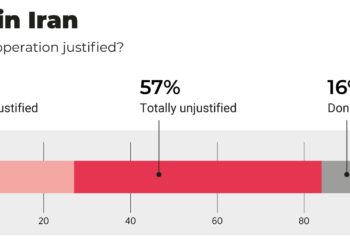
For 56 per cent of those surveyed, the large-scale military operations launched by the United States and Israel more than three months ago are “unjustified.” More specifically, 36 per cent of the sample considered the attack to be “entirely unjustified,” while the remaining 20 per cent deemed it “partly unjustified.” Those who considered the Israeli-American military operation legitimate are therefore in a clear minority, representing 25 per cent of the sample, with 10 per cent considering the intervention “entirely justified” and 15 per cent considering it “partly justified.” The remaining 19 per cent, however, did not answer the question or stated that they did not have sufficient information to form an opinion.
Opposition to the actions of Washington and Tel Aviv is widespread in all five EU countries for which the data is analysed in detail. Italy leads the way, as in the previous April poll, with 73 per cent of respondents believing the war to be unjustified, followed by Spain (62 per cent), Poland (53 per cent), and France (42 per cent). Unusually, therefore, the country least opposed is precisely the one with the longest-standing tradition of hostility towards US foreign-policy interventionism, while two typically Atlanticist countries, such as Poland and Germany, record opposition rates exceeding 50 per cent.
Interesting data also emerge when examining the sample breakdown by European political affiliation. Confirming the findings from the April survey, the military operation by Donald Trump and Benjamin Netanyahu does not find particular support even among right-wing and far-right voters, who are usually closer to the positions of the two leaders. Among voters of ECR – the party to which Fratelli d’Italia, Giorgia Meloni’s party, belongs – those opposed (45 per cent) outnumber those in favour (41 per cent). Also among supporters of the Patriots – the political family of the League – opponents account for 41 per cent and supporters for 40 per cent. Among those who support ESN, opponents outnumber supporters by 47 to 33. More predictably, the level of opposition to the war in Iran is even higher among the centre-left, centre and centre-right political families: 70 per cent oppose it among S&D voters, 65 per cent among those who vote for the Greens, 61 per cent among supporters of The Left, 50 per cent among the liberals of Renew Europe, and 53 per cent among the electorate of the EPP.
The cross-party political opposition to US and Israeli operations appears to be driven primarily by economic considerations. 92 per cent of those surveyed describe themselves as “concerned” about rising energy and fuel prices triggered by the closure of the Strait of Hormuz, while only 8 per cent have no concerns whatsoever. Once again, Italians recorded the highest proportion of negative opinions (97 per cent), followed by the Spanish (95 per cent), the Poles (92 per cent), the French (92 per cent), and the Germans (88 per cent). In terms of political orientation, high energy prices are a cause for concern on both the right and the left: 94 per cent of S&D and Patriots voters are concerned, followed by EPP supporters (92 per cent), Renew, ECR, and ESN (all three at 91 per cent), and The Left (87 per cent).
Finally, the question that serves as the common thread linking the two main themes of the survey: “Do you think the energy crisis caused by the closure of the Strait of Hormuz has or will have an impact on your financial situation?” 72 per cent of respondents believe this impact is already being felt, and the figure rises to 94 per cent when including those who expect the repercussions to begin in the coming months. Among Italians, 96 per cent of the sample expressed a negative view, as did the Spanish. They are followed by the French (94 per cent), the Germans (92 per cent), and the Poles (91 per cent).
Once again, therefore, those expressing concern far outnumber those appearing unconcerned.
The survey was conducted online using the CAWI (Computer-Assisted Web Interview) method on a representative sample of the EU population aged 18 and over. A total of 5,458 complete interviews were conducted, distributed proportionally across the population of the 27 EU countries with a slight adjustment to allow for pan-European analysis, with breakdowns for the five largest countries (Germany, France, Italy, Spain, and Poland) and across three different regions: Eastern Europe, Northern Europe, and Southern Europe. For each country, proportional quotas were established for age and gender, based on the most recent parameters provided by Eurostat.
English version by the Translation Service of Withub