Brussels – The war waged by the United States and Israel is unjustified and is causing Europeans great concern, even more so than Russia’s aggression against Ukraine. Furthermore, Europe should avoid providing military support to Washington, but should nevertheless strengthen its defence capabilities and press ahead with the energy transition, which is seen as a priority for achieving independence from market volatility and geopolitical tensions. This is what emerges from the new survey by Polling Europe Euroscope, a market research and polling institute based in Brussels, the result of a joint venture between SWG and OpinionWay, which has been exclusively previewed by Eunews.
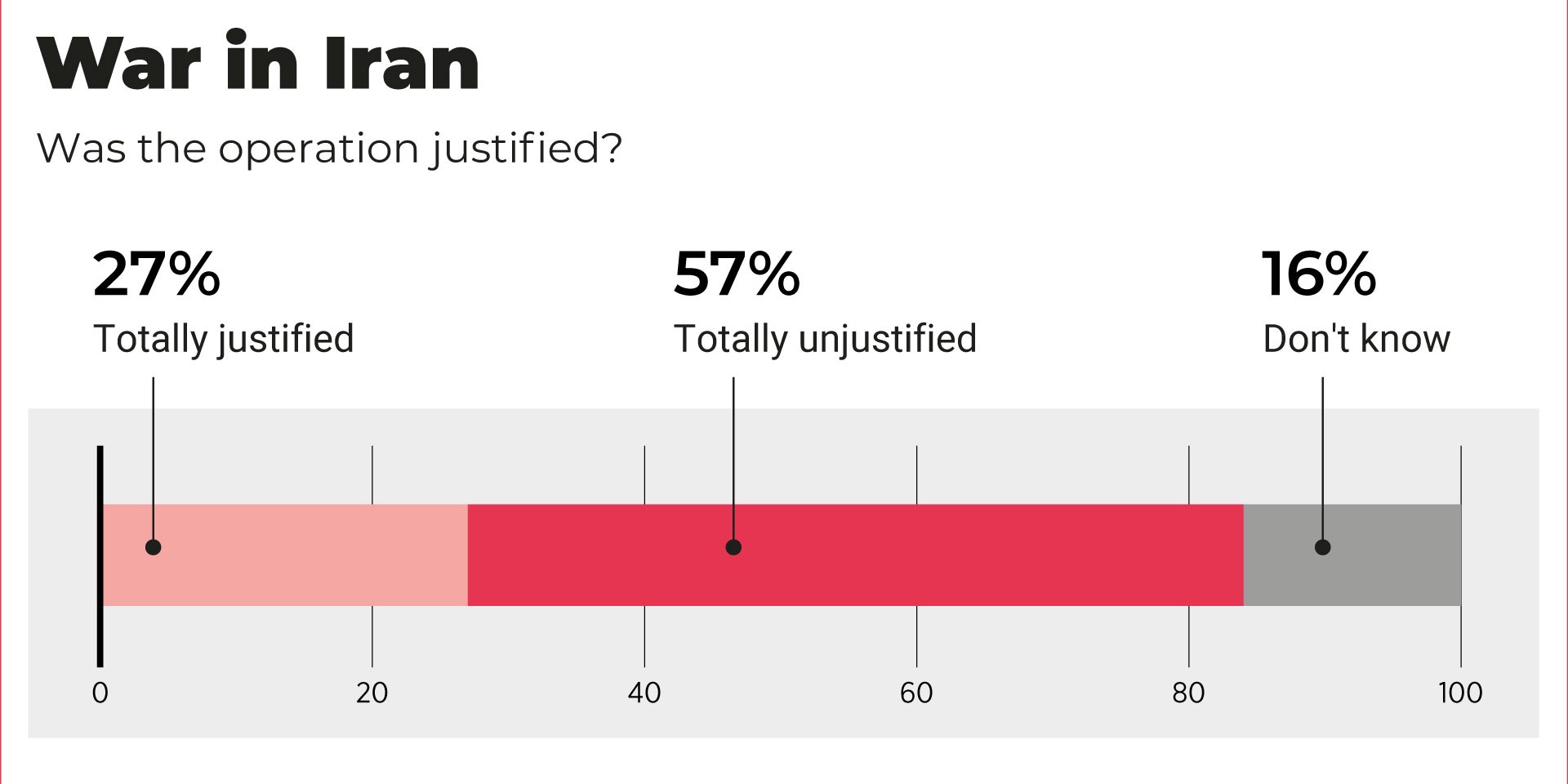
For 57 per cent of respondents, the large-scale military operations launched in late February by the United States and Israel in Iran are “unjustified”, while 27 per cent consider them justified (16 per cent did not answer, stating they “did not know” or “did not have enough information to judge”). Among the five countries for which breakdowns are available, Italy has the highest percentage of opposition, with 72 per cent of respondents considering the war “unjustified” (19 per cent, however, hold the opposite view). Following Italy are Spain (69 per cent), Poland (57 per cent), Germany (51 per cent), and France (47 per cent). In terms of the political stance of those surveyed, it is interesting to note that the operations against Tehran are not viewed favourably even by almost half of the electorate of the far-right and sovereigntist political groups closest to US President Donald Trump. Looking at European parties, the war is deemed “unjustified” by 77 per cent of voters for The Left and the Greens/EFA, 71 per cent of Socialists and Democrats (S&D), 55 per cent of the European People’s Party (EPP), 49 per cent of Renew Europe, 45 per cent of the European Conservatives and Reformists (ECR, the same group as Italian Prime Minister Giorgia Meloni), 41 per cent of Patriots for Europe (PfE, Matteo Salvini’s political family), and 43 per cent of Viktor Orbán’s Europe of Sovereign Nations (ESN).
The wars in Iran and Ukraine are causing fear, and a great deal of it, but with some differences. 86 per cent of respondents are “concerned” about operations against Tehran (51 per cent very alarmed), whilst 79 per cent are concerned about those against Kyiv (44 per cent very concerned). Here too, Italy records the highest percentage, 92 per cent, of those who say they are “concerned” about the war in Iran. In Italy, the figure drops to 82 per cent regarding the war in Ukraine, but remains the second-highest among the five selected countries, after Poland’s 87 per cent, where fears over the war against Tehran are expressed by 90 per cent of those surveyed. Furthermore, concerns about US and Israeli operations against the Islamic Republic dominate across all voter groups: 93 per cent of Green voters are “concerned”, as are 92 per cent of S&D voters, 91 per cent of The Left voters and 90 per cent of Renew Europe voters. But also 86 per cent of the People’s Party (EPP), 85 per cent of the Conservatives (ECR), 80 per cent of the Patriots (PfE), and 73 per cent of the Sovereignists (ESN). All these percentages fall in the wake of Russia’s invasion of Ukraine: 90 per cent of Greens, 88 per cent of S&D, 84 per cent of Renew Europe, 83 per cent of the People’s Party, 79 per cent of The Left, 80 per cent of the Conservatives, 69 per cent of the Patriots, and 60 per cent of the Sovereignists.
In this context, Europeans are reluctant to see the Old Continent supporting the actions of Washington and Tel Aviv. In cases such as the offensives against Iran, 70 per cent of respondents oppose the possibility of European countries providing the United States with “military support through participation in attacks”, “equipment and weapons” (65 per cent), “authorisation to use military bases and airports on European territory” (56 per cent), and “warships to defend oil tankers” (53 per cent). For all four items, Italy recorded the highest rates of opposition among the five countries surveyed: 84 per cent (“military support through participation in attacks”), 83 per cent (“equipment and weapons”), 70 per cent (“authorisation to use military bases and airports on European territory”) and 66 per cent (“warships to defend oil tankers”) respectively.
With regard to the impact of the war in Iran on energy supplies, the majority of respondents (49 per cent) believe we should focus on the “green” transition and agree with the idea that “the rise in fossil fuel prices is a good reason to redouble efforts to combat climate change, promote renewable energy and uphold the EU’s emissions reduction policies”. In particular, this statement receives the highest level of support in Italy, at 56 per cent, while only 26 per cent of Italians surveyed believe that “the EU’s emissions reduction policies should be weakened because they force factories and power stations to pay a carbon price for the pollution they produce” (33 per cent overall).
However, compared with the current international situation, respondents agree with the approach taken by the European Union and its member states in defence: the idea of increased investment is supported by 67 per cent of respondents and rejected by 33 per cent, while in Italy the split is exactly 50-50, with 50 per cent in favour and 50 per cent against increased funding for the sector. The highest percentage in favour among the five countries is in Poland, at 88 per cent, whilst the lowest is in Italy (at 50 per cent).
However, in the face of wars and geopolitical tensions, the majority of respondents believe it is important to preserve the influence of multilateral organisations, particularly the UN and NATO, which received 80 per cent and 81 per cent of responses in support (in Italy, 83 per cent—the highest figure alongside France and Poland—and 77 per cent, the lowest among the five countries). Finally, what worries Europeans most is rising inflation and prices (44 per cent; 41 per cent in Italy), a new economic crisis (30 per cent; 38 per cent in Italy), and rising tensions in international politics (24 per cent; 31 per cent in Italy). Among other concerns are the possibility of war in their own country (23 per cent; 18 per cent in Italy), immigration (20 per cent; 14 per cent in Italy), the weakening of the rule of law and democracy in their own country (17 per cent; 24 per cent in Italy), climate change (14 per cent; 13 per cent in Italy), and social tensions in their own country (11 per cent; 5 per cent in Italy).
The survey was conducted online using the CAWI (Computer-Assisted Web Interview) method on a representative sample of the EU population aged 18 and over. A total of 5,386 complete interviews were conducted—collected between 25 March and 7 April 2026—distributed proportionally across the populations of the 27 EU countries with a slight adjustment to allow for pan-European analysis, with breakdowns for the five largest states (Germany, France, Italy, Spain, and Poland) and across three different regions: Eastern Europe, Northern Europe, and Southern Europe. For each country, proportional quotas were established for age and gender, based on the most recent parameters provided by Eurostat.
English version by the Translation Service of Withub

![[foto: European Council]](https://www.eunews.it/wp-content/uploads/2026/03/euco-260319-120x86.jpg)