Brussels – Europeans do not like US President Donald Trump: 64 per cent of respondents in a new survey by Polling Europe Euroscope, a Brussels-based market research and polling institute, the result of a joint venture between SWG and OpinionWay, express a negative opinion of the White House tenant. But it is not just a personal matter: under the current American administration, perceptions of the United States have also changed. Today, 51 per cent say they are sceptical of their historic ally, and only 25 per cent consider it a friendly country: this figure is down 36 per cent from the October 2024 survey, conducted shortly before his election. Furthermore, 47 per cent of respondents believe that Trump is responsible for the rift in relations between the European Union and the United States and that this rift will only be healed after the end of his term. This is what emerges from the survey, conducted online using the CAWI (Computer-Assisted Web Interview) method on a representative sample of the EU population aged 18 and over. In total, 5,273 complete interviews were conducted, distributed proportionally across the population of the 27 EU countries with a slight correction to allow for pan-European analysis, broken down by the five largest countries (Germany, France, Italy, Spain and Poland) and by three different areas: Eastern Europe, Northern Europe and Southern Europe. Proportional quotas for age and gender were established for each country, based on the most recent Eurostat parameters.
It comes as no surprise that President Donald Trump is not particularly popular in the European Union. On a scale of 0 to 10, his average approval rating stands at 3.1, down 0.4 points from the October 2024 survey. Sixty-four per cent of respondents express a negative opinion of him, while only a quarter view the tycoon favourably. At the national level, France (2.5), Italy (2.5) and Germany (2.8) have the lowest approval ratings for the White House tenant. Spain (3.3) and Poland (4.2), on the other hand, are above the EU average. The divide also emerges along European political lines. The harshest judgements come from left-wing groups: The Left and the Socialists and Democrats (S&D) score 1.8; the Greens/EFA score 1.9. They are followed by Renew Europe (RE) with 2.6 and the European People’s Party (EPP) with 2.9. The average is raised mainly by the groups on the far right: the European Conservatives and Reformists (ECR) with 5.1, Patriots for Europe (PfE) with 4.5, Europe of Sovereign Nations (ESN) with 4.7 and non-attached members (3.6).
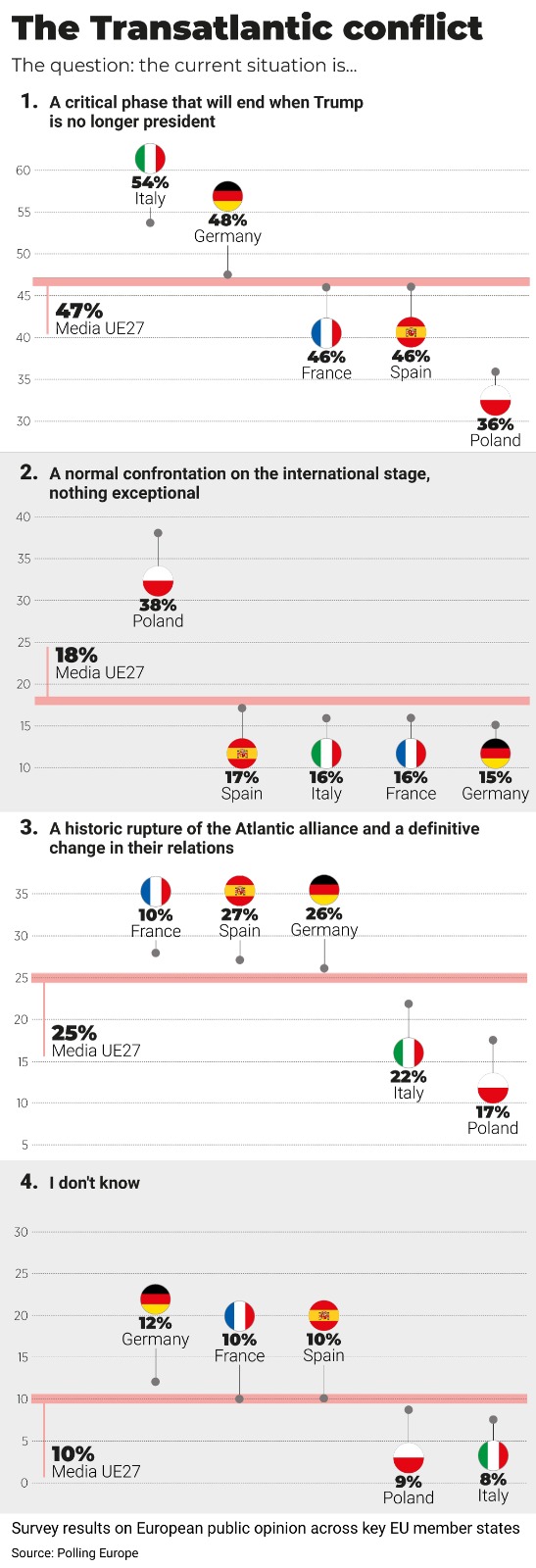
As for transatlantic relations, 47 per cent of respondents believe that Trump is the cause of the discord between the European Union and the United States, but expect this critical phase to end with his term in office. On the contrary, 25 per cent believe that this is not a temporary situation: the rift is considered historic and destined to permanently mark relations with the other side of the Atlantic. Only 18 per cent, on the other hand, speak of a normal confrontation between allies, with no lasting consequences for the future of relations. Significant differences emerge at the national level. Among those who believe that the crisis will end with Trump’s departure from the White House, Italians stand out (54 per cent), while in Poland the figure drops to 36 per cent. Furthermore, among Poles, the idea that this is not a definitive break (only 17 per cent think so) but rather a normal confrontation on the international stage (38 per cent) is more widespread.
Friends or enemies?
The perception of the United States in Europe marks a clear break between before and after the start of Donald Trump’s second term. In October 2024, before the elections that sealed his victory, 61 per cent of Europeans still considered Washington a friendly country. Today, the scenario has changed radically: only 25 per cent describe the United States as a friendly ally, while 51 per cent now consider it hostile (unfriendly). Twenty-four per cent do not place it in either category. In a global comparison, the United States ranks third from last among countries perceived as friends, ahead of only Russia (11 per cent) and Iran (10 per cent). The European Union now lists the United Kingdom (61 per cent), Japan (60 per cent), Brazil (49 per cent), India (42 per cent), Saudi Arabia (28 per cent), Israel (27 per cent) and China (27 per cent) as its closest countries.
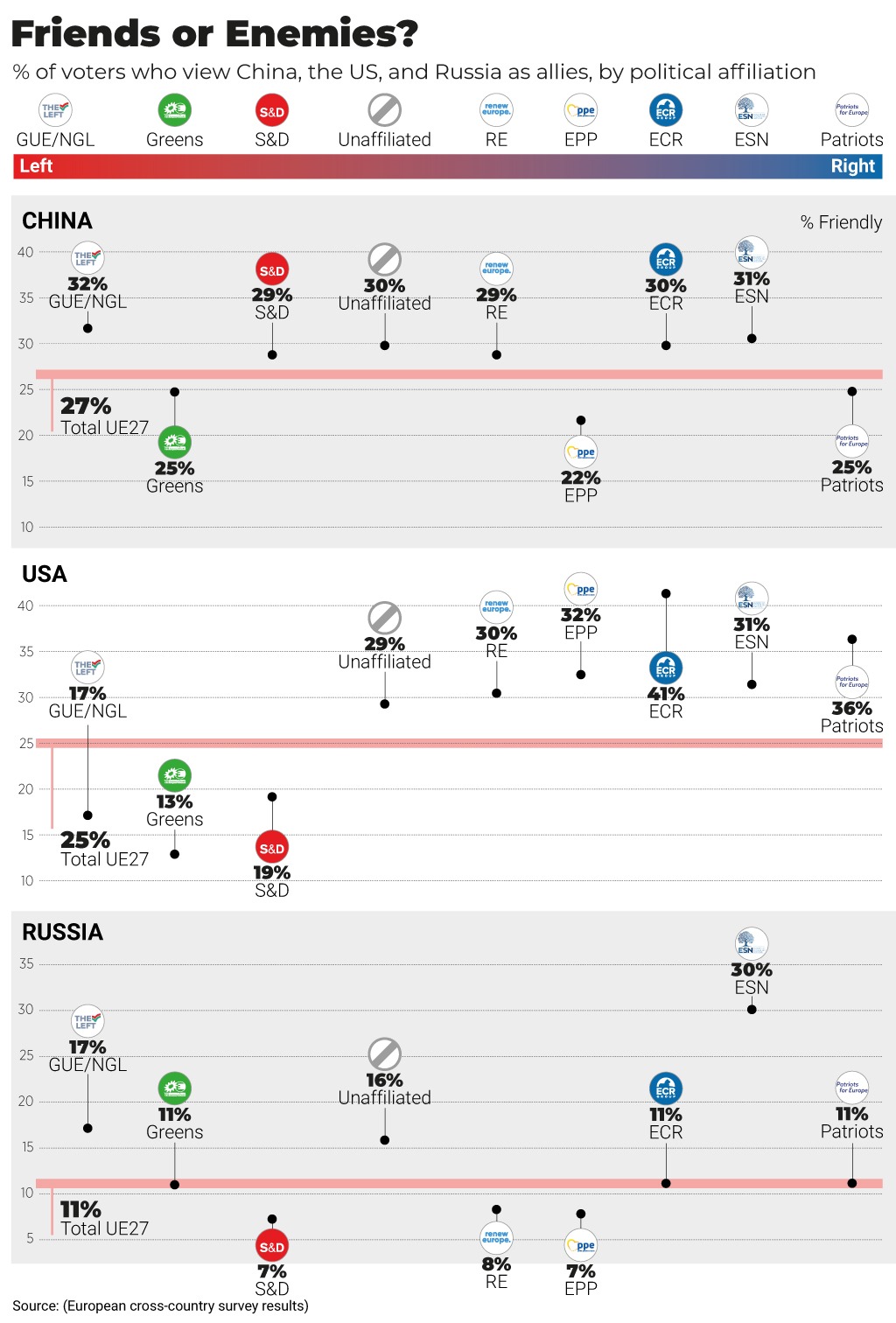
There are marked differences among member countries. France is the country that most perceives the United States as distant from the European Union: only 17 per cent of its citizens still consider Washington a friendly country, while 67 per cent believe the United Kingdom to be so. At the opposite end of the spectrum is Poland, which remains the country most convinced of the strength of the transatlantic link: 40 per cent of respondents say they are confident in relations with the United States, a significant proportion, but still less than half the population.
Europeans are also critical of the European Union’s position towards the United States. Twenty-two per cent describe it as “uncoordinated” and another 22 per cent as “hesitant”. For 13 per cent, it is even “confrontational”, while 11 per cent consider it “permissive”. More modest percentages express positive assessments: only 9 per cent describe the attitude as “balanced”, 7 per cent as “decisive”, and just 5 per cent as “calm”.
The Greenland issue
European public opinion is up in arms against Washington’s ambitions regarding Greenland, rejecting the idea that transferring sovereignty to the United States could translate into greater security for the Old Continent. According to Euroscope data, as many as 63 per cent of respondents perceive possible American control over the island as a risk rather than a stabilising factor. Despite the growing expansionist ambitions of Russia and China in the Arctic, only a marginal 25 per cent of survey participants consider US intervention a necessary strategic move to neutralise Eastern powers, highlighting a deep mistrust of a change in hegemony.
The “no” camp appears particularly united among the large countries of the European Union, which almost unanimously reject the idea of Greenland falling into the hands of the Trump administration. France leads the sceptics with 70 per cent of respondents opposed to the idea, closely followed by Italy (68 per cent), Germany (63 per cent) and Spain (57 per cent), while Poland trails behind with a narrower, but still majority, 51 per cent. From a political point of view, the strongest resistance comes from left-wing parties, which remain the main opponents of Washington’s manoeuvres regarding territory belonging to the Danish Kingdom.
Citizens’ concerns are not limited to territorial sovereignty, but extend to the threat of undermining the very foundations of international cooperation. More than half of the sample believes that an American annexation of Greenland would affect NATO cohesion even more severely than the European Union. Italy emerges as the country most alarmed about the stability of the Atlantic Alliance, with 69 per cent of respondents agreeing with this statement, while Poland remains the most optimistic member; however, even in Warsaw, only 27 per cent of the population is convinced that forceful action by the United States would bring real benefits to the strength of the common defence.
English version by the Translation Service of Withub



![[Copyright: European Union]](https://www.eunews.it/wp-content/uploads/2026/10/euco-261015-120x86.png)