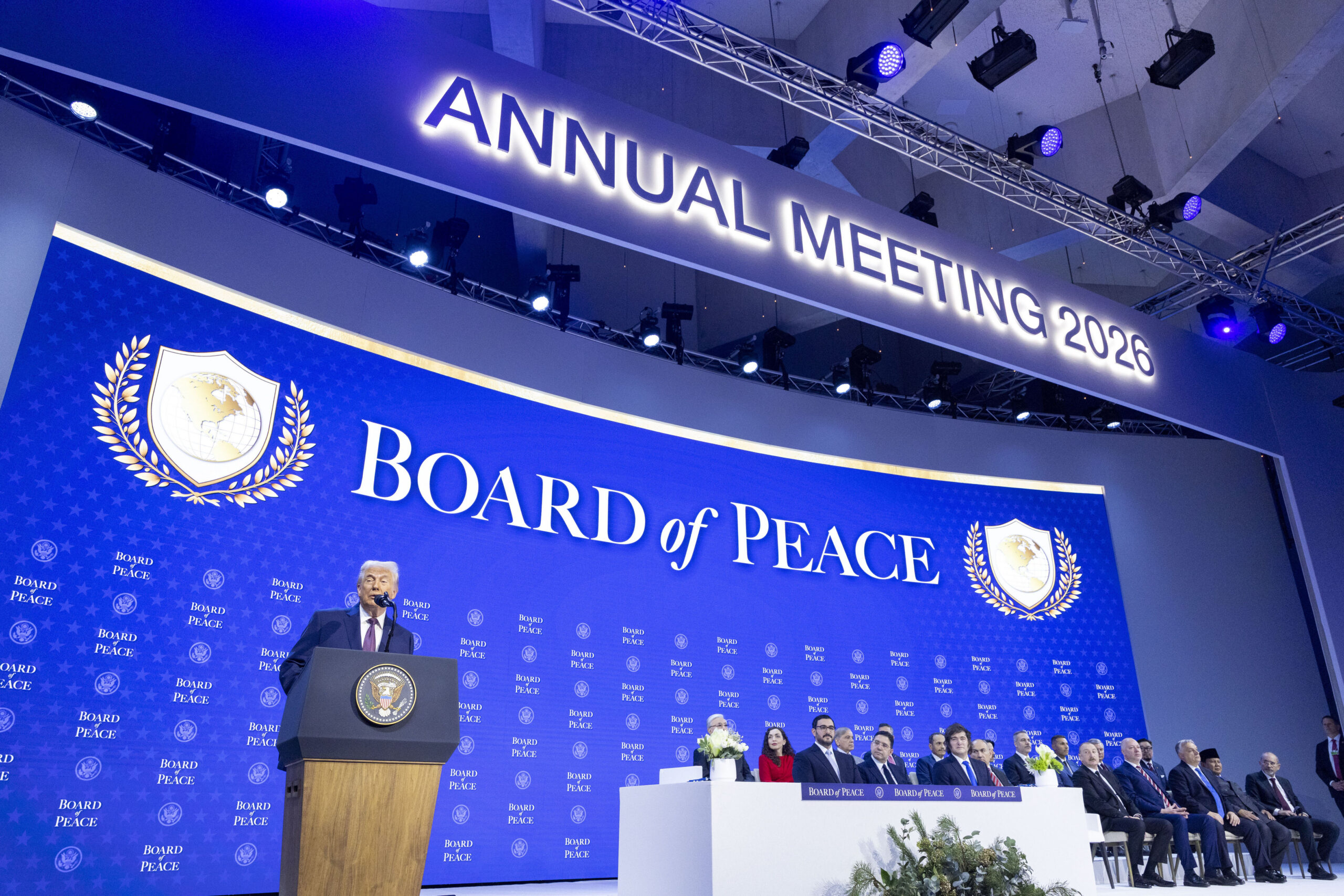
Brussels – Today (19 February) will see the first meeting of the controversial Board of Peace, created and led by Donald Trump to oversee the administration and reconstruction of the Gaza Strip, which, in the US president’s intentions, will become an international organisation parallel to the United Nations. Several Arab countries and representatives of authoritarian governments and dictatorships will be present in Washington. All share a desire to please the most powerful man in the world and seek international recognition. But the European Commission will also be present as an observer: a decision that risks legitimising Trump’s Board of Peace and is creating considerable discontent among EU capitals.
For now, there will be just over twenty full members. They include Trump’s most loyal allies and supporters of the MAGA (Make America Great Again) ideology: Hungarian Prime Minister Viktor Orbán, Argentine President Javier Milei, and El Salvadorian President Nayib Bukele. The complete list of participants is: United States, Israel, United Arab Emirates, Saudi Arabia, Qatar, Bahrain, Turkey, Egypt, Morocco, Pakistan, Hungary, Kosovo, Albania, Bulgaria, Belarus, Argentina, Paraguay, Kazakhstan, Mongolia, Uzbekistan, Indonesia, Vietnam, Cambodia, and El Salvador.
In addition to Hungary and Bulgaria, at least eight other European Union countries are expected to participate as observers: Italy, Romania, the Czech Republic, Slovakia, Greece, Cyprus, Poland, and Austria. However, other member states are sending diplomats or officials as observers at the last minute: a European Commission spokesperson said today that there would be 14. In total, representatives from around 40 countries are expected to attend. Participation is by invitation only, and Donald Trump has not invited everyone: for example, he did not invite Denmark due to recent tensions with the United States over Greenland, and he withdrew Canada’s invitation. Among those excluded from the table that is expected to manage the reconstruction of Gaza is the Palestinian National Authority.

The main leaders of the old continent – French President Emmanuel Macron, German Chancellor Friedrich Merz, and British Prime Minister Keir Starmer – declined the invitation. The reason is as serious as it is simple: the Board of Peace’s founding charter is incompatible with the commitments made by countries within the United Nations, and its very structure raises many concerns. Trump has proclaimed himself head of the Board of Peace and has chosen who to invite. To secure a permanent seat, more than a billion dollars must be paid to the organisation. Its executive board, appointed by Trump, consists of US Secretary of State Marco Rubio, US President’s Envoy Steve Witkoff, and former British Prime Minister Tony Blair.
Even Pope Leo XIV refrained from participating. The Cardinal and Secretary of State of the Vatican, Pietro Parolin, confirmed that the Pope “has a number of concerns about the initiative and, as a result, will not participate.” In particular, the Holy See insisted that “at the international level, it should be primarily the UN that manages these crisis situations.” Finally, Russia and China, although invited, did not formally respond to Trump.

These defections would be enough to warrant considering the bizarre (and dangerous) idea of the Board of Peace a failure. Except that the European Commission, after verbally rejecting the initiative, decided to send the Commissioner for the Mediterranean, Dubravka Šuica, to Washington as an observer. The immediate effect: Italy’s foreign minister, Antonio Tajani, pressed by the opposition in Parliament over Giorgia Meloni’s decision to take part in the meeting, justified his presence by pointing to that of the EU executive.
However, the Commission – and its president, Ursula von der Leyen, who received Trump’s invitation – has no jurisdiction over EU foreign policy and acted without the consent of the capitals. According to reports, the issue of Šuica’s participation in the Board of Peace was raised yesterday during the Member State ambassadors’ meeting. There was considerable unease in the room: the Commission has no mandate from Member States and its participation risks legitimising an organisation that overshadows the United Nations. The High Representative for Foreign Affairs, Kaja Kallas, also warned that the Board of Peace risks becoming a unilateral forum that excludes the Palestinians and ignores international agreements, including the UN resolutions that guide the peace process. According to Il Mattinale Europeo, the head of EU diplomacy reportedly admitted to capitals that Šuica’s trip to Washington “is not a good idea, either for the Commission or for Member States.”
On the other hand, the EU executive justifies its choice essentially with the same argument as its critics: it is precisely the Board of Peace’s opacity that requires the EU to closely monitor its developments. This is all the more true when one considers the organisation’s stated objective of managing the transition and reconstruction of Gaza: to remain outside it would mean delegating its logic and methods exclusively to Trump. Even today, a spokesperson for the European Commission emphasised that Šuica is participating only on behalf of the executive, that her presence will focus exclusively on the reconstruction of Gaza, and that the Commission has no intention of becoming a member of the Board of Peace.
English version by the Translation Service of Withub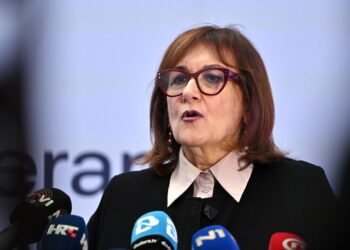

![Viktor Orban e Donald Trump alla cerimonia per il lancio del Board of Peace [Ph: Account X Viktor Orban]](https://www.eunews.it/wp-content/uploads/2026/01/G_Q2lfrWcAAED3X-350x250.jpg)

![Da sinistra: il presidente del Consiglio europeo, Antonio Costa; il presidente dell'Ucraina, Volodymir Zelensky: la presidente della Commissione europea, Ursula von der Leyen [Bruxelles, 18 giugno 2024. Foto: European Council]](https://www.eunews.it/wp-content/uploads/2026/06/euco_ua260618-120x86.jpg)
![[foto: Saverio De Giglio/imagoeconomica]](https://www.eunews.it/wp-content/uploads/2026/10/cpt-120x86.png)