![[Foto: Unsplash]](https://www.eunews.it/wp-content/uploads/2026/06/koshu-kunii-t86cJxwmBWc-unsplash-scaled.jpg)
Brussels – The new internationalism must start with civil society. Today (10 June), the European Parliament hosted a debate on the future of cooperation, solidarity, and integration in an era marked by conflict. The meeting was organised by The Left parliamentary group, with MEP Ilaria Salis opening the proceedings by highlighting “the importance of relationships between people fighting similar struggles” and of “the community as both the guide and the objective of institutional actions.”
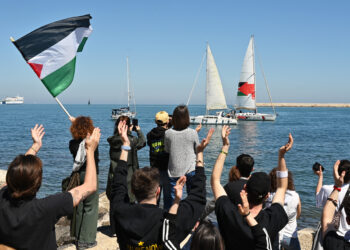
To reflect on the new internationalism, The Left has sought to bring as many voices as possible to Brussels. First and foremost, that of Pablo Quesada (Podemos), who was on board the boats of the Global Sumud Flotilla during the last mission. Quesada recalled, first and foremost, the situation facing “our comrades of the land Flotilla, seized by Libyan militias and left to fend for themselves, with virtually no consular assistance.” The Flotilla’s most recent experience is “unprecedented and unique,” not because of the demonstration of Israeli violence, but “because of the contribution it makes to the discourse on internationalism.”
Unfortunately, we are still stuck on the idea that “violence must be directed at white Europeans in order for it to be discussed publicly,” but experiences such as the Flotilla “help to widen a rift between the Israeli narrative and the reality of the genocidal state.” The new internationalism, Quesada continued, “must involve the decolonisation of ourselves. We must demand that states break with the structures that sustain the colonial system.” And this is where “organised civil society comes into play, which must be at the forefront of the fight against all forms of imperialism.” While states “such as Spain take a stand against genocide, yet continue to sell arms to Israel and maintain academic collaborations, people are taking action.”
The key role of civil society was also highlighted by Martina Steinwurzel, the initiator of the Let cuba breathe campaign. The crisis in Cuba and the embargo “are nothing new,” she noted, “but we are facing the most difficult moment in its history.” Citizens, however, “have managed to reach the island and show their solidarity. Why can’t governments do the same?” The contradiction, according to Steinwurzel, is glaringly obvious: “Since 1996, with the Blocking statute, the European Union has recognised that the United States may not trade with Cuba, but it has also made clear that European companies are not required to comply with US sanctions.” The reality we face today, however, “is quite different.”
The event took the form of a sort of assembly, and numerous civil society organisations (Mediterranea Saving Humans, From the River to the Field, Un Ponte Per and many others) took the floor to share their experiences of cooperation, struggle, and resistance. The picture that emerges has many faces, but a single message: there is a human tide that wants to get involved to change course, united by anti-fascism and anti-colonialism.
English version by the Translation Service of Withub