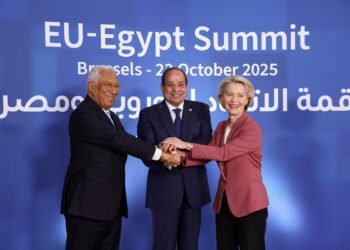
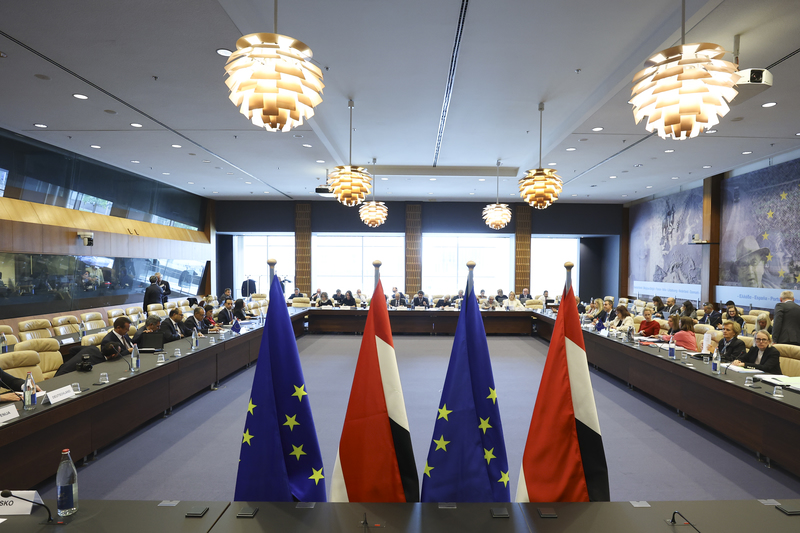
Brussels – Energy, security, stability: the European Union and Egypt are seeking to give new impetus to bilateral relations, which must be shaped and adapted to address entirely new global challenges. The 11th meeting of the EU-Egypt Association Council addresses all of this and aims to lay new foundations for joint action across these areas. For the EU, there is much at stake, starting with the sustainability agenda. On the sidelines of the meeting, the European Commission presented the first flagship project under the Trans-Mediterranean Cooperation on Renewable Energy and Clean Technologies (T-MED), with a total value of €690 million.
Specifically, this involves loans totalling €600 million from the European Investment Bank (EIB) and €90 million in grants from the European Commission, made available to modernise and expand Egypt’s national electricity grid. The EU intends to help its North African partner to integrate 22 GW of renewable energy by 2030, enough to power 10 million homes in the country. Work is scheduled to begin in 2027, with the first flows of renewable energy expected by 2028. The total public and private investment planned for this project amounts to €1.6 billion and will contribute to achieving the objectives of the EU-Egypt Strategic and Comprehensive Partnership.
However, the EU-Egypt Association Council intends to forge new anti-Russian alliances. This is the stated objective of the EU High Representative for Foreign Affairs and Security Policy, Kaja Kallas, who immediately emphasises cooperation in this regard. “Russia’s fleet of ghost ships poses a threat to European and Egyptian waters,” she states before the start of proceedings, during a press briefing organised for the occasion alongside the Egyptian Foreign Minister, Badr Abdelatty. Faced with the threat of Moscow’s ghost ships, for which the EU has been seeking solutions for two years, “we will discuss how to jointly tighten the enforcement of sanctions in the Mediterranean,” assures Kallas, who views Egypt as a key player in resolving the Israeli-Palestinian conflict as well as the war in Iran.
On the most politically sensitive issue—relations with Russia—Abdelatty is keeping his cards close to his chest. At least not publicly. The Egyptian Foreign Minister acknowledges that there are “major challenges” on an international scale, with “the significant repercussions of growing geopolitical tensions,” but tends to remain vague about commitments. He welcomes the announcement of a peace agreement between the United States and Iran, seeing it as an opportunity for “a new chapter in reducing tensions in our region,” but makes no mention of Russia.
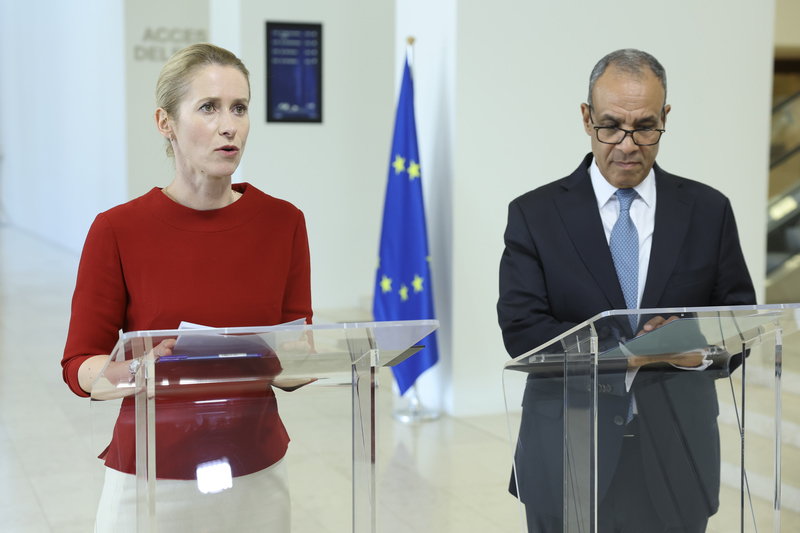
Speaking in front of the cameras, the Egyptian Foreign Minister stated that his country “appreciates the growing cooperation with the European Union” and emphasised the importance of economic and trade relations and investment. “Over the past year, we have seen tangible progress in trade and investment,” he says – but remains silent on Russia.
An understandable silence, given that Egypt has been a member of the BRICS group since 2024, with Russia as a founding member.
But it is, in a way, the whole history of Egypt that speaks Russian. The country has had direct relations with Moscow since the days of the Soviet Union. Since the early 2000s, Putin’s Russia has been a key partner in terms of security and defence, with imports of “made in Russia” arms and ammunition accounting for almost a third of foreign orders. Bilateral relations between Egypt and Russia entered a whole new phase in 2018, when the two countries signed a Global Partnership and Strategic Cooperation Agreement, which came into force on 10 January 2021, to which was added the military cooperation protocol.
It is therefore not surprising that, ever since the start of the Russian military campaign in Ukraine, the Egyptian president Abdel Fattah al-Sisi has sought to maintain an ambivalent policy, balancing the demands of the West without jeopardising good relations with Moscow. Furthermore, EU sanctions, including bans on entry to European territory, have led to a surge in Russian tourism in Egypt, which benefits economically from this influx.
English version by the Translation Service of Withub