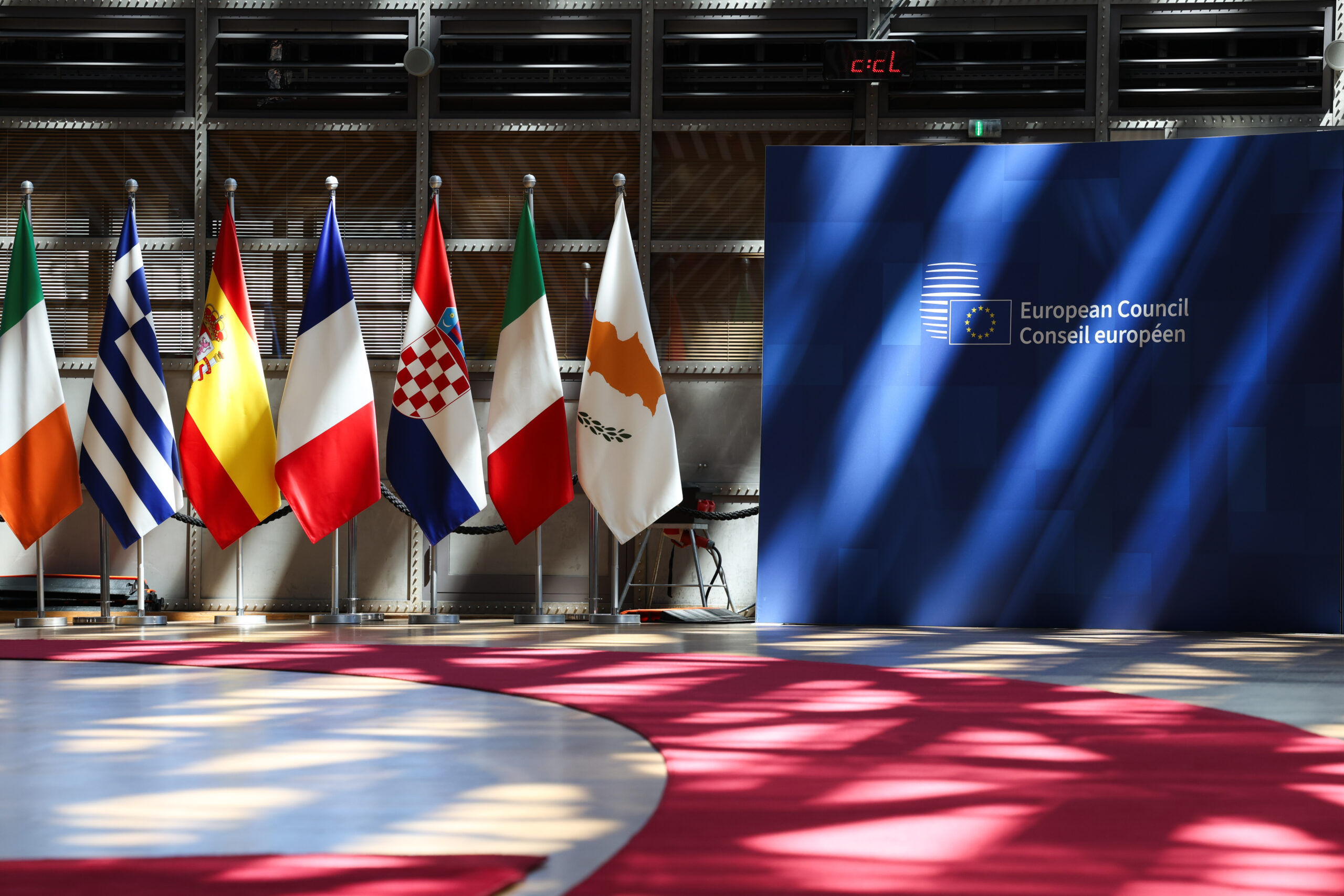
Brussels – The diagnosis is clear and widely accepted: macroeconomic imbalances, particularly those between European Union countries and China, have reached an unacceptable level. What remains more uncertain and still under discussion is the nature of the response we must all adopt together. And even more divisive is the view held by the 27 EU capitals regarding the instrument, perhaps the most important one, for equipping the Union with the resources it needs to become self-sufficient and competitive: the EU budget. The impression, or fear, emerging just hours before the start of the European Council—which aims to bring to Brussels the unity rediscovered at the G7 summit in Evian and extend it from the Ukrainian issue to those of competitiveness and the Middle East—is that the 27 heads of state and government will confine themselves to holding a mere “neighbourhood meeting” in the face of the far more energetic and decisive manoeuvres by the Chinese and US giants to conquer markets and power. For while it is true that all 27 agree that the economic system dictated by Beijing poses a threat to be tackled with both old and new tools, the divide is equally clear between those who wish to cut funding for the common budget, thereby curtailing one of the EU’s main means of manoeuvre (these are the so-called “frugal” countries), and those who, on the other hand, aim, through the common budget, to give substance to the creation of autonomous European value chains and to strengthen the European economy and project.
The European Council meeting will begin this afternoon, at around 6 pm.
Before the formal start, there will be two meetings: the first, hosted by Italy and Romania, with the so-called “Friends of Cohesion” (17 in total, but 16 will be attending as the 17th, Cyprus, holds the rotating presidency of the Council of the EU), the second, hosted by Denmark, on migration (the group comprises, at any one time, between 10 and 15 countries).
At the start of proceedings, following the traditional exchange with the President of the European Parliament, Roberta Metsola, the agenda will turn to Ukraine, with a speech by President Volodymyr Zelensky. This issue will be central to this first European Council of the post-Viktor Orbán era, not only because it comes on the heels of the renewed transatlantic unity at the G7 and of the European Council, which will result in conclusions endorsed by all 27 member states, but also because earlier this week, the first round of negotiations began on Ukraine and Moldova’s path to EU membership. Attention will now turn to the opening of the other “clusters” (the groups of issues to be addressed on the path to accession), for which work has already been carried out and for which Kyiv, with the support of the Nordic and Baltic countries, is calling for a swift start. “It is a request that many are considering,” the sources explain. “The issue is the correct application of the enlargement process methodology, while also taking other countries into account, such as those in the Western Balkans. Therefore, the challenge is to ensure equal treatment among candidate countries,” and that the process remains “merit-based.” The outcome of the leaders’ discussions remains to be seen, but one possibility is that the clusters could be opened as early as July, before the summer. In any case, the opening of the chapters marks the start of the process, but the decisive factor will be their closure. One thing is certain, however: “the progress made by Ukraine and Moldova makes it necessary to address EU enlargement seriously.” This is an issue that the German Chancellor, Friedrich Merz, would have liked to address as early as today’s and tomorrow’s meetings and which he is likely to raise, given the intention of the President of the European Council, António Costa, to lay the groundwork for an in-depth discussion at the October summit.
Meanwhile, as regards support for Kyiv and the response to Moscow, the EU is working on the 21st package of sanctions against Russia. In the meantime, Costa’s office has made brief diplomatic contacts to explore possible channels of communication. This move is in line with Ukrainian President Volodymyr Zelensky’s request to the EU to be ready to support Ukraine at any future negotiating table. It is also consistent with the conclusions of several European Council meetings, which emphasise the need for Europe to be present in discussions concerning the continent’s security.
During this evening’s dinner, the discussion awaiting the leaders will be on macroeconomic imbalances. “An issue that has come to be known as ‘the discussion on China’, but only because the imbalances with Beijing are the most visible: all EU countries recognise this and agree that action is needed,” reports a diplomatic source. On a practical level, the countries are “all in agreement on the need for dialogue” with Beijing. But they also agree that this dialogue must be “accompanied by measures capable of restoring balance.” The EU’s toolbox is “well-stocked, but little used so far.” It includes anti-dumping and anti-subsidy investigations, and within this context, “the idea of introducing a new instrument to encourage the diversification of supply chains” fits. In other words, to establish a system that is not directed against a third country, but which aims to support those, particularly companies, who manage to replace critical strategic components in their value chains with components made in Europe, rather than sourcing them from third countries. Obviously, this is not a cost-free operation, and one of the issues to be resolved will be how to offset the necessary expenditure. In general, “we need the Chinese who wish to enter the European market to understand that a rebalancing is necessary,” the sources explain. At the same time, “we in the EU must do our homework” and, therefore, in particular, give substance to the
One Europe, One Market agenda.
The battleground, however, will be tomorrow’s debate—albeit a general and superficial one—on the EU’s next Multiannual Financial Framework, that is, the 2028–2034 budget. Following the Commission’s proposal, the point of reference is now the so-called “negobox”presented by the Cypriot Presidency of the Council of the EU. This document sets out precise figures and provides for a 2 per cent cut (33 billion) compared with the approximately 2,000 billion put on the table by the European Commission. Not enough for the frugal countries (Germany, Austria, the Netherlands, Sweden, Finland, and Denmark) who are calling for cuts of up to 400 billion and for the cuts to be concentrated not on the Competitiveness and Global Europe headings, as envisaged by the Cypriots, but on Cohesion and Agriculture. The starting points, therefore, are far apart, and a clash between the leaders is expected. In addition to the cuts, another battleground will be over own resources (new revenue to be introduced) and so-called rebates, the refunds paid to certain Member States for their contributions to the common budget. The debate will be heated, and the aim is to reach an agreement by December to ensure that the programming of funds can take place in a timely manner and that substantial pre-financing from the budget can begin. This latter point is of no small importance for a country such as Italy, which must contend with the imminent end of funding from the Next Generation EU programme, namely the Recovery Fund and the National Recovery and Resilience Plan (NRRP).
Yet it is precisely this heated debate over the long-term budget that highlights the EU’s internal disconnect, where countries claim to be aware of global challenges and the dangers posed by certain powers, China foremost among them, yet they fail to make use of a tool—namely the MFF—that could be a powerful means of supporting the EU’s competitiveness and strategic autonomy. Read the section entitled “Mario Draghi’s report” to see for yourself.
Finally, among the other issues on the leaders’ agenda is the situation in the Middle East. Here, a large majority of countries are calling, at the very least, for sanctions to be imposed on extremist ministers in the Israeli government, while the High Representative for Foreign Affairs, Kaja Kallas, intends to present options for measures targeting products originating from illegal Israeli settlements. However, the suspension of the EU–Israel Association Agreement remains off the table. Also on the agenda are migration, drug trafficking, the fight against the Ebola epidemic, support for Armenia, backing for the International Criminal Court, and the issue of coastal areas and their specific sectoral characteristics.
English version by the Translation Service of Withub![VERTICE UE-CINA Luglio 2025 [Fonte: Imagoeconomica]](https://www.eunews.it/wp-content/uploads/2026/06/Imagoeconomica_2513581-350x250.jpg)
![[foto: European Council]](https://www.eunews.it/wp-content/uploads/2024/06/euco-strem-350x250.jpg)

![Da sinistra: il presidente del Consiglio europeo, Antonio Costa; il presidente dell'Ucraina, Volodymir Zelensky: la presidente della Commissione europea, Ursula von der Leyen [Bruxelles, 18 giugno 2024. Foto: European Council]](https://www.eunews.it/wp-content/uploads/2026/06/euco_ua260618-120x86.jpg)
![[foto: Saverio De Giglio/imagoeconomica]](https://www.eunews.it/wp-content/uploads/2026/10/cpt-120x86.png)