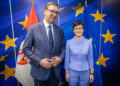
![VERTICE UE-CINA Luglio 2025 [Fonte: Imagoeconomica]](https://www.eunews.it/wp-content/uploads/2026/06/Imagoeconomica_2513581-scaled.jpg)
China is one of the European Union’s major sources of frustration. Perhaps not the biggest; it is hard to rank them in these years marked by Russia’s aggression against Ukraine; Israel’s bombings and killings, including against anyone who might, perhaps, disagree, with its illegal settlers allowed to do the same; a US presidency that could hardly have been worse, for the US itself and for the rest of the world, also engaged in bombings seemingly aimed at supporting the defence industry and rewarding those closest to it; and wars it typically loses, as in Iran, only to later strike deals to rebuild what it had destroyed just a few years earlier.
In any case, China is a huge problem because it is constantly growing (albeit at an ever-slower rate), exporting more and more, buying up companies, taking over commercial spaces, and has managed to run a trade surplus with every country in the EU. What’s more, it exports whatever it wants, doesn’t help us with components for building weapons (which, according to many, is perhaps just as well) and has a stranglehold on much of our industry, starting with the ailing car industry, which consciously committed industrial suicide a few years ago.
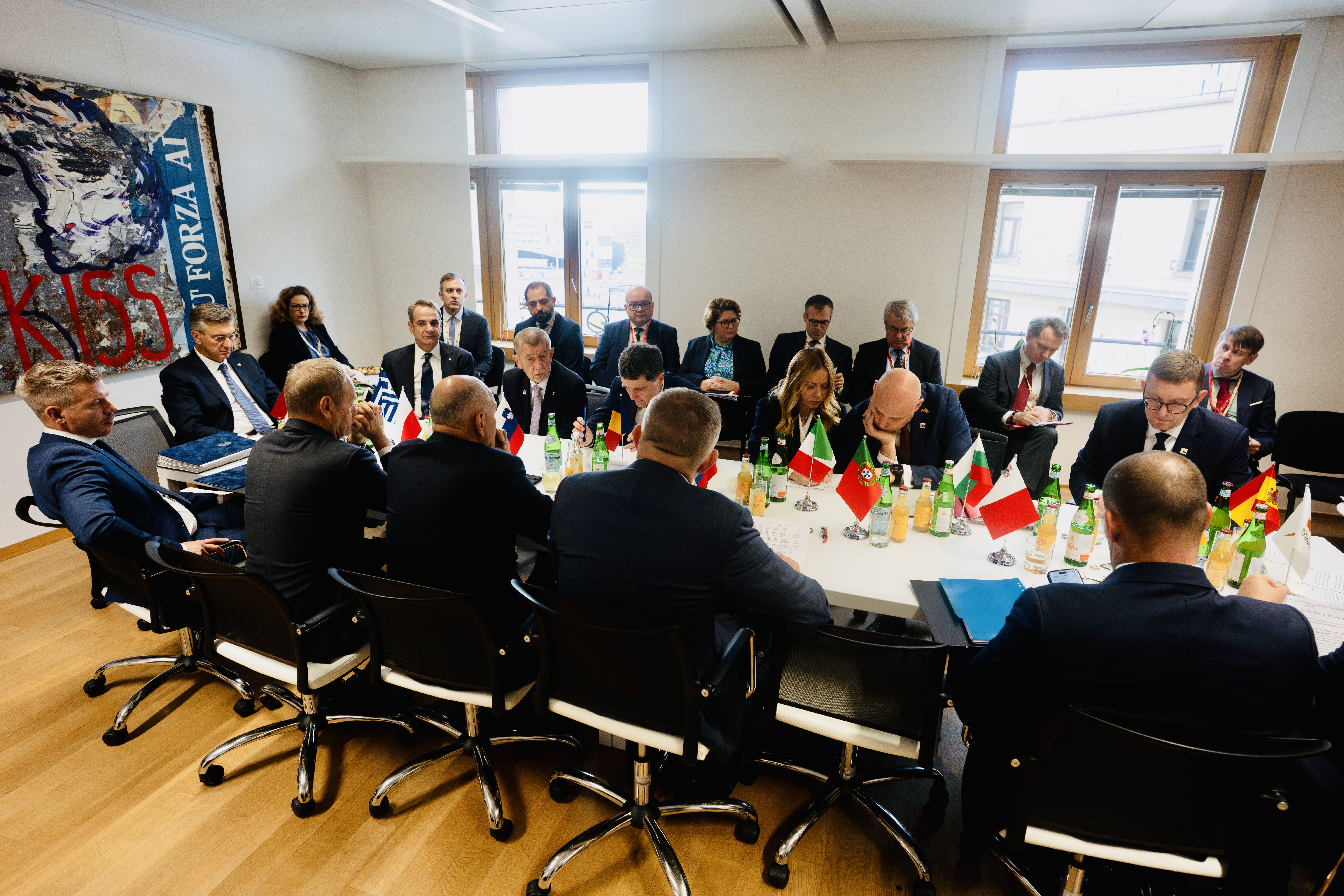
The challenge now is to defend ourselves by clawing back some ground. Leaders have been discussing this for some time; they talked about it at the G7, and they will discuss it again at today’s and tomorrow’s European Council, under a generic and rather ridiculous agenda heading on global macroeconomic imbalances, so as not to offend Beijing, a great show of courage that hardly inspires confidence. Yet none of the debate will be reflected in the summit conclusions.
The aim, as a senior EU diplomat explained today, is “to strike a balance of interests with China.” That is, of course, the spirit of any negotiation: to reach a compromise that ultimately satisfies everyone. But the tone is rising, after two years of measures and announcements that never took off and led nowhere: China “is interested in this European market, particularly in the face of falling domestic demand.” There you have it: the aim is to identify internal weaknesses to capitalise on in order to build a more balanced relationship, and then begin the tug‑of‑war. “All Member States have a trade imbalance with China,” is the premise, which also expresses the hope that those who have already been burned by China, such as Germany, might this time show greater solidarity so that the 27 can act as one. “We have tools, but they are rarely used,” the diplomat admits, explaining that internal measures are also under consideration. “Šefčovič (Maroš, the Trade Commissioner, ed.) is proposing a scheme to reward European companies that manage to use European components and raw materials.” A stimulus based on self‑reliance, which could be useful.
Roberto Italia, a researcher at ISPI, in a recent paper on the subject, confirmed that “not all the rules and conditions can be defined by the EU, but, given US protectionist policies, China has a great deal to lose if it does not accept an agreement with the second-largest market for its products (behind ASEAN)”.
According to the scholar, it is also necessary — as the diplomat also hinted — that the instruments already in place to be “supplemented by more effective mechanisms at the EU level, drawing on the US model of the Sections and restoring credibility to the Anti-Coercion Instrument, as well as forms of coordination with G7 members and partners aligned with the group, such as South Korea and Australia, in the field of economic security.” For Italy, “the issue of imbalances in the Chinese economy does not only affect Europe, but is of global significance. Such collective efforts would not only strengthen deterrence in the eyes of Beijing, depriving it of the ‘divide and rule’ tactic, but would also prevent an aggressive response to China by one country (in this case the US) from having a negative impact on the economy of a less active country.”
English version by the Translation Service of Withub![Da sinistra: il presidente del Consiglio europeo, Antonio Costa; il presidente dell'Ucraina, Volodymir Zelensky: la presidente della Commissione europea, Ursula von der Leyen [Bruxelles, 18 giugno 2024. Foto: European Council]](https://www.eunews.it/wp-content/uploads/2026/06/euco_ua260618-350x250.jpg)


![Da sinistra: il presidente del Consiglio europeo, Antonio Costa; il presidente dell'Ucraina, Volodymir Zelensky: la presidente della Commissione europea, Ursula von der Leyen [Bruxelles, 18 giugno 2024. Foto: European Council]](https://www.eunews.it/wp-content/uploads/2026/06/euco_ua260618-120x86.jpg)
![[foto: Saverio De Giglio/imagoeconomica]](https://www.eunews.it/wp-content/uploads/2026/10/cpt-120x86.png)