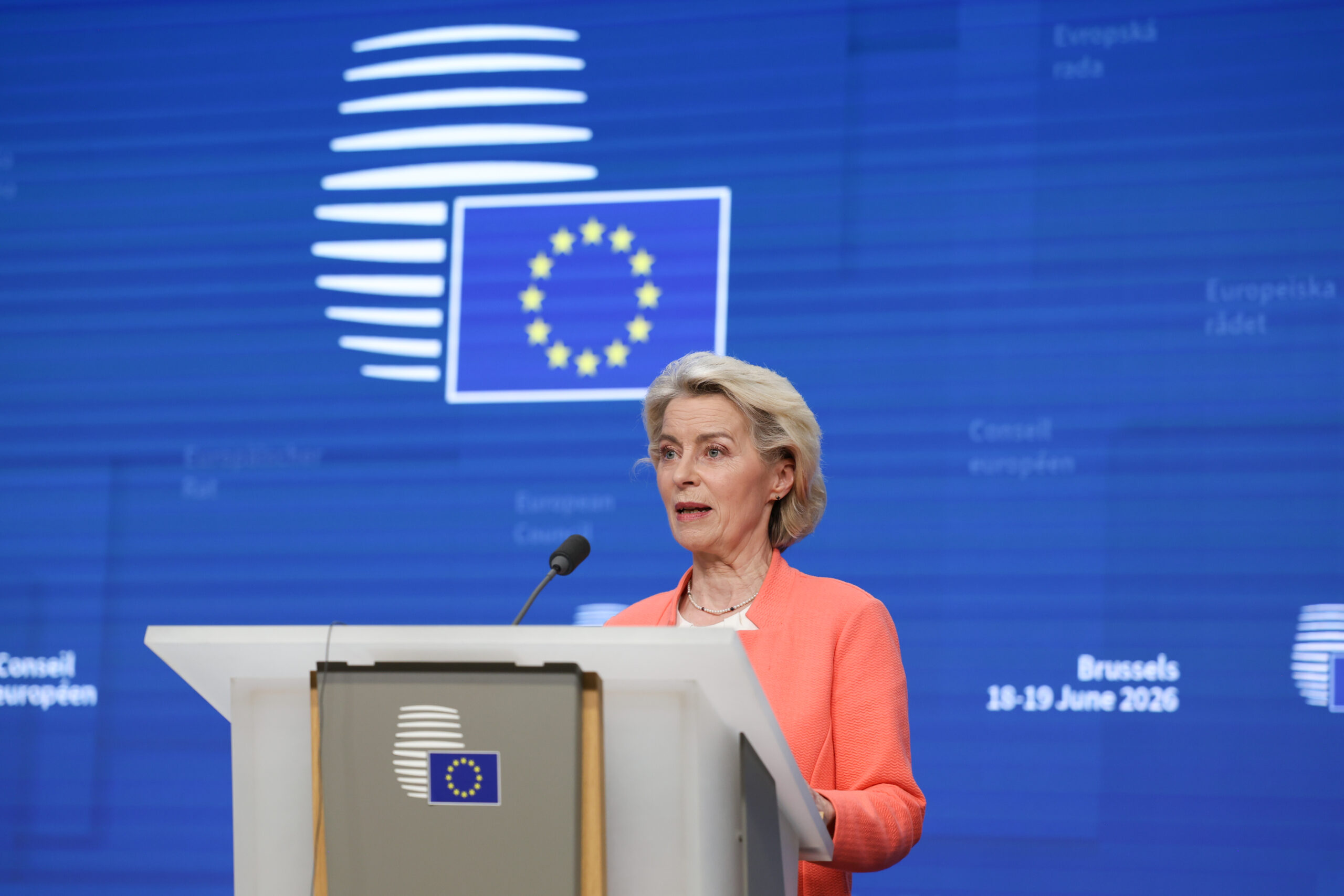
Brussels – The 27 Member States of the European Union have approved the framework for the next seven-year European budget (2028–2034). Following the approval already secured last Tuesday (16 June) in the General Affairs Council, the result was confirmed by the President of the European Commission, Ursula von der Leyen. “The Council has reached an agreement on the new structure of the multiannual financial framework (MFF). This is a significant step forward. It demonstrates that the Member States share the Commission’s ambition for a simpler, future-proof budget,” emphasised the head of the Berlaymont Building at the press conference at the conclusion of the European Council.
But for von der Leyen, this is not the only outcome; it is also the figures set out in black and white by the Cyprus’s Presidency of the Council of the EU in its so-called “Nego Box“. “For the first time, thanks to the Cypriot Presidency, we have a negotiating box with figures. This is another important step forward,” noted von der Leyen. However, the figures do not yet reflect the final outcome. “Of course, no one immediately sees their ideal budget in this box; but it is a solid basis for negotiation, for the next presidency—the Irish one—to take forward,” she explained. Negotiations on the multiannual budget have, in fact, begun at this EU summit, and the goal everyone is hoping for is to conclude the talks by the end of this year: “An agreement by the end of 2026 would allow for the adoption of legislative acts in 2027, which are necessary to ensure that EU funding reaches beneficiaries without interruption in January 2028,” noted von der Leyen.
The architecture of the Multiannual Financial Framework (MFF) for the period 2028 to 2034 proposed by the European Commission is characterised, in a way that is specifically new compared with the structures of previous QfPs, by the national and regional partnership plans (NRP plans). Under the future fund for the NRPs, the Berlaymont Building envisages drastic administrative simplification and increased efficiency in the disbursement of resources. In particular, the cornerstone of the reform is the creation of a single plan for each Member State, which will replace the current separate sectoral programmes, combining funding for cohesion, agriculture, fisheries, migration, security and the Social Climate Fund into a single instrument.
Last Tuesday (16 June), the General Affairs Council, which is responsible for this dossier and for preparing the European Council’s proceedings, has agreed on its provisional negotiating position on a key regulation concerning the EU budget for the period 2028–2034—the national and regional partnership plans (NRPs). Thus, the European Affairs ministers of the 27 Member States had already approved the plans signed by the leaders today.
However, as von der Leyen pointed out, the EU is called upon to “maintain its level of ambition,” which “must be matched by the means to achieve it.” For this reason, “we need a robust and stable system of new own resources. And that is why, by the time of our next meeting (in October, ed.), we should have a shared understanding of how we want to finance the next MFF.”
But while the rift over the architecture appears to have been resolved, the battle over the so-called “financial equation” is very much still on the table. How much to allocate in terms of total resources and how to distribute them is a divisive issue for Member States, which are split between “frugals“—that is, those Member States favouring a reduced EU budget—and those who would prefer more resources (the Friends of Cohesion).
English version by the Translation Service of Withub
![[foto: European Council]](https://www.eunews.it/wp-content/uploads/2024/06/euco-strem-350x250.jpg)

![Da sinistra: il presidente del Consiglio europeo, Antonio Costa; il presidente dell'Ucraina, Volodymir Zelensky: la presidente della Commissione europea, Ursula von der Leyen [Bruxelles, 18 giugno 2024. Foto: European Council]](https://www.eunews.it/wp-content/uploads/2026/06/euco_ua260618-120x86.jpg)
![[foto: Saverio De Giglio/imagoeconomica]](https://www.eunews.it/wp-content/uploads/2026/10/cpt-120x86.png)