After all, we are ‘ at the exam season…’ One goes down to the Piraeus, in that descent which opens the Republic, and before Socrates can set off towards the city, an old man holds him back. Cephalus, an arms manufacturer, wealthy and courteous, sits garlanded for a household sacrifice, and welcomes his guest with the serenity of one who has ceased to fear. Old age, he says, has loosed him from the tyranny of the desires, like a servant freed at last from many raging masters; and when his interlocutor hints that it is money which makes his twilight light, the old man corrects him with grace: what counts is the character one has built, not one’s wealth. Then, with a gesture that few students, those reluctant readers, recall, Cephalus takes his leave. He takes part in the rites and leaves the argument to the younger men. He had named, without emphasis, what the Greeks truly feared: the clouding of judgment, not white hair.
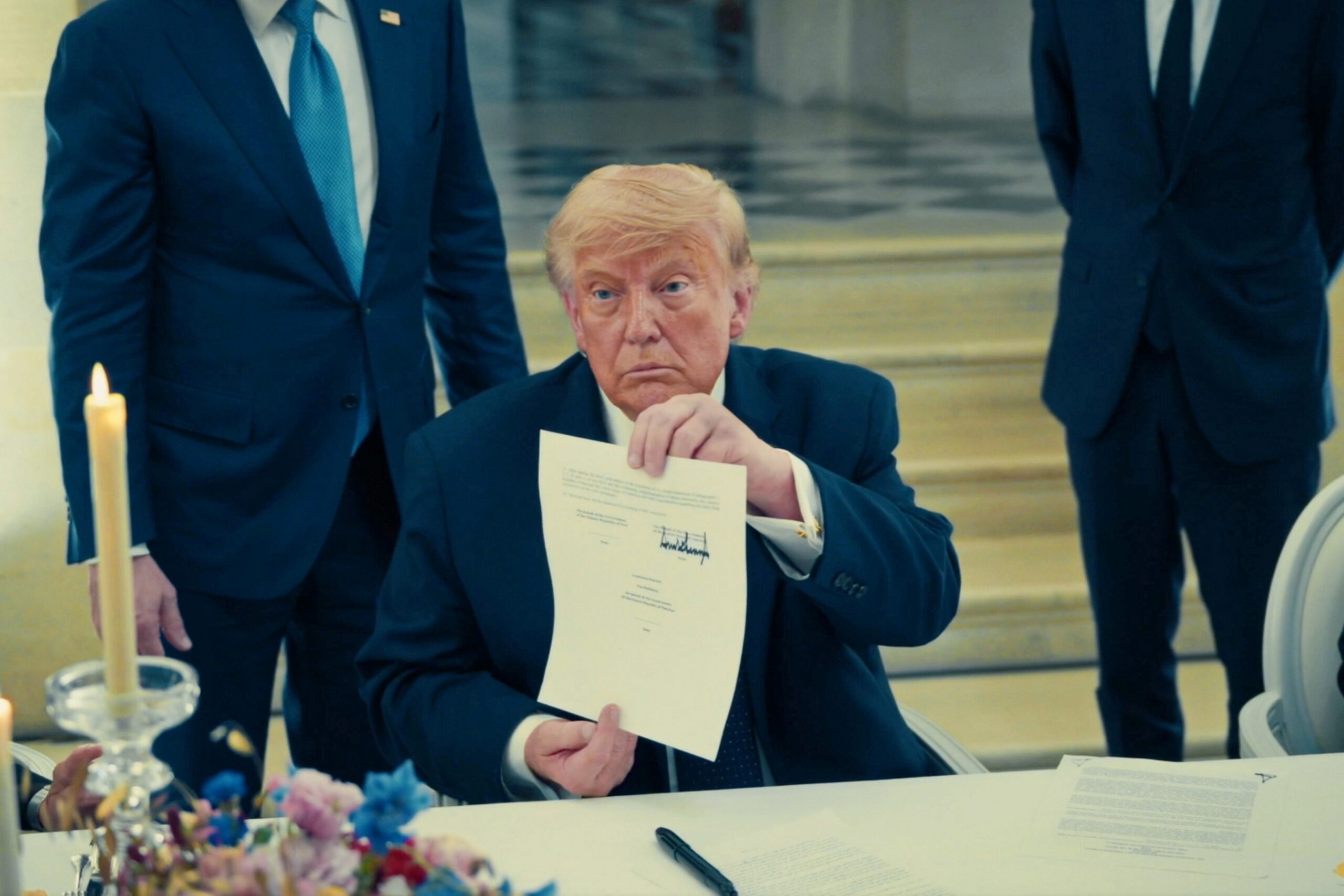
After more than a year and a half of his second presidency, it is hard not to remain perplexed before the improvised ways in which the occupant of the White House manifests, details and imposes his terms: the messages dashed off at dawn on the platform he owns, the threats and the gibes entrusted to capital letters, the register that swings between the rally and the medical report.
This spring the question slipped, distastefully, into the family sphere. Mary Trump, the president’s niece and a clinical psychologist by training, has spoken in public of a cognitive decline that she calls serious and by now evident, recalling the Alzheimer’s of his grandfather Fred. It is not for me to issue diagnoses at a distance, and the niece herself had the honesty to recall that a clinical psychologist is not a neuropsychiatrist. The point is not the clinical verdict. It is the question that surrounds it: to what lucidity, and how much of it, are the governed entitled?
Here a small census proves useful. Civilisations, almost all of them, have carefully drawn the threshold of entry into judgement. To vote in conclave a cardinal must not have turned eighty at the death of the pontiff, a rule willed by Paul VI in 1970; in Karlsruhe a constitutional judge departs in any case at sixty-eight; in London a Supreme Court justice retires at seventy-five; in Rome the Constitutional Court sets no age, yet it demands decades on the bench, in the chair or at the bar. The Supreme Soviet required twenty-one years to be elected to it, the Japanese Diet asks for twenty-five and thirty. Everywhere a line, at the beginning. Then look to the summit: the most powerful executive office on the planet knows no upper limit, and the Court that ought to watch over it sits for life, with no term and no ceiling of age. We know how to mark the beginning of discernment. It is its end that no one dares to assess.
And yet it was the oldest of Western institutions that made of the threshold an act of humility. When the Church removes the vote from the cardinal of eighty, it admits that not even a life of sanctity exempts the mind from time. Widespread, shared and accessible knowledge reminds me that the same thing was known in the cloisters of the monasteries, where discretion, the capacity to see rightly, was held to be the mother of the virtues, and was guarded, not presumed: prudence they called the right reason applied to action, made of memory of the past and attention to the present, the two faculties that decline wears away first. The sacred page venerates the grey head, true, but it ties honour to the justice of one’s days, not to mere duration. Lucidity as a condition, never as a privilege of seniority.
The Greek philosophers tell us one thing only, and they repeat it in many voices: practical wisdom, the art of deliberating well about the good, is not an eternal possession; it is earned with the years and with the years it may be spent. They tell us that he governs well who has his mind in its best form, not he who has simply remained in his place. A friend of mine, a professor of Philosophy of Law, reminds me that what they leave us, carved into the language, is a clue worth more than a thousand verdicts: the word by which they named judgment, the separating and the distinguishing, is the very root of our word justice. The right to clarity of judgement, for them, did not belong to the one who commands. It belonged to the city, which entrusted the decision to another and holds both the right and the standing to demand that that mind be awake.
The Romans hand down to us two things. The first is an idea of law: a mind that is no longer its own master must be protected and not exploited, and the fitness to perform valid acts is measured by good sense, not by one’s years; their Senate was, after all, the council of the elders, yet the authority of the old was prestige that guides, not command that orders, and command always remained for a fixed term. The second is an image, the clearest they have handed us of taking one’s leave with honour. Cincinnatus, called from the plough to the dictatorship, who, the danger past, laid down absolute power within a few days and returned to his field beyond the Tiber.
The republic that most elected him as its father, the American one, which made of Washington its own Cincinnatus and named after him the society of its veterans, seems to have mislaid the second half of the story: not the seizing of power, but the knowing how to lay it down serenely. They had written it for us, on a page penned by an old man: age is beautiful when it is the harvest of a life well spent, and it turns bitter only when one clings to it.
Elsewhere the elder who withdraws is not cast aside, he is raised up, and precisely because he withdraws. The filial piety of the Confucian East rests on the obligation of the young towards the old; and yet that same China fixes at eighteen the citizen’s capacity for judgement and reserves for wisdom the role of counsel, not of perpetual command. In the societies of central Africa and below the great desert, the council of elders sits in the shade of the tree of speech, and the old man speaks last, binding little by force and much by respect. The elder of the Native Americans keeps the memory and gives counsel, precisely because he no longer needs to prevail. Even secularised Northern Europe, which has thinned the rites, has kept their substance: the emeritus chair, the dignity of the pension, the Scandinavian leader who leaves at the height of esteem and not a minute beyond. The honour of the emeritus lies in the act of taking leave.
And here, perhaps, it is wise to entrust ourselves to those who do not carry our same burden. The twentieth century, the short century, has handed us a reflex we struggle to dismantle: the cult of the providential old leader, the row of gerontocrats stiff upon the mausoleum, the notion that duration is in itself a credential. A generation raised inside that reflex hesitates to draw the threshold, because it fears to be wanting in respect. Those who come after have no such fear. For the natives of the fast century competence is not presumed, it is verified, and it is verified in real time, continually, to the rhythm of a response that arrives within a few moments; power administered at dawn in bursts of capital letters, in their eyes, is not venerable, it is simply lagging behind the feed.
They measure lucidity in latency. An entire generation had already sensed it back in 1964, when Catherine Spaak, in her guise as a singer, called her contemporaries “l’esercito del surf,” the surf army (in English, there is a version released in Brazil, The Youngsters). Every season has its wave and its army. This one rides a far swifter wave. Let us grant them that, and let us grant them a chance: free of the legacies of the short century, with the parameters of the fast century in hand, it might be precisely they who redraw the line that we no longer dare to touch. They will pay a price: short memory, impatience with the long time of things; but the threshold, that they will know how to see.
Europe, with its mandates of fixed term and its retirements written into the Constitution, may well be slow, may well be grey, but of that threshold it has at least kept the memory. The rest, perhaps, without disturbing a revision of the De Senectute, will truly be written by the surf army.
English version by the Translation Service of Withub