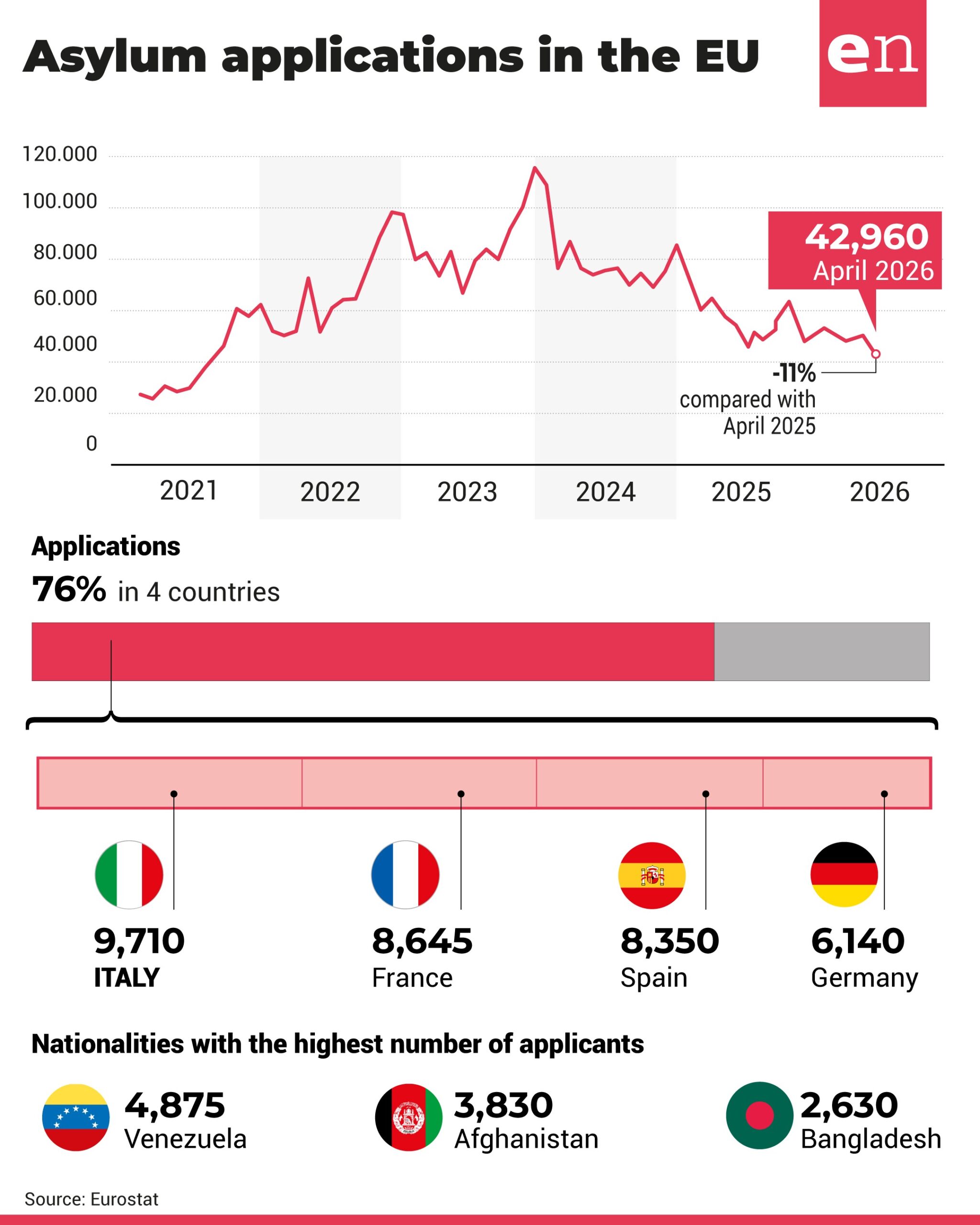

Brussels – In April 2026, 42,960 third-country nationals lodged an initial application for international protection in a Member State of the European Union. Asylum applications in the EU fell by 11 per cent compared with the previous year (in April 2025, the number of applicants stood at 48,465) and by 9 per cent compared with the previous month (in March 2026, the number of applications stood at 47,155). These and other figures on trends in migration flows to the EU have been released by Eurostat, the European Union’s statistical office, in a report published today (16 July).
In so-called second-instance applications, submitted by those whose previous application had already been rejected, April 2026 saw an increase compared with the previous year, but a decrease compared with March 2026: there were 9,145, 17 per cent more than in April 2025 but 9 per cent fewer than in March 2026.
The nationality most commonly represented among asylum seekers remains unchanged: as in March 2026, Venezuela is the leading country of origin for those seeking protection and admission to the EU, with 4,875 applications, followed by Afghanistan (3,830), Bangladesh (2,630), and Sudan (1,720).
By themselves, Italy (9,710), France (8,645), Spain (8,350), and Germany (6,140) accounted for three-quarters of asylum applications, up to 76 per cent of first-time applications. In April 2026, there were 9.5 asylum seekers per 100,000 people in the EU. This was an unprecedented figure for the EU. Relative to the population of each EU country (as at 1 January 2026), the highest rates of first-time applicants were recorded in Greece (26.1), ahead of Luxembourg (20.6), and Ireland (18.7).
A separate category is that of unaccompanied minors. There were 930 who applied for international protection within the EU in April this year. Most of them come from Somalia (190), Afghanistan (100), Sudan (75), Egypt (75), and Venezuela (55).