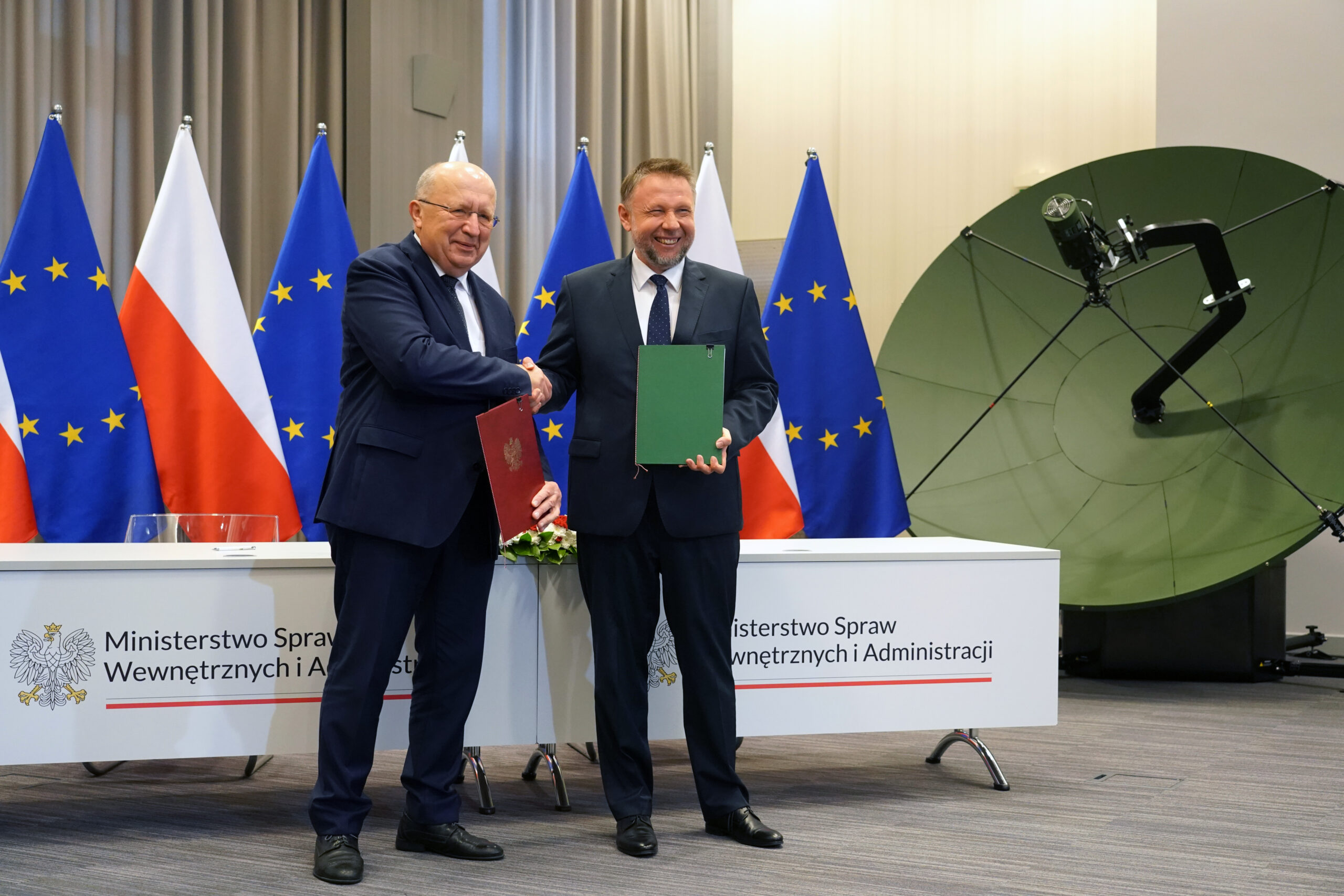

Brussels – Poland will invest €656 million of the remaining funds from the National Recovery and Resilience Plan (NRRP) in IRIS², the European programme for secure satellite connectivity for governments, businesses, and citizens. The aim is to strengthen the resilience of the EU’s strategic infrastructure and make Poland one of the pillars of the future European satellite network. The agreement was signed today in Warsaw by the European Commissioner for Defence and Space, Andrius Kubilius, alongside the Polish Minister of the Interior, Marcin Kierwiński, and the Under-Secretary of State Konrad Szymański. “This huge investment demonstrates great leadership on Poland’s part. I hope that other Member States will follow this example,” Kubilius said on the sidelines of the signing.
Poland is the first country to use NRRP funds to finance a national constellation integrated into IRIS². The European Commission had identified three possible areas for allocating the resources still available from the NRRP: security, defence, and space. In total, the country has received around €60 billion from the European Recovery and Resilience Facility.
Membership of IRIS² forms part of a broader strategy to strengthen the national space sector. Key initiatives include the Polish Earth Observation Constellation CAMILA, which is also funded by the EU, the new Centre for Civil Security and Resilience developed in collaboration with the European Space Agency (ESA), and the growing participation of Polish companies in European space programmes.
“By choosing to develop its own constellation as part of IRIS², Poland has decided to collaborate with Europe within a single system,” Kubilius emphasised. A decision which, according to the Commissioner, will enable the country to benefit from more secure government communications, a shared satellite system at a lower cost than a wholly national solution, and new opportunities for highly skilled employment.
The investment will also be of strategic importance for the Union’s entire eastern flank. Poland’s participation in the European programme “will make the country a connectivity hub for the entire eastern flank and will boost secure communications capacity across the whole region,” said Kubilius. “Secure connectivity from space is our lifeline in times of crisis and war.”
At the European level, the next steps involve expanding GOVSATCOM, the European Union programme that provides secure and resilient satellite communications to governments, police forces, emergency services, and European institutions, by integrating new commercial services. At the same time, development of IRIS² will continue, with the aim of commencing initial operations by 2029.
For the European Commissioner, the way forward is clear: to strengthen shared capabilities rather than multiplying national ones. “It is better to develop a single European system, capable of growing over time, rather than multiplying separate national systems, which are more expensive, less interoperable, and less efficient,” concluded Kubilius.
English version by the Translation Service of Withub