

- Europe, like you've never read before -
Monday, 21 September 2026
No Result
View All Result
  • it ITA
  • en ENG
Eunews
  • Politics
  • World
  • Business
  • News
  • Defence
  • Health
  • Agrifood
  • Other sections
    • Culture
    • Rights
    • Energy
    • Green Economy
    • Finance & Insurance
    • Industry & Markets
    • Media
    • Mobility & Logistics
    • Net & Tech
    • Sports
  • European 2024
    Eunews
    • Politics
    • World
    • Business
    • News
    • Defence
    • Health
    • Agrifood
    • Other sections
      • Culture
      • Rights
      • Energy
      • Green Economy
      • Finance & Insurance
      • Industry & Markets
      • Media
      • Mobility & Logistics
      • Net & Tech
      • Sports
    No Result
    View All Result
    Eunews
    No Result
    View All Result

    Home » Rights » Social rights, EU: “Greater access to the labour market, harness AI and reduce inequalities”

    Social rights, EU: “Greater access to the labour market, harness AI and reduce inequalities”

    European Commissioner Roxana Mînzatu: “Ten years on from the presentation of the European Social Pillar, we have taken stock to identify what needs to be improved and what more can be done”

    Iolanda Cuomo by Iolanda Cuomo
    22 July 2026
    in Rights
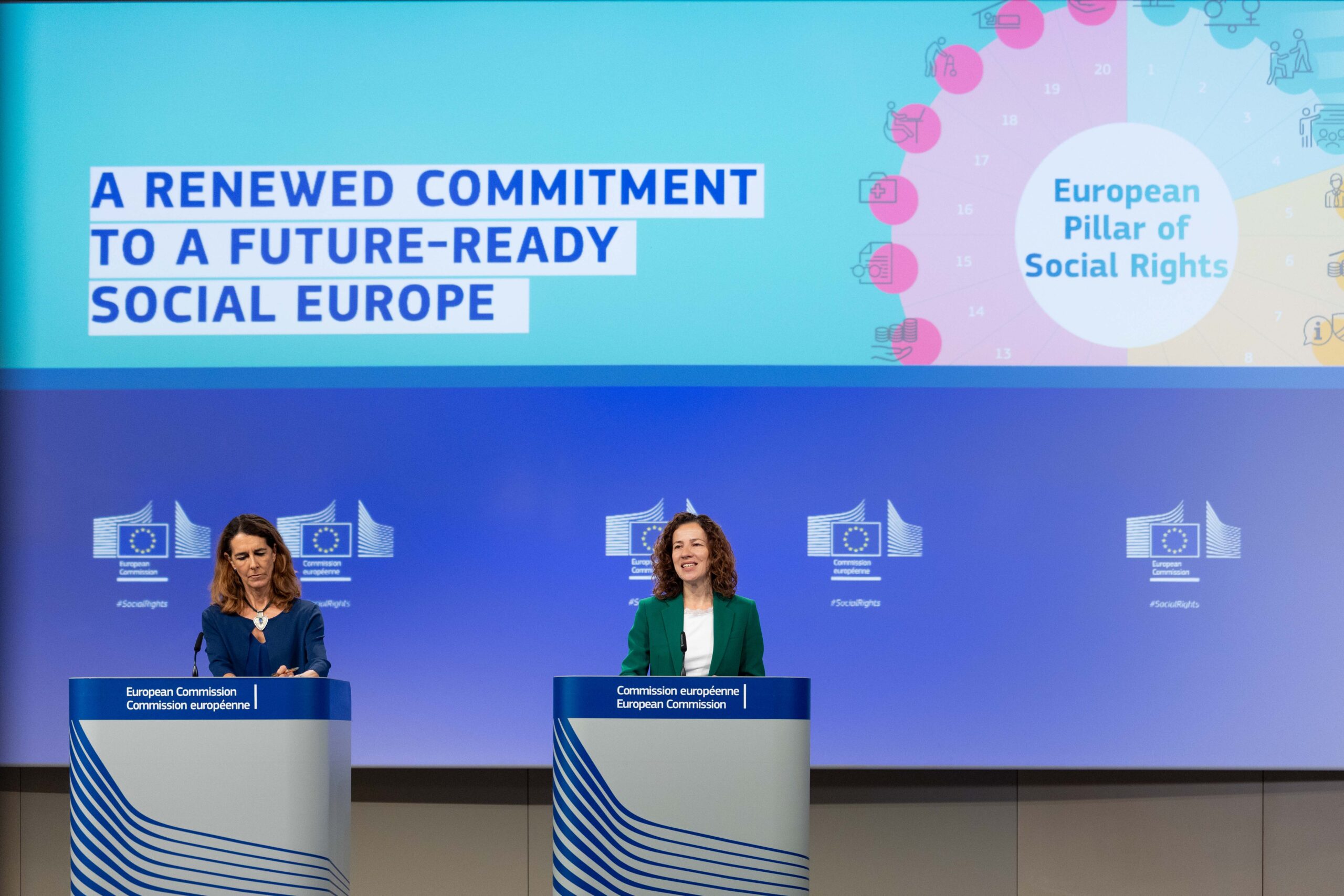
    Da sinistra a destra la portavoce della Commissione europea, Paula Pinho, e la commissaria europea e vice presidente esecutiva della Commissione europea a Diritti sociali e competenze, posti di lavoro di qualità e preparazione, Roxana Mînzatu, durante la presentazione della comunicazione sul Pilastro sociale europeo. Crediti: Commissione europea

    Roxana Mînzatu

    Powered by powered by evolution group

    Brussels – “We have three areas to focus on: more targeted and in-depth measures to control costs and ensure affordability; harnessing the impact of artificial intelligence (AI) on the world of work; and tackling inequalities.” This was stated today (22 July) by the European Commission’s Executive Vice-President for Social Rights, Skills, Quality Jobs and Education, Roxana Mînzatu, during a press release on the European Pillar of Social Rights. 

    Mînzatu pointed out that the Pillar—a set of 20 fundamental principles and rights aimed at building a more equitable, inclusive and citizen-centred Europe—was adopted almost ten years ago and has since served as “a social compass that the EU has adopted” to develop policies that promote employment and social progress, monitor national policies, and guide European funding. “After almost a decade, we have taken stock to understand what needs improving and what more needs to be done,” said the Vice-President, emphasising that, compared to when the pillar was adopted, “times have changed.” Today’s communication aims to “anticipate and manage structural changes,” to seize the opportunities presented by the ongoing transformations on the one hand, and to continue to ensure “equity and prosperity” through the European social model on the other. In this context, the three areas highlighted by the Vice-President require “urgent and additional” attention. 

    On the issue of affordability and the cost of living, the government has acknowledged that many households continue to face “high costs for housing, energy, services and essential goods”; it will therefore “continue to support measures that reduce the risk of poverty and strengthen access to essential services.” Mînzatu cited among the “successful” measures the Directive on pay transparency (EU 2023/970)—European legislation aimed at eliminating the gender pay gap and ensuring equal pay for work of equal value—but highlighted that although “minimum wages have risen significantly across the EU”, there are many “talents that remain untapped outside the labour market.” This amounts to “50 million people who are outside the labour market, of whom 33 million are women.” These people are not unemployed, but “believe they cannot work or face obstacles,” the Vice-President clarified, identifying “childcare” as one of the key issues on which the EU must take action. To help these groups, the Berlaymont building has announced that, in accordance with the principle of subsidiarity, it will launch “an initial consultation phase with the EU’s social partners” to integrate these people into the labour market. This consultation will provide the Commission with “first-hand information on combating poverty and exclusion, promoting labour market inclusion and enhancing competitiveness.” 

    On the subject of the development and adoption of AI, the Commission has acknowledged that these new technologies are raising “important and critical questions about the future of work, education, skills, social inclusion, and public services.” Consequently, the Commission believes that it is “urgent for Europe to prepare for these profound changes, ensuring that citizens, workers, and businesses can fully benefit from the potential of AI.” The Commission has therefore announced that it “will set up a new high-level group on the impact of AI on the labour market.” 

    As for the chapter on reducing inequalities, the Berlaymont Building explains that “persistent inequalities undermine social and territorial cohesion and weaken the EU’s long-term sustainability, innovation, and competitiveness, as well as its demographic fabric” and that, despite the progress made in recent years, “inequalities persist across all areas of life, requiring ongoing efforts. With a view to improving equal opportunities in certain key sectors of the economy, the Commission has expressed its commitment to supporting small and medium-sized enterprises in implementing the Pay Transparency Directive, as well as to presenting the forthcoming initiative “Right to stay“—a strategy aimed at tackling depopulation and demographic and economic decline in inland and peripheral areas—and the post-2027 EU Youth Strategy. Furthermore, in the course of the year, the Commission will also present the Quality Jobs Act, a document that “will also explore new indicators to measure the quality of work across the EU, complementing existing EU targets for 2030 on employment, skills and poverty reduction.” 

    Adopted in 2017, the European Pillar of Social Rights sets out 20 principles to ensure fair working conditions, social protection and equal opportunities. At the 2021 Porto Social Summit, EU leaders, institutions and other stakeholders agreed to place social issues at the heart of EU policies.

    English version by the Translation Service of Withub
    Tags: accesso al lavoroartificial intelligencediritti-donneeuropean pillar of social rightspovertà alimentarepovertyroxana minzatuunemployment

    Eunews Newsletter

    Related Posts

    La Presidente del CESE, Nicoletta Merlo [fonte Eunews]
    Rights

    INTERVIEW / “Nothing about young people without young people”: the challenge (and motto) of the chair of the EESC Youth Group

    22 July 2026
    Palazzo Chigi [foto: imagoeconomica]
    Business

    Italy: public debt rises further in the first quarter of 2026; Greece is catching up

    21 July 2026
    CENTRO CITTA' LAVORO GRU' CALDO RISTRUTTURAZIONE OMBRELLONE OPERAIO EDILIZIA EDILE
    Business

    Heat and work: European trade unions are once again calling for legislation on maximum temperatures

    20 July 2026
    Electrolux - Lega - Commissione UE
    Business

    Electrolux, Séjourné: “Job protection is not a criterion for receiving EU funding”

    15 July 2026
    map visualization
    Aerei via Unsplash

    Eurostat: over 2 million commercial flights in the EU between June and August 2026

    by Iolanda Cuomo
    21 September 2026

    Brussels – Summer usually means holidays — and more flights and air traffic. The last summer months confirm the trend, with...

    L’Alta rappresentante dell’Unione europea per la Politica estera, Kaja Kallas. Crediti: Commissione europea

    Red Sea: Kallas tells EU ministers the bloc must act to counter the Houthi threat

    by Iolanda Cuomo
    21 September 2026

    In a letter, the High Representative asks EU ministers to consider increasing the bloc’s naval presence in the region via...

    Friedrich Merz

    Germany: Merz’s centrist bloc slumps at the polls as AfD and the Left advance

    by Redazione eunewsit
    21 September 2026

    The far right has retained its position as the leading force in Mecklenburg-Western Pomerania, whilst Die Linke won the capital,...

    The aftermath of a Russian drone attack on Kyiv on 9 September 2026 (Imagoeconomica)

    Weekend Round-Up War in Ukraine Brief — Europe

    by Antonia Williams
    21 September 2026

    Russia continues launching ballistic missiles that Ukraine has few reliable methods of defeating without Patriot

    • Director’s Point of View
    • Opinions
    • About us
    • Contacts
    • Privacy Policy
    • Cookie policy

    Eunews is a registered newspaper
    Press Register of the Court of Turin n° 27

    Copyright © 2025 - WITHUB S.p.a., Via Savona 127/B, 20144 Milano
    VAT number: 10067080969 - ROC registration number n.30628
    Fully paid-up share capital 50.000,00€


    No Result
    View All Result
    • it ITA
    • en ENG
    • Politics
    • Newsletter
    • World politics
    • Business
    • General News
    • Defence & Security
    • Health
    • Agrifood
    • Altre sezioni
      • Culture
      • Rights
      • Energy
      • Green Economy
      • Gallery
      • Finance & Insurance
      • Industry & Markets
      • Media
      • Mobility & Logistics
      • Net & Tech
      • News
      • Opinions
      • Sports
    • Director’s Point of View
    • Draghi Report
    • Eunews Newsletter

    No Result
    View All Result
    • it ITA
    • en ENG
    • Politics
    • Newsletter
    • World politics
    • Business
    • General News
    • Defence & Security
    • Health
    • Agrifood
    • Altre sezioni
      • Culture
      • Rights
      • Energy
      • Green Economy
      • Gallery
      • Finance & Insurance
      • Industry & Markets
      • Media
      • Mobility & Logistics
      • Net & Tech
      • News
      • Opinions
      • Sports
    • Director’s Point of View
    • Draghi Report
    • Eunews Newsletter

    Attention