
Brussels – The closure of an Electrolux factory in Italy and the resulting redundancies affecting around 1,700 workers have come to the attention of the European Commission. Lega MEPs Anna Maria Cisint, Paolo Borchia, and Silvia Sardone, from the Patriots for Europe (PfE) group, have tabled a parliamentary question to the Executive Vice-President responsible for Industry, Stéphane Séjourné, in which they link the matter to the “contradictions” in the European Union’s industrial policy.
In the parliamentary question, the three MEPs criticise some of the instruments introduced by the EU to support the industrial transition, including the Carbon Border Adjustment Mechanism (CBAM), which imposes a cost on carbon emissions embedded in certain products imported from third countries. According to Cisint, Borchia, and Sardone, measures such as the CBAM, which “are intended to safeguard the competitiveness of EU industries vis-à-vis third countries,” are instead “emblematic of European contradictions within regulatory frameworks.”
Lega representatives are therefore asking the Commission whether the European funding received by Electrolux was conditional on the company’s commitment to safeguard jobs and maintain production capacity, and whether Brussels intends to review EU environmental and industrial legislation to prevent “further deindustrialisation of the European manufacturing sector.”
In the reply to the parliamentary question, Séjourné points out that “Electrolux Italia has received EU funding for research and innovation under the Seventh Framework Programme, Horizon 2020, and Horizon Europe.” However, she clarifies, “the protection of jobs or the maintenance of production capacity are not eligibility or award criteria” for European funds.
As for the regulatory framework, the Executive Vice-President implicitly rejects the idea of a rethink of European industrial strategy, emphasising instead that the Commission is already taking action to strengthen the competitiveness of industry without compromising the objectives of the green transition. Among the initiatives mentioned are the Clean Industrial Deal, the Industrial Accelerator Act and the the “Omnibus” simplification package.
Séjourné also points out that the Commission “has put forward a proposal on legislation relating to energy products to simplify further certain energy labelling rules for manufacturers of household appliances,” including Electrolux.
Even on the CBAM, which MEPs have identified as one of the factors undermining the competitiveness of European businesses, the Commission is proud of the work it has carried out. The European Commission, explains Séjourné, “is constantly monitoring its implementation” and in 2025 “put forward two proposals to revise the CBAM” to “simplify the mechanism and extend its scope.”
English version by the Translation Service of Withub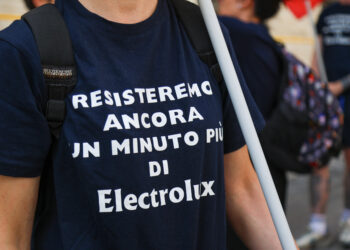


![Il ministro dei Trasporti, Matteo Salvini [Bruxelles, 5 dicembre 2024. Foto: Emanuele Bonini per Eunews]](https://www.eunews.it/wp-content/uploads/2024/12/salvini241205-120x86.jpeg)