

Brussels – According to the latest data published by Eurostat on public funding for research and development, in 2025, European Union governments allocated approximately €130.2 billion to research and development (R&D), equivalent to 0.69 per cent of the EU’s GDP.
This figure represents a 2.4 per cent increase compared with the €127.1 billion in 2024 and 60.5 per cent compared with 2015, when funding stood at €81.1 billion. Over the past ten years, therefore, European public budgets have allocated almost €50 billion more to R&D.
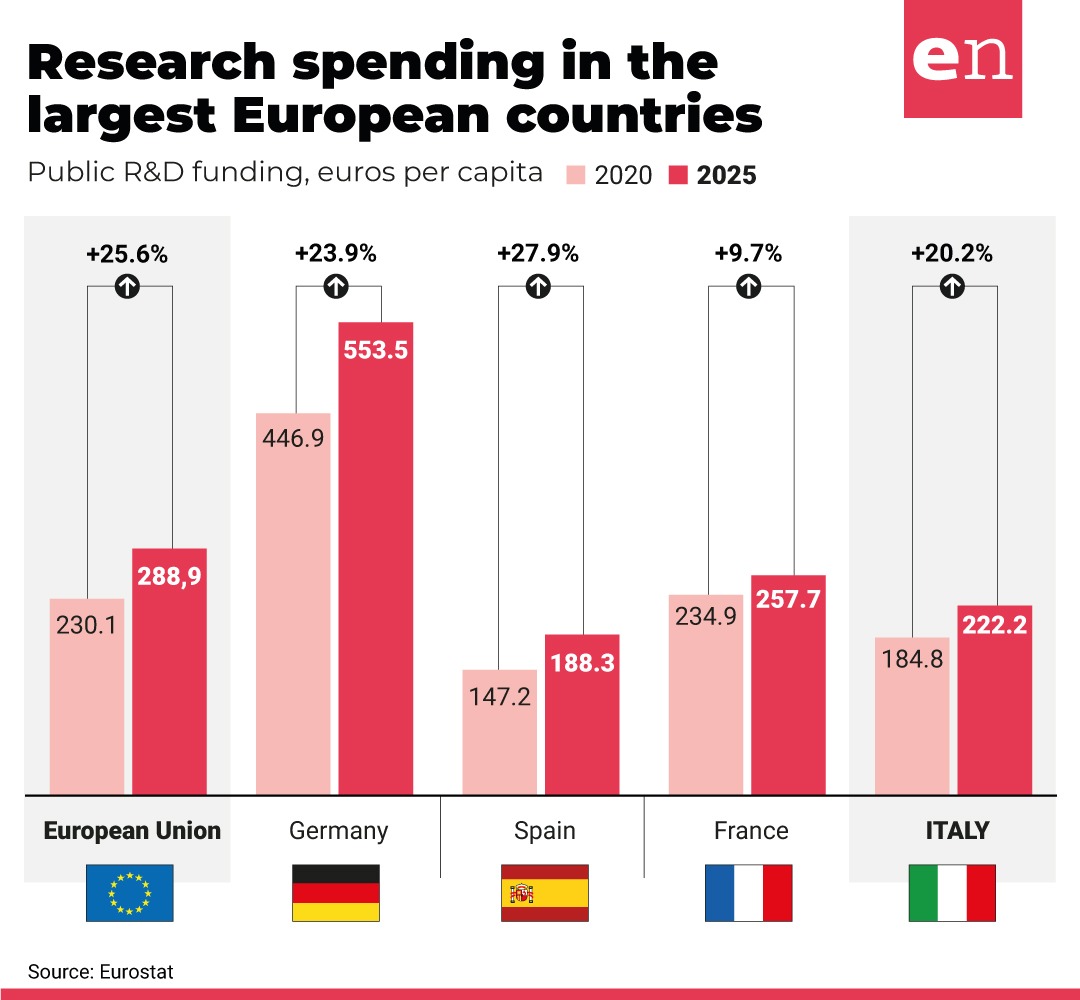
Almost €290 per inhabitant
Taking population into account, in 2025 EU governments allocated an average of €288.9 per inhabitant to research and development, 57.7 per cent more than the €183.2 spent in 2015.
However, there are very marked differences between countries. First is Luxembourg, with €917.2 per inhabitant, followed by Denmark with €627.1, and Germany with €553.5.
At the other end of the table are Romania, Hungary, and Malta. Romania has allocated just €18.8 per inhabitant, Hungary €57.4, and Malta €73.7.
Compared with 2015, however, almost all countries have increased their per capita allocations. The only exception is Romania, where spending fell from 20.8 to 18.8 euros per inhabitant, a decrease of 9.6.
The most significant increases, however, were recorded in Bulgaria, which saw its per capita funding rise almost sixfold, from €15.5 to €92.3 (+495.5 per cent). The other EU countries follow, with much more modest increases: Sweden, for example, rose from €363.4 to €416.7 per inhabitant, a 14.7 per cent increase, the lowest of those recorded.
Over a third to fund universities
How are public research funds allocated? In 2025, 37.3 per cent of the EU’s GBARD was allocated to the “general advancement of knowledge”. This mainly consists of general public funding for universities (GUF), which public universities use to support their research activities.
A further 18.4 per cent of the funding was allocated to the general advancement of knowledge through sources other than general university funding.
Other key sectors include industrial production and technology, which accounted for 9.5 per cent of the total, healthcare 6.7 per cent, and defence 5.8 per cent.
Overall, therefore, more than half of European public funding for R&D is allocated to general knowledge funding, while smaller proportions are directed towards specific sectors such as technology, health, and defence.
English version by the Translation Service of Withub![[foto: Kodyak Tisch/Wikimedia Commons]](https://www.eunews.it/wp-content/uploads/2026/08/Woman_drinking_12661070643-350x250.jpg)