Brussels – Public spending on education in 2023 reached 4.7 per cent of the gross domestic product (GDP) of European Union countries, stable from the previous year. According to Eurostat figures published today (18 August), 2020 was the year in which EU countries allocated the highest share of their gross domestic product (GDP), 5.0 per cent, likely to address the difficulties that the Covid-19 pandemic brought to European students.
These figures are also confirmed by a European Commission report, which states that, in 2023, EU countries spent a total of 806 billion euros on education. At the national level, the proportion of total public expenditure allocated to education averaged 9.6 per cent. However, there are variations between European countries.
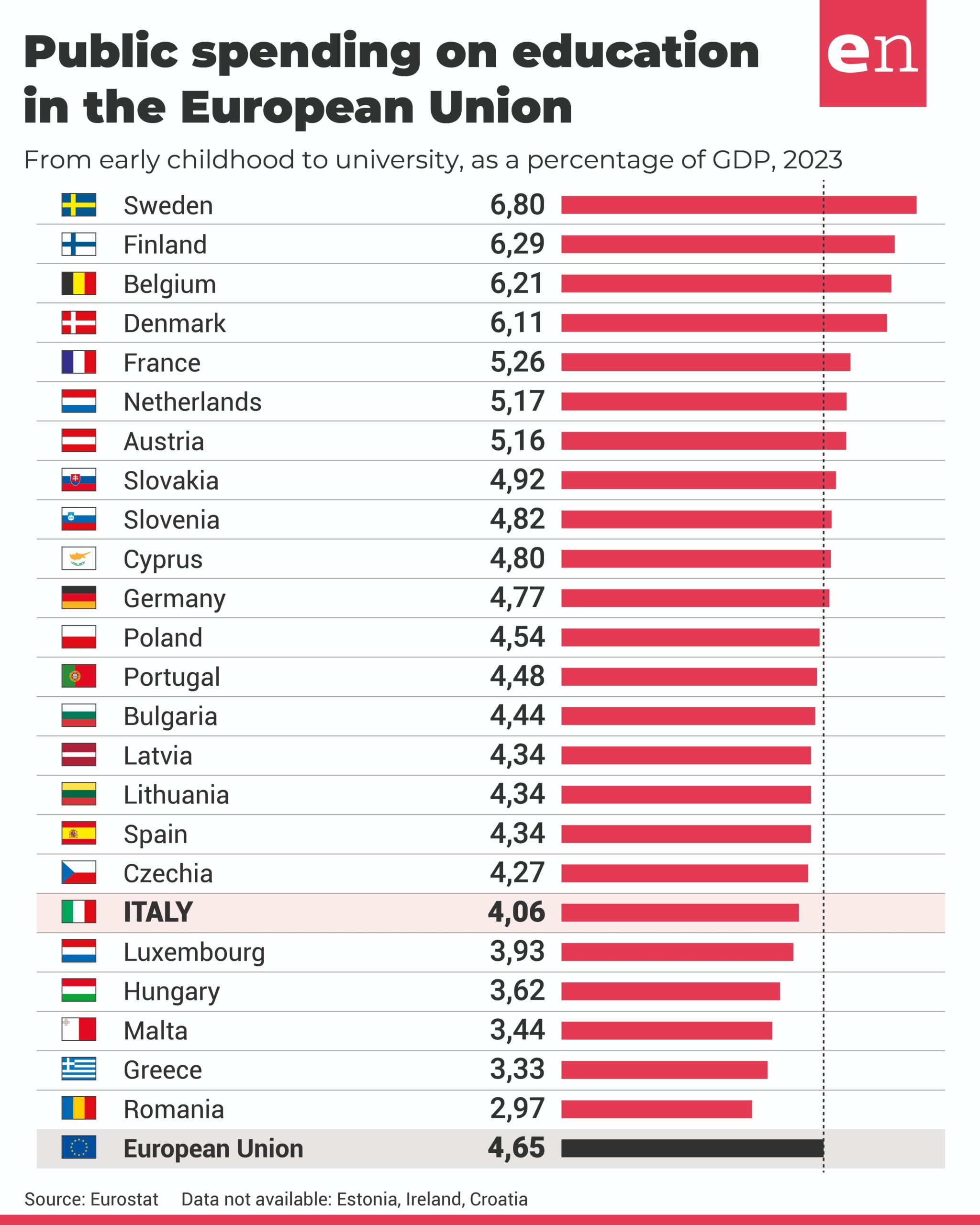
In 2023, only twelve EU Member States increased public spending on education from 2022 levels. Public spending on education was highest in northern Europe: Sweden (6.8 per cent), Finland (6.3 per cent), and Belgium (6.2 per cent), while the lowest percentages as a proportion of GDP were recorded further south: in Romania (3.0 per cent), Greece (3.3 per cent), and Malta (3.4 per cent).
Italy’s percentage is lower than the European average: in 2023, Italy allocated 4.1 per cent of its GDP to education, a figure that remained stable compared with 2022 but was 0.38 percentage points lower than in 2020, the year in which public spending on education reached its highest level.
Last year, the European Commission already presented a new report highlighting a positive shift in education funding across the EU and giving fresh momentum to the Union’s competitive edge. Titled Investing in Education 2025, the report details the multiple economic and social benefits of education spending, supporting the goals of the Union of Skills strategy.
English version by the Translation Service of Withub




![Da sinistra: il presidente del Consiglio europeo, Antonio Costa; il presidente dell'Ucraina, Volodymir Zelensky: la presidente della Commissione europea, Ursula von der Leyen [Bruxelles, 18 giugno 2024. Foto: European Council]](https://www.eunews.it/wp-content/uploads/2026/06/euco_ua260618-120x86.jpg)
![[foto: Saverio De Giglio/imagoeconomica]](https://www.eunews.it/wp-content/uploads/2026/10/cpt-120x86.png)