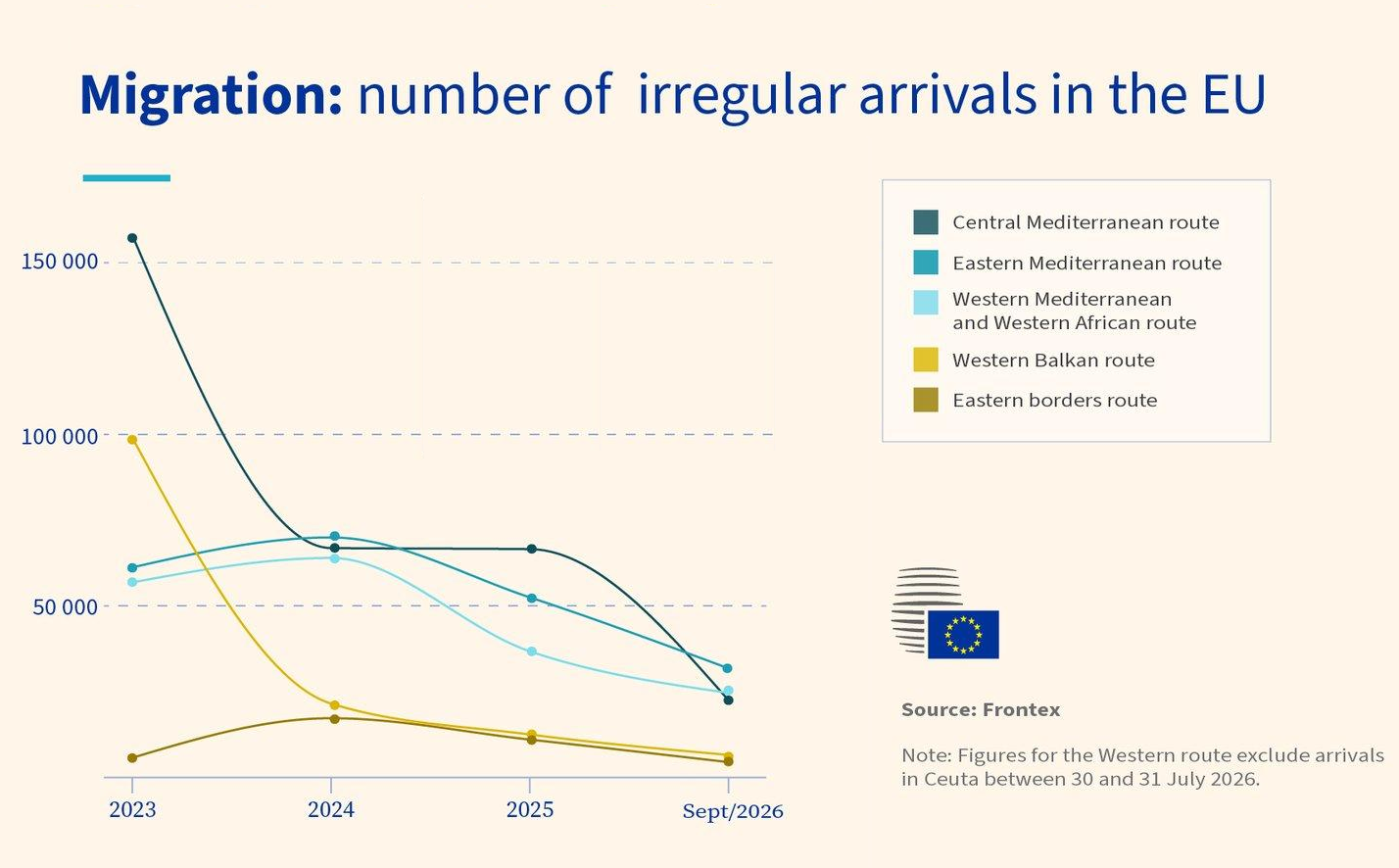
Brussels – On the subject of immigration, “the figures show that the EU’s comprehensive approach is bearing fruit: irregular border crossings into the EU are at their lowest level since 2021.” At the same time, “we must, however, remain vigilant and step up the fight against migrant smuggling and against all forms of exploitation of migrants themselves.” This is how the President of the European Council, António Costa, summarises the situation and the essence of today’s (16 October) debate among Heads of State and Government on an issue that continues to stir strong emotions.
According to Brussels, the common rules on immigration – particularly irregular immigration – are working. But the Ceuta crisis has burst onto the political scene, reigniting the disputes and divisions seen in August. Denmark has opened a rift with Spain, in a clash entirely within the Socialist family. The Danish Prime Minister, Mette Frederiksen, has publicly criticised the immigration policies introduced by the Socialist government of Pedro Sánchez, calling on the European Commission to examine whether the plan to regularise the status of 600,000 asylum seekers is compatible with the common rules.

“I have asked the European Commission to investigate what happens when a country does almost the exact opposite of what the rest of us are doing,”, namely encouraging arrivals on EU soil, stated the Danish Prime Minister on the second day of the European Council summit, with the debate on immigration among the items on the agenda. Frederiksen insists: “I believe this runs counter to the migration policy currently supported by a large majority in Europe.”
For the outgoing Spanish government and its leader, the blow therefore comes from representatives of political forces that are, in theory, allies – the Danish Socialists – who are instead revealing their conservative and intransigent nature, which enables them to reach agreements with the European centre-right and the most extreme factions. On the issue of immigration, the Copenhagen government shares the same stance as Giorgia Meloni’s government in Italy, which, in opposition to Madrid, has ordered the extension of checks to those arriving from Spain.
The reason for the tensions lies precisely in the analysis shared by all the leaders around the table: the number of irregular arrivals has fallen thanks to ongoing cooperation with partner countries and preventive measures in the main countries of origin and transit. The decisions taken by the Sánchez government are seen as contradicting the work carried out in recent years, and there are therefore fears that the results achieved may be put at risk.
The Prime Minister, Giorgia Meloni, expressed her satisfaction with the debate. During the European Council meeting, “we discussed migration,” although this is “the start of a debate that will conclude at the next European Council,” she explained at a press briefing following the meeting. “But I believe the European Commission’s announcement of new measures and a joint assessment with Member States to understand how we can establish a framework of measures enabling Member States to provide immediate responses in the event of a crisis is very important,” she noted. “What we saw happen, for example, in Ceuta at the start of August illustrates this kind of scenario, and so there is a reference to this emergency framework,” the Prime Minister emphasised, clarifying that these are “tools for national governments to be able to intervene in such a scenario.” For Italy, “this is very important” as it “raised the issue months and months ago, well before the Ceuta crisis,” through one of its “draft security bills.”
It is precisely on the subject of Ceuta and the rift with Spain that Meloni explains she has spoken with Sánchez and announces efforts to reach a solution with Madrid following the seven-day extension of the suspension of the Schengen Agreement with Spain. “We have decided to have our Home Affairs Ministers work next week to replace the reciprocal measures currently in place with other forms of cooperation. We are moving towards a different kind of solution, while certainly continuing our monitoring to ensure, on the one hand, that Schengen functions properly, and, on the other, that our nation’s borders are protected,” she stated.
This point was also highlighted by the Spanish Prime Minister. Regarding the temporary suspension of the Schengen rules between Italy and Spain, “I hope that an agreement can be reached as soon as possible”, Sánchez said at a press conference following the European summit. “The governments of Italy and Spain will work to provide a timely response to the exceptional situation arising from the non-application of the Schengen rules between Spain and Italy,” he added.
As is customary, on the sidelines of this European Council meeting, Meloni, together with Denmark’s Frederiksen and the Dutch Prime Minister, Rob Jetten, hosted an informal meeting this morning between some of the Member States most interested in the issue of innovative solutions to be applied to the management of migration. Alongside Italy, Denmark, the Netherlands, and the European Commission – as announced by Palazzo Chigi – the meeting was attended by Austria, Belgium, Bulgaria, Cyprus, Croatia, Finland, Germany, Greece, Latvia, Lithuania, Malta, Poland, Slovakia, Slovenia, and Sweden. “The meeting provided an opportunity to take stock of the progress made in recent months and to discuss upcoming initiatives, with particular attention to preventing mass irregular arrivals, the exploitation of migrants and the implementation of the new European regulatory framework,” the statement reads. As for the events in Ceuta, Meloni emphasised “the need to maintain a high level of vigilance at the Union’s external borders, focusing on the prevention of irregular immigration and the associated security risks,” and “raised the issue of a targeted review of European legislation to make the new procedures relating to the detention of irregular migrants during border procedures more effective,” she added.




![[foto: Saverio De Giglio/imagoeconomica]](https://www.eunews.it/wp-content/uploads/2026/10/cpt.png)


![Da sinistra: il presidente del Consiglio europeo, Antonio Costa; il presidente dell'Ucraina, Volodymir Zelensky: la presidente della Commissione europea, Ursula von der Leyen [Bruxelles, 18 giugno 2024. Foto: European Council]](https://www.eunews.it/wp-content/uploads/2026/06/euco_ua260618-120x86.jpg)
![[foto: Saverio De Giglio/imagoeconomica]](https://www.eunews.it/wp-content/uploads/2026/10/cpt-120x86.png)