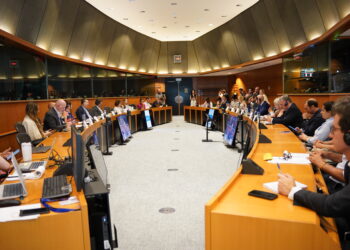

Brussels – How much does poor European regulation cost? According to the new report “The Hidden Cost of EU Regulation. Why Policy Design Matters for Growth, Competitiveness, and Investment”, the cost could amount to €159 billion of GDP per year and put 419,000 jobs at risk between 2026 and 2030. The report, produced by the European Policy Innovation Council (EPIC), attempts to quantify what it terms the “hidden” costs of European policies: not only bureaucratic burdens, but also regulatory uncertainty, poorly planned transitions and overlapping obligations that can slow down investment, limit innovation, and ultimately undermine the very objectives of the policies themselves.
The analysis takes as its starting point three major issues already on the European agenda: the EU–Mercosur agreement, the transition of the automotive sector and the Common Agricultural Policy. According to the report, weaknesses in their design and implementation generate a total of approximately €63 billion in annual costs, equivalent to 0.35 per cent of the EU’s GDP. The report then examines five regulatory areas that will have an impact in the coming years: the Revision of the Tobacco Products Directive
(TPD), the regulation of artificial intelligence, the Packaging and Packaging Waste Regulation (PPWR), the Carbon Border Adjustment Mechanism (CBAM) and the rules on biotechnology and novel foods. For each of these, a restrictive scenario is compared with one based on better-designed regulation.
In the first scenario, the estimate is €159 billion in lost GDP each year, with around 419,000 jobs at risk. A more proportionate, gradual, and evidence-based approach, on the other hand, would reduce the impact to €33 billion and 178,000 jobs at risk. According to the model, the difference amounts to €125 billion in GDP and 241,000 jobs each year. The report makes it clear that these are estimates based on scenarios, rather than losses already observed or guaranteed outcomes.
“The most important figure in the report is not the cost of regulation. It is the cost of poor regulation,” Antonios Nestoras, director of EPIC—the think tank that carried out the study—explains to Eunews. “We are not calling for less regulation. We are calling for fewer regulatory errors. And we see that the same mistakes keep being repeated, regardless of the sector.” For Nestoras, therefore, the issue is not to call into question EU intervention as such. “Regulation is not inherently bad. It creates the conditions for economic activity and industrial policy, builds consumer confidence and so on. However, it becomes harmful when it is poorly designed.”
The problem, according to EPIC’s director, is that institutions do not always manage to adhere to the very principles they have set themselves for achieving “better regulation”. He points out that the Commission has guidelines, assessments, and impact analyses at its disposal. “But sometimes, like any other bureaucracy, it fails to adhere to its own rules on better regulation.”
Among the cases analysed, Nestoras considers the tobacco sector to be the most striking. In a restrictive environment, the revision of the TPD could result in an annual loss of €48 billion in GDP, including 24 billion in lost tax revenue. With regulation tailored to the varying levels of risk associated with the products, however, the scenario estimated by the report is reversed: an additional €32 billion in GDP per year, including around €16 billion in tax revenue, alongside improved health outcomes.
“There is no objection to tobacco. There is absolutely no one who says, “We don’t want fewer people to smoke; we want more people to smoke.” Yet, even though the Commission is regulating independently, we continue to see the same problems,” he observes. The key point, for EPIC, is therefore to distinguish between the product and the associated risk. “A stricter rule does not automatically lead to a healthier outcome. Different products should be regulated according to their different levels of risk,” argues Nestoras. And the question we should be asking is not how many products are being restricted, but what concrete effect this has on public health: “The relevant question for us is not how many products we manage to restrict, but how many people stop smoking.”
Because, he warns, removing a product from the legal market does not necessarily mean putting an end to its consumption. “Even if a product were completely restricted and removed from the legal market, consumption would not disappear along with it. We would end up with an illicit market.”
Tobacco, however, is not an exception. According to Nestoras, the same problem with policy design also arises in the other sectors analysed, ranging from artificial intelligence to the automotive industry, and from agriculture to international trade. In the case of AI, for example, the report estimates that current regulations reduce the potential gains in productivity by 38 per cent, resulting in an average annual loss of €24 billion in GDP and putting 62,000 jobs at risk. “Very often, the decision-making process is impervious to evidence and data,” argues Nestoras. Even when data is presented by industry, think tanks or NGOs, “the starting position is, in most cases, very rigid and ideological. In this respect, the evidence is ignored.”
However, according to EPIC, the differences between the various case studies serve to show that there is no single path to achieving a goal. In the case of Mercosur, for example, the issue concerns distributional effects: a policy may produce a positive economic outcome overall, but face strong opposition if it does not consider in advance who will bear the costs. “This is poor policy design. It is not a bad decision.”
As for the CAP, however, the lesson would be that uniform rules do not always work. They may be simpler to administer, but they are not necessarily economically efficient in a Union characterised by very diverse agricultural economies. Finally, as regards the automotive sector, the problem would be the gap between the targets set and what the industry is actually capable of achieving. “We have these extremely ambitious targets. But ultimately, the industry itself has failed to keep pace with them. So what do we end up with? We end up with an industry in difficulty, which means the regulation has failed.”
Hence the report’s central proposal: governance based on “Stability-by-Design”, that is, regulation that takes into account economic effects, the sectors’ capacity to adapt, differences between firms and technologies, and the interaction between different rules before they are adopted—rather than when they begin to produce undesirable effects.
“Regulatory uncertainty is not merely an abstract legal issue. It is a tangible obstacle to economic activity,” underlines Nestoras. The report emphasises that the aim is therefore not to abandon Europe’s ambitions in the areas of health, the environment or safety, but to find more credible ways of achieving them, while safeguarding European investment, innovation, and competitiveness.
English version by the Translation Service of Withub