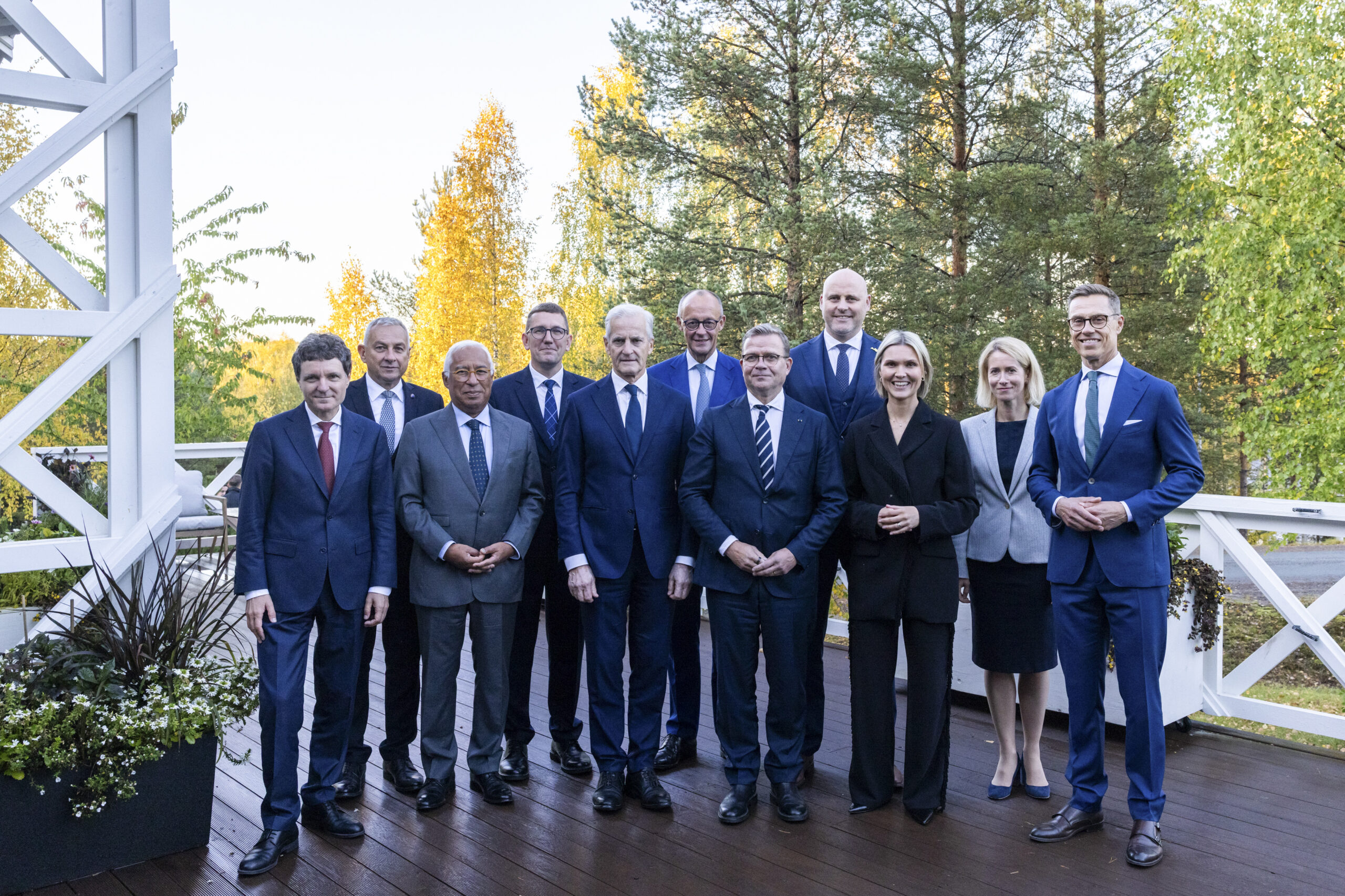
Brussels – The European Union must have a stronger presence in the European Arctic. This call has been made by 12 EU Member States (Finland, Denmark, Estonia, France, Greece, Germany, Latvia, Lithuania, the Netherlands, Poland, Romania, and Sweden) in a joint statement published on the occasion of the European Arctic Summit currently taking place in Rovaniemi, Finland. “We call on the European Union to take on a more strategic and proactive role in the European Arctic, and we are committed to strengthening the Union’s engagement in the Arctic in a coherent and forward-looking manner, with adequate resources and in line with the changing geopolitical realities. We agree on the need for the EU to step up its efforts to promote stability, sustainable development, and prosperity, while safeguarding its interests,” the declaration states.
The signatory countries look forward “with interest to the forthcoming joint communication from the European Commission and the High Representative on a resilient, secure, and peaceful Arctic,” due by the end of October. Above all, however, they emphasise that “the Arctic is undergoing rapid and profound transformation, with growing implications for Europe’s security and stability” and that “the intensifying competition between major powers, the consequences of Russia’s war of aggression against Ukraine, China’s growing interest in security policies, and the serious and accelerating impacts of climate change are reshaping the region’s strategic landscape.” In particular, “we note with grave concern the significant and long-term threat that Russia poses to Euro-Atlantic security” and “Russia’s ambitions to increase its influence in the Arctic, combined with its hostility towards Europe—including the rise in hybrid activities—highlight the need to strengthen the EU’s Arctic policy.”
This point was also highlighted by the EU High Representative for Foreign Affairs and Security Policy, Kaja Kallas. “We note that Russia is reactivating Soviet-era military bases and conducting missile exercises in the far north. We are also seeing growing interest from China in the region; we must therefore remain vigilant,” she said upon arriving at the summit. She added that the EU’s new Arctic strategy would be “centred on security, as the Arctic is clearly an integral part of the European security architecture” and “will, of course, also include concrete projects.”
The point that the signatory countries wish to emphasise is the view of the Arctic as a European issue, concerning all 27 Member States. “We emphasise that the European Arctic regions are an integral part of the European Union
“encompassing both land and maritime territories and including a long external EU border with Russia,” they write, adding that “security in the Arctic must be achieved collectively.” The northern front must be viewed in the same light as the eastern border or the Mediterranean. Therefore, in addition to the “need to increase investment in military mobility, cross-border connectivity, and the necessary infrastructure in the EU’s northernmost regions,” according to the twelve countries, “addressing critical and urgent needs—such as transport links, digital connectivity and satellite technologies and services—and strengthening Member States’ capacity to address hybrid threats is fundamental to European security and defence, including along the eastern flank.”
A concept embraced by the President of the European Council, António Costa. “What matters for the Arctic matters for all Member States of the European Union” and “what happens here is not a regional issue, but a European one. This means that Arctic security is European security,” he went on to explain. Therefore, “when we talk about security in the Arctic, we must adapt to the new geopolitical reality,” not least because the region “is, in fact, another victim of the weakening of the multilateral system” and “sovereignty and respect for territorial integrity can no longer be taken for granted, and fundamental concepts of international law, such as freedom of navigation, are being called into question.” A situation in which “Russia, the largest Arctic nation, is one of the main architects.” Costa supports the objective “of promoting coordinated action” and of “creating a network of partners stretching from the Baltic, through the Arctic and the North Atlantic, to ensure a comprehensive, rules-based approach to security and defence in the Arctic region.” The next step is the EU’s multiannual financial framework covering the period 2028–2034, in which “this new geopolitical reality will be reflected,” with a “consequent increase in investment in Europe’s security and defence, including the Arctic region.”
English version by the Translation Service of Withub


![Il ministro dei Trasporti, Matteo Salvini [Bruxelles, 5 dicembre 2024. Foto: Emanuele Bonini per Eunews]](https://www.eunews.it/wp-content/uploads/2024/12/salvini241205-120x86.jpeg)