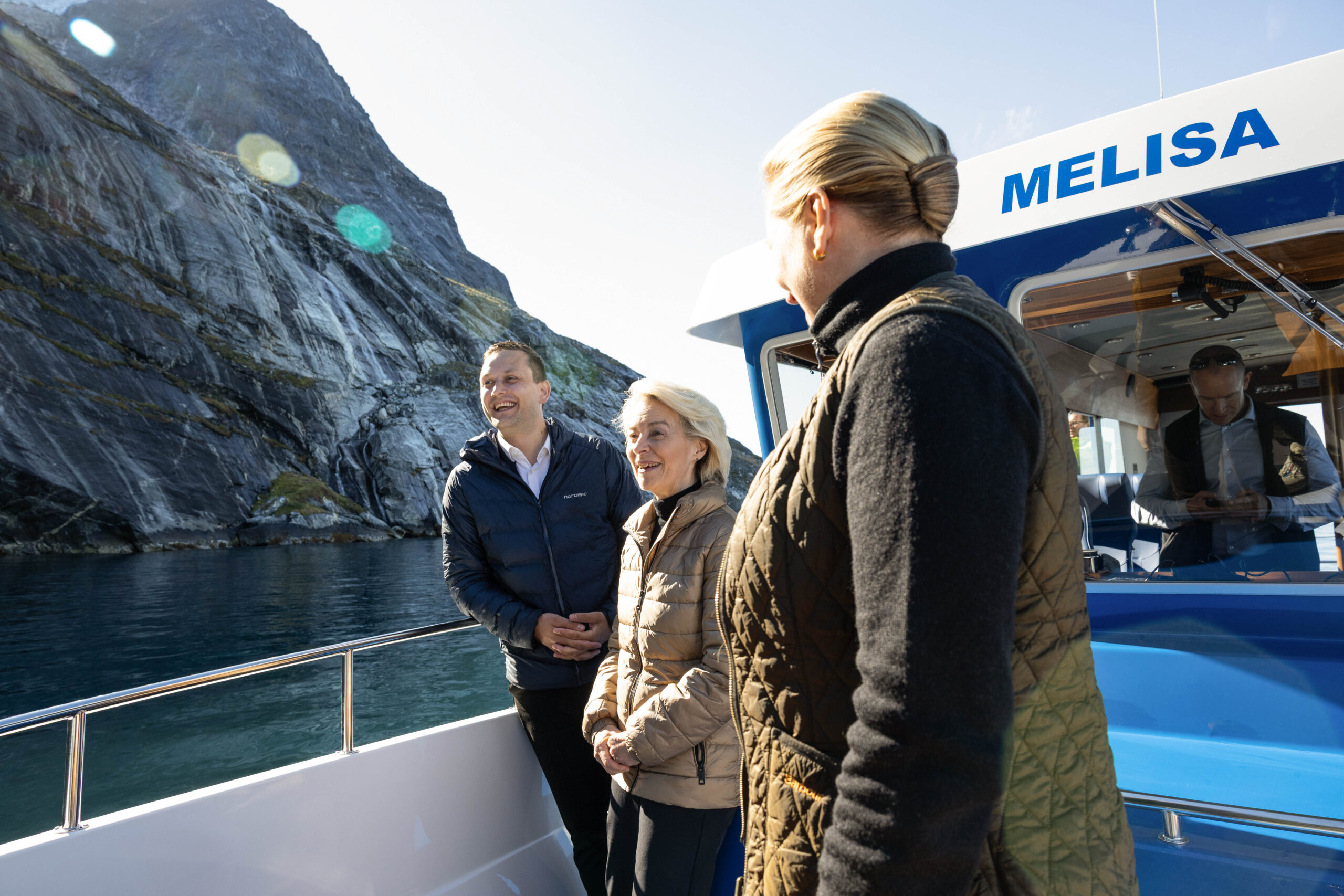
Brussels – Showcasing results and setting the agenda. The President of the European Commission, Ursula von der Leyen, is visiting Greenland, where she is, on the one hand, highlighting the “concrete results” achieved through “close cooperation” between the EU and the Arctic island, and, on the other, signing “a new partnership package with Greenland worth €200 million.” She announced it today (7 September) in Nuuk, the island’s capital, where she undertook an official visit alongside the Prime Minister of Greenland, Jens-Frederik Nielsen, and the Prime Minister of Denmark, Mette Frederiksen.
The aim, in addition to the 200 million “Global Gateway partnership package”, is to sign the joint declaration together with Greenland and Denmark to strengthen cooperation with the EU. According to the European Commission, the two initiatives reinforce “the EU-Greenland cooperation across the board, from traditional sectors such as education and fisheries, to improved satellite and cable connectivity, hydropower, and critical raw materials.” At the same time, the package aims to improve the daily lives of Greenlandic citizens by promoting, for example, “better housing, sustainable tourism, and greater support for small businesses.” To this end, von der Leyen recalled that two years ago, when she visited Nuuk for the first time, she had been urged to work towards achieving tangible results, and she claimed to be “ready” today to demonstrate them and to “put them into practice.”
The Joint Declaration
Among the objectives set by the three parties is to “strengthen the common investment agenda, political dialogue, and people-to-people exchanges, reaffirming a partnership based on shared values and interests.” Drawing inspiration from the previous 2015 Statement—which, like today’s declaration, had provided a framework for their relations—the new declaration recognises Greenland’s growing strategic importance. Further, it strengthens and expands the partnership in areas of common interest. The President stated that, on the one hand, the document “reflects a clear choice” on the part of Greenland “to strengthen ties with the European Union”, but on the other “it also demonstrates a very strong interest on the part of Europe in having made the choice to be more present and more engaged in Greenland and the Arctic.”
A new partnership package
The partnership package aims to create “economic opportunities for the local population, while contributing to a sustainable, prosperous, and peaceful Arctic region.” Among the numerous initiatives, an initial set of
Global Gateway
projects—the new European strategy aimed at promoting smart, clean and safe connections in the digital, energy, and transport sectors and at strengthening healthcare, education, and research systems worldwide—has already been agreed with the Nielsen government, with whom the Berlaymont is already working to explore a range of new investments.
According to the tenant of the Berlaymont Building, the package “focuses primarily on three areas or strategic priorities: connectivity, clean energy, and critical raw materials.” With regard to the first area, the three leaders welcomed “a project for enhanced satellite connectivity for Greenland.” The EU will work with Tusass, the island’s leading postal and telecommunications company, to support the expansion of satellite capacity across Greenland through European providers over the next five years. “The benefits will be felt as early as tomorrow in communities in North Greenland, which will have better and faster internet access,” said von der Leyen, while “by October, even remote communities in East Greenland will have better and faster internet access.”
As regards clean energy, the two sides are also considering expanding the Buksefjordn hydroelectric power station, Greenland’s main hydroelectric plant, to meet the growing demand for electricity in Nuuk. The Commission will also support a programme led by Nukissiorfiit, Greenland’s national energy company, to modernise and decarbonise the energy supply in remote settlements.
On the subject of critical raw materials, the President emphasised that “everyone knows that Greenland possesses vast resources” and for that reason, “they should be used to create value, jobs, and growth here in the country.” With this in mind, the government has announced that it is working on two projects. One concerns molybdenum mining at Malmbjerg, a chemical element used primarily as an alloying element to improve mechanical strength, hardness, and thermal stability of special steels, which “could become one of Greenland’s largest initiatives” and “generate up to €90 million a year for the country in terms of added value.” The second concerns the extraction of graphite, a key critical material for the energy transition, promoted by the company GreenRoc Strategic Materials. The EU and Greenland have agreed to use the remaining funds to accelerate preparations for several additional programmes in priority sectors, particularly tourism and housing.
At the end of her speech at the press conference, the Prime Minister explained that Greenland’s importance is a matter of discussion “also in the next budget,” referring to the ongoing negotiations for the next Multiannual Financial Framework (MFF), the European Union’s long-term budget, which sets out spending priorities and funding ceilings for the period 2028–2034. “We have proposed doubling EU funding for Greenland to €530 million in the next budget,” she clarified. “We want our partnership to be built for the long term,” she noted.
This is yet another step which, for Brussels, also serves to reaffirm the EU’s solidarity with the Kingdom of Denmark and the people of Greenland in the face of US President Donald Trump’s ambitions. “We will continue to do so, and we want to be very clear and reiterate once again here that the future of Greenland is a matter for the people of Greenland and Denmark—and no one else—to decide,” emphasised von der Leyen. “Territorial integrity, sovereignty, and the inviolability of borders are fundamental principles of international law, and we know that the Arctic has become one of the places where the tectonic plates of geopolitics collide. “We therefore have a direct interest in what is happening here” and “that is why we are drawing up a new EU strategy for the Arctic, which will be presented this autumn.” As part of von der Leyen’s and the EU’s plans, “it will set out our vision for the Arctic and for a stronger partnership with Europe’s northern neighbours,” the President concluded.
English version by the Translation Service of Withub


![Da sinistra: il presidente del Consiglio europeo, Antonio Costa; il presidente dell'Ucraina, Volodymir Zelensky: la presidente della Commissione europea, Ursula von der Leyen [Bruxelles, 18 giugno 2024. Foto: European Council]](https://www.eunews.it/wp-content/uploads/2026/06/euco_ua260618-120x86.jpg)
![[foto: Saverio De Giglio/imagoeconomica]](https://www.eunews.it/wp-content/uploads/2026/10/cpt-120x86.png)