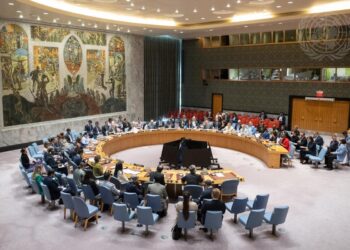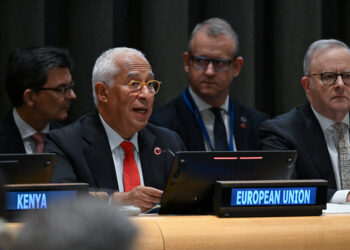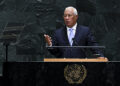
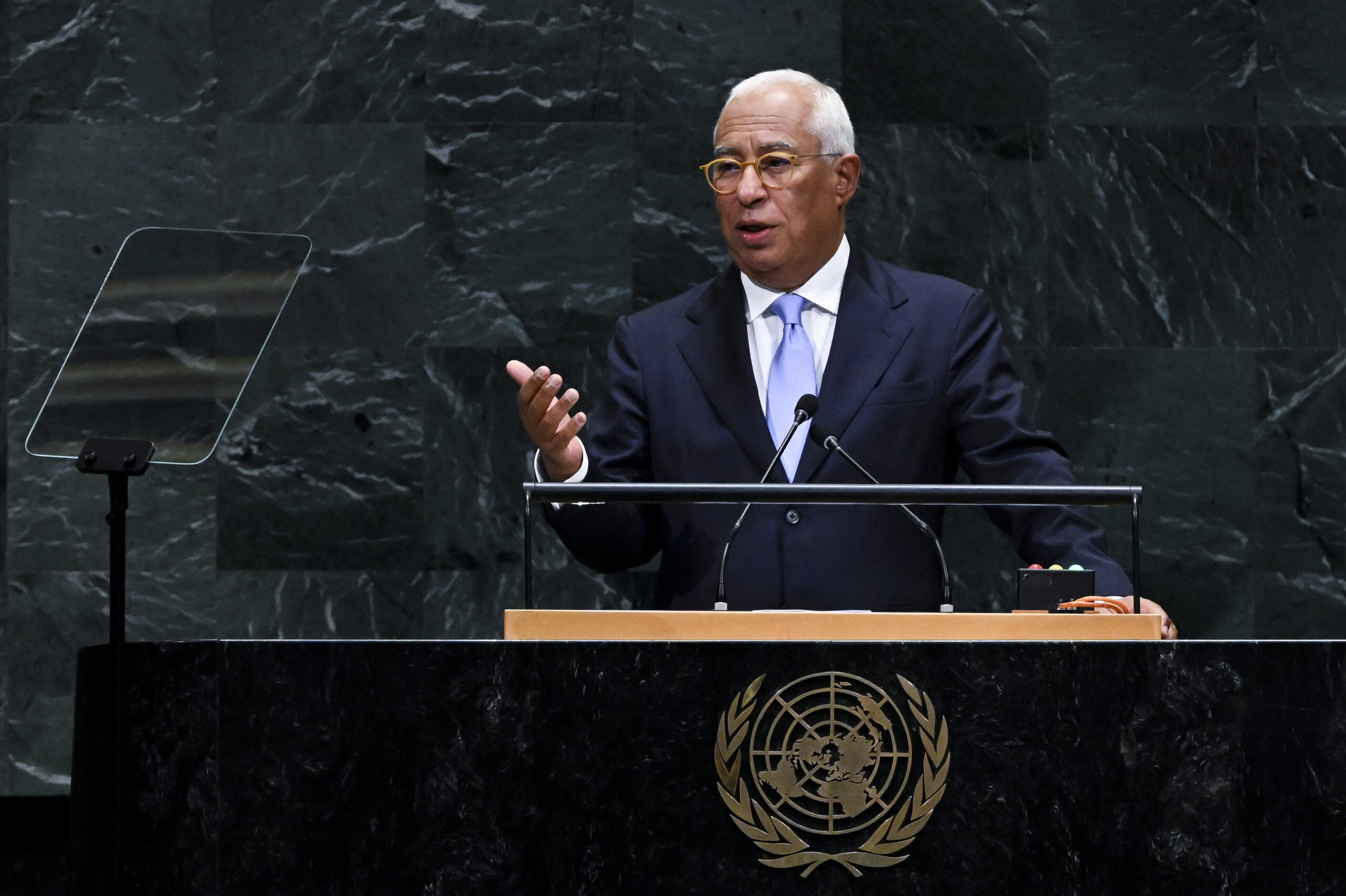

Brussels – Faced with the advance of artificial intelligence, pandemics, and the climate, food and financial crises, multilateralism is “the only realistic way to address the problems of today,” said the President of the European Council, António Costa, yesterday (24 September) in his address to the 81st United Nations General Assembly in New York. Faced with “pressure from geopolitical polarisation, financial constraints and institutional shortcomings” the response cannot be “withdrawal.” Instead, the solution is to “ reform, renew and reinvest,” which is why “the European Union continues to call for a comprehensive reform of the UN Security Council.” The aim? To make it “more effective, inclusive, democratic and accountable,” the President explained.
According to Costa, in addition to reform, today’s challenges also require “an ambitious leader, firmly committed to the principles of the UN Charter and to respect for international law, like António Guterres.” On 31 December 2026, the second (and final) five-year term of the current United Nations Secretary-General will end. His successor “will have to continue to fully mobilise all instruments at their disposal to prevent conflicts, mediate in crises and build peace, with a particular focus on Ukraine, the Middle East and Sudan,” Costa noted.
The Portuguese official took the opportunity to announce that this week the EU “has launched, together with Australia, Barbados, Brazil, Canada, India and Kenya, the P4M: Partners for Multilateralism, International Law, Peace and Prosperity,” an open platform for those wishing to “defend common principles and work towards practical solutions,” he explained, inviting those present in the chamber to join.
According to Costa, international law is something that “applies everywhere”, just as “human rights apply everywhere: in Ukraine, the Middle East, Africa, Asia and in Latin America”. As for the war launched by the Kremlin against its neighbour, “it is unacceptable that, over the past 12 months, Russia has repeatedly threatened the security of the EU’s member states,” and Moscow “must stop this dangerous escalation.” In this context, Costa appealed to the international community before the UN audience to “ must use every lever at its disposal concerning Russia to put a stop to this war and create the conditions for negotiating a comprehensive, fair and lasting peace” because “this war must end.” The same applies to the Middle East. “We regret the current stalemate in Gaza, and in Palestine more broadly, which is prolonging the suffering of millions of civilians, despite the momentum to end the conflict which seemed to be emerging last year. The EU and its member states have a clear position: the two-state solution, which is the only solution that can ensure lasting peace in the Middle East,” he stressed. As regards Iran and the Strait of Hormuz, “the ceasefire must be fully observed” and “freedom of navigation in the Strait of Hormuz must be preserved, unconditionally and without hindrance,” he said, recalling that “Iran must never be allowed to acquire a nuclear weapon.”
Finally, Costa reaffirmed his support for the International Criminal Court. “There can be no double standards when it comes to international law,” especially now that “we are witnessing deliberate violations of international law,” referring to the Trump administration’s attacks on the International Criminal Court. “It is unacceptable to threaten or attack the International Criminal Court, its officials and its staff,” he warned, noting that “international law applies everywhere,” whether in “Ukraine, Middle East, Africa, Asia or Latin America,” he concluded.
English version by the Translation Service of Withub