Brussels – EU economy and finance ministers reached an agreement on European supervision of financial markets: the European Securities and Markets Authority (ESMA) will be able to replace national authorities only for the largest and most significant entities. This is the central point of the agreement reached during today’s (9 October) Ecofin Council meeting on one of the European Commission’s proposals, which is regarded as key to completing the capital markets union.
It is a compromise, of course, but not a foregone conclusion, given that the ministers had previously expressed their opposition to European supervision. In the end, the decision was made to opt for partial supervision, with ESMA overseeing the most significant cross-border trading venues and the most significant post-trade entities, such as central securities depositories (CSDs) and central counterparties (CCPs).
The governments’ proposal prevails; the states rejoice
The agreement follows the model adopted when the EU launched the banking union process, with direct supervision by the ECB of only the largest banks, the “systemically important” ones, which are therefore more difficult to rescue in the event of a liquidity shock. Italy and its Minister for the Economy, Giancarlo Giorgetti, welcome the solution: “Centralisation must focus on the activities and infrastructure for which a European dimension to supervision delivers real added value,” to have an architecture that is “proportionate” and capable of “taking national specificities into account.” In this regard, the Finance Minister stressed, “I believe the compromise is a great political success,” during the public session of the proceedings.
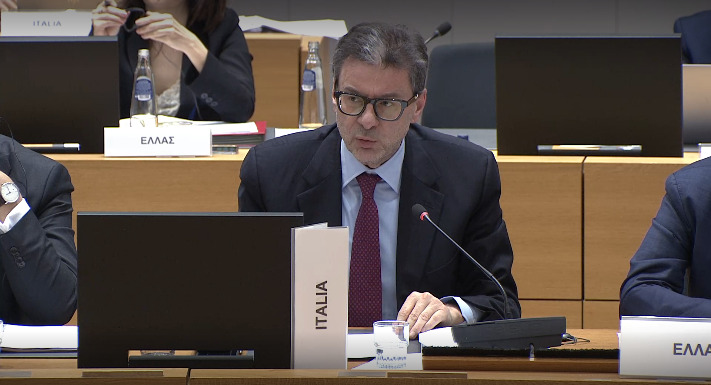
The package, Giorgetti goes on to explain, “strengthens the integration of European markets and provides ESMA with broader responsibilities and a governance structure better suited to exercising them”. As for Italy, he continues, “we are in favour of a functional governance structure that gives adequate weight to the Executive Board without, however, requiring us to relinquish the powers currently held at the national level.” Now, he warns, “the quality of European supervision will also depend on the ability to incorporate, in a structured manner, knowledge of local markets and the experience of national authorities.”
The Dutch Finance Minister, Eelco Heinen, is also pleased: “With this agreement, we are moving in the right direction.” Meanwhile, the German Finance Minister, Lars Klingbeil, has no doubts: “This agreement is a game-changer.” The French Finance Minister, Roland Lescure, spoke of “good work.” Austria is not entirely satisfied, but “in the spirit of compromise, we support this text,” conceded Minister Markus Marterbauer. Belgium did not endorse the compromise, abstaining due to doubts that remain unaddressed.
National competence preserved, Commission “deplores” the compromise
The issue of national competences was at the heart of a debate that drew resistance from virtually all sides. The group of countries calling for national safeguards against pan-European centralisation was large (Austria, Belgium, Denmark, Finland, Italy, Latvia, Lithuania, Luxembourg, Malta, Poland, the Czech Republic and Sweden, with reservations also expressed by the Netherlands, Romania, and France). The Irish Presidency of the Council of the EU had to devise a compromise proposal to make an agreement possible.
Based on the agreed-upon general approach, the text ensures a role for national authorities while maintaining a separate Board of Supervisors, which would remain ESMA’s primary body for regulatory decisions, strategy, the budget, and supervisory convergence. The Management Board would also make recommendations on the decisions of the Board of Supervisors addressed to the competent authorities, including in relation to the resolution of disputes and infringements of Union law.
The European Commission, however, is not at all pleased with the compromise: “This lowers the level of ambition of the package and undermines its rationale,” said the Commissioner for Financial Services, Maria Luis Albuquerque. While representatives of national governments are celebrating, the European Commission takes a different view. “The Commission deeply regrets this compromise,” Albuquerque added, stressing that “the Commission had called for the entire sector of crypto-asset providers to be subject to ESMA supervision, whereas only some will now be covered.”
The ECB also has reservations
It is not uncommon for senior officials from the European Central Bank to participate in Eurogroup and Ecofin meetings, but it is less common for ECB presidents to speak. More often than not, the current president, Christine Lagarde, has left it to her deputy to take the floor. On this occasion, however, she herself asked to speak after the French and German ministers to take the governments to task: “I share the concerns regarding governance and scope” of the new rules, she stressed. She then warned: “The use of different distributed ledger technologies (DLT) risks creating new fragmentation,” the exact opposite of what the proposal for a capital markets union should aim to achieve.
DLTs are IT systems that use a shared, replicated and simultaneously synchronised database. They make it possible to overcome fragmentation. These technologies are fundamental to the digital economy and digital transactions, as they could become the de facto operating system of the financial markets.
There is still further work to be done to finalise the package, but the agreement reached at the Ecofin Council appears far from being a genuine victory. Europe is currently being driven by its member states, with a disconnect between the Council, on the one hand, and the Commission and the ECB, on the other. All eyes are now on the Parliament.
English version by the Translation Service of Withub
![La riunione dell'Ecofin [Bruxelles, 5 maggio 2026. Foto: European Council]](https://www.eunews.it/wp-content/uploads/2026/05/ecofin-260505-350x250.jpg)
![Maria Luís Albuquerque, commissaria per i Servizi Finanziari e l'Unione del Risparmio e degli Investimenti [Bruxelles, 4 dicembre 2025]](https://www.eunews.it/wp-content/uploads/2025/12/albuquerque-350x250.png)