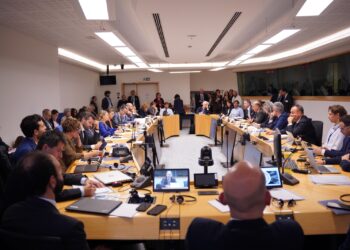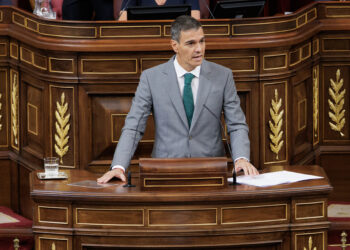
Brussels – The Italian financial sector brings its blueprint for reviving the European economy to Brussels. The president of the ABI, Antonio Patuelli, the president of ANIA, Giovanni Liverani, and the president of FeBAF, Fabio Cerchiai, presented a document to the EU institutions during a mission to the Belgian capital, setting out a path to “support growth, competitiveness and strategic autonomy,” according to a joint statement from the associations. FeBAF, along with ABI and ANIA, brings together 10 other organisations in the sector.
The document, presented to the European Parliament, is intended as a roadmap for the second half of the parliamentary term and centres on three interlinked priorities. To give an idea of the sector’s significance, the associations cite figures for the end of 2025: in Italy, bank lending to households and businesses amounts to around 1,290 billion euros, insurance companies’ investments to 1,050 billion euros, while claims paid out exceed 42 billion euros.
The first concerns the competitiveness of the European financial system. According to the document, this requires overcoming market fragmentation, completing the Banking Union, ensuring more efficient management of capital and liquidity, and recognising insurance companies as long-term investors. The associations stress that all this must be achieved without compromising financial stability and consumer protection.
The second is the implementation of the Savings and Investment Union (SIU) to channel savings into productive investments. European households hold around 41,000 billion euros in financial assets, and to mobilise these, the organisations are calling for tax incentives for medium- and, above all, long-term investments, a strengthening of supplementary pensions and more financial education. A key role is assigned to savings and investment accounts, which are to be rolled out across Europe through national frameworks flexible enough to accommodate the specific characteristics of individual countries and their different distribution models. The document also calls for expanding opportunities in infrastructure, innovation and SMEs, including through public-private partnerships and risk-sharing.
The third is a concrete agenda for regulatory simplification: “simpler, more consistent and proportionate” rules, fewer instances of duplication in reporting requirements, and impact assessments of regulation’s effects on competitiveness and on the financing of the economy. The associations are also calling for the rationalisation of regulations on sustainable finance and digital innovation.
The organisers conclude that the mission reaffirms the sector’s commitment to contributing to a shared agenda with European and national institutions to support businesses and households and strengthen Europe’s strategic autonomy, “while preserving financial stability and protecting savers.”
English version by the Translation Service of Withub