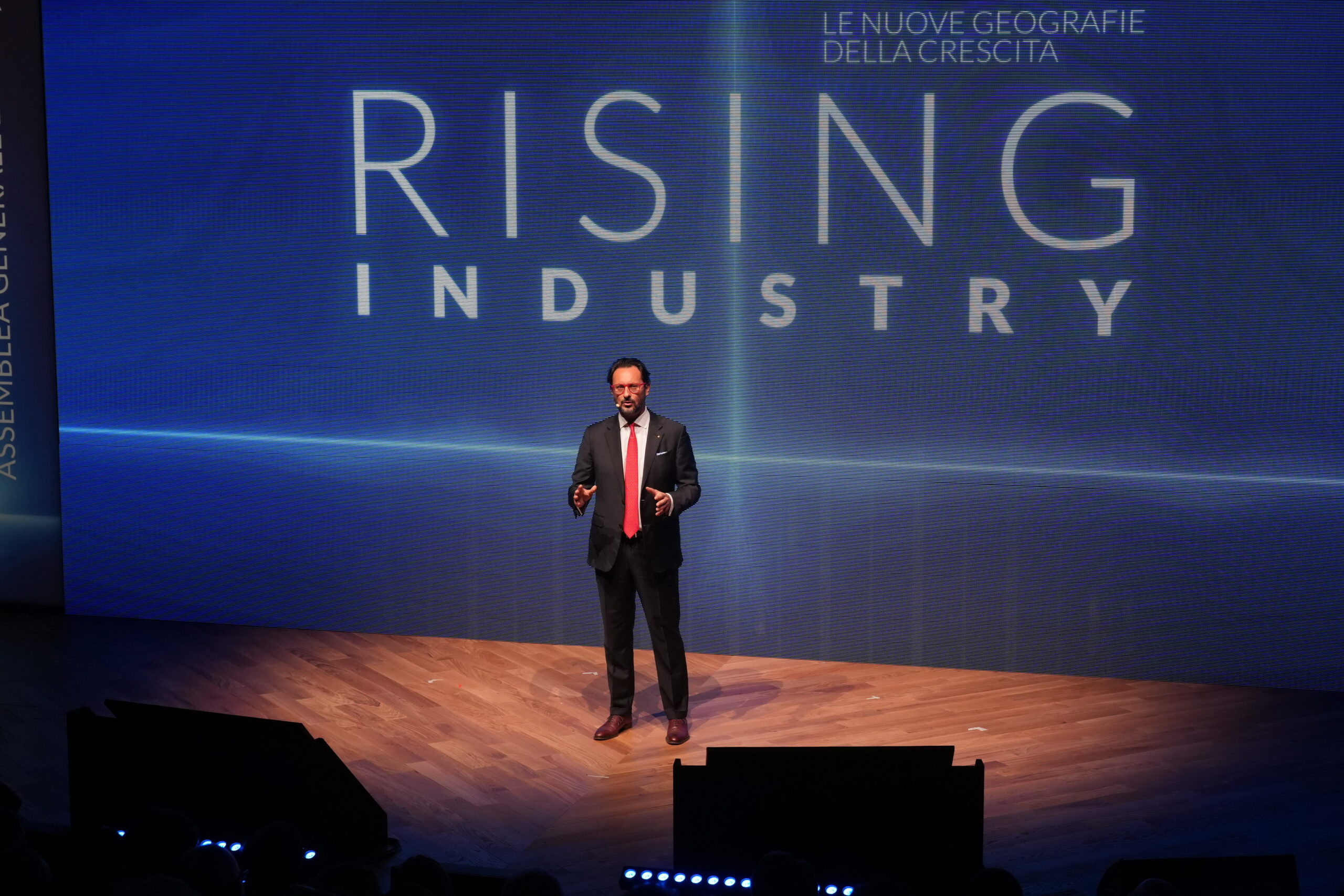
At the Teatro Dal Verme, in front of Prime Minister Giorgia Meloni, Alvise Biffi chose a precise image: physical AI, artificial intelligence that steps out of screens and into factories, robots and warehouses. The president of Assolombarda observed that California produces ideas and patents at a pace Europe cannot match, but converts a surprisingly small share of those inventions into real industrial products. It is in that gap between invention and industrialisation that Biffi locates the Italian opportunity: not to chase the United States and China by copying their model, but to hold the ground where mechatronics, sensors, machine tools and decades of accumulated factory knowledge count.
Two days later, at the Hotel Quisisana in Capri, the Young Entrepreneurs of Confindustria opened their annual conference, entitled StrategIA, with words that run parallel to Biffi’s. President Maria Anghileri spoke of Italian productivity that has stood still for twenty five years, and of artificial intelligence that, applied with care in small and medium sized firms, could set it moving again. She put forward a concrete proposal, an AI special economic zone (a Zes dell’IA) together with a national steering committee, and set out a principle that serves as a generational manifesto: Italy must not be reduced to playing digital waiter to Washington and Beijing.
The two voices, that of big Lombard industry and that of the young entrepreneurs gathered in Capri, draw the same map from two different latitudes. Biffi speaks of mechatronics as a seam to be mined; Anghileri speaks of an AI supply chain to be built before others build it for us. Where they join is the conviction, at last no longer merely political, that Italian industrial know how, protected in its intellectual property and in the confidentiality of its data, is oil still to be extracted.
A sharp change of perspective is needed here. This is no longer just a wish addressed to governments or to Brussels. It is a direct invitation to those who are today between twenty five and forty to take back a role that over recent decades has too often been delegated. Young Italian entrepreneurship needs to leave behind a logic of protection, a babysitting that the larger industrial system, the trade associations and in part the state have provided with good intentions but with the side effect of slowing the decision making autonomy of the youngest. The demographic picture of Italian entrepreneurs under forty remains favourable: there is still room, and still useful time, before the transition between 2030 and 2050 closes without Italian protagonists.
Comparison with the rest of Europe shows how narrow the window is. In France new businesses are still born in solid numbers, but turning them into high productivity industrial growth is proving hard: startups multiply, supply chains much less so. Germany protects its historic manufacturing core, the Mittelstand included, but does not generate with equal intensity a new young entrepreneurial geography able to renew it from within. Spain suffers from private spending on research and development of less than half the EU average, a structural limit that weighs on its young founders’ capacity to scale beyond the initial phase. In the United Kingdom, outside the Union but still the reference point for European risk capital, the generation of technology founders continues to benefit from a deep financial ecosystem, a competitive advantage the continent has yet to close.
The Nordic area tells a different and instructive story. In Finland the minimum capital for setting up a company has been abolished, and the country stands out as the most receptive in the region to young entrepreneurship, with a marked vocation for deep tech, digital health and applied artificial intelligence; Helsinki, Oulu and Tampere now form a technology axis recognised across Europe. Sweden remains the market where the region’s largest pool of early stage capital is raised, direct heir to Spotify. Norway, strong in maritime and energy skills, is steering young founders towards clean tech and deep tech applied to the offshore sector. These are small economies that chose to specialise rather than chase every frontier at once: a lesson that Italy’s industrial fragmentation would do well to heed.
In the east, the centre of gravity is shifting faster than Italian public opinion perceives. Poland is going through a phase of industrial expansion driven by European nearshoring, with manufacturing output growing steadily in 2026 and a fabric of technology parks and incubators increasingly populated by Polish and foreign founders under thirty. Warsaw and Kraków are no longer merely sites for low cost relocation of production, but are becoming laboratories of advanced manufacturing enterprise.
And then there is the eastern shore of the Adriatic, an area that Italian industry still views mainly through a commercial lens, when it deserves to be seen as an equal industrial partner. The European Commission’s Economic and Investment Plan for the Western Balkans puts thirty billion euros on the table, a third of the whole region’s GDP, aimed also at small and medium sized firms and young entrepreneurship. Croatia, Montenegro, Albania, Serbia and Bosnia and Herzegovina are moving closer to the Union, a process that, if accompanied by targeted Italian industrial investment and not only by financial capital, could within ten years produce an integrated Adriatic manufacturing supply chain, with Italy as its natural technological shore.
Returning to Capri and the Dal Verme: the real capital that Biffi and Anghileri have put on the table, beyond their respective industrial agendas, is the awareness that the historic window is open but will not stay so indefinitely. Young Italian entrepreneurs have the age, they have in part the financial and regulatory instruments the state is preparing, and ahead of them lies a period, between 2030 and 2050, in which Europe’s industrial map will be redrawn regardless, with or without Italian protagonists. The question this reflection leaves open is not whether artificial intelligence applied to industry is an opportunity; by definition, it already is. The question is whether the most youthful part of the country’s entrepreneurial leadership will stop waiting for permission to seize it.