When August arrives, the continent splits into two categories: those who vanish, as I do, for weeks on end, like Pedro Sánchez, who allowed himself five this year between Doñana and Lanzarote, and those who never really switch off.
Ursula, Uschi to family and friends, von der Leyen belongs to the second species. No official residences, no exotic coastlines: for years the formula has been the same, a few days in Lower Saxony with her husband Heiko and their seven children, a social media photo leaning against a tree trunk with reading glasses perched on her nose, a book in hand and a caption on the pleasure of summer reading. It is the image of a Lutheran German work ethic made flesh, a quiet reproach to anyone who allows themselves to be away from the files for whole weeks.
These are the occasions on which she sets aside the baronial lineage acquired through her husband: noble stock attributed to his family of silk merchants as early as 1786, formalised by a Napoleonic decree in 1813 and subsequently confirmed by the King of Prussia three years later. It should be noted that another branch of the Leyen family has grander, princely origins dating back to the tenth century, but it is not his.
Yet once she steps outside the banality of the Urlaub, that sacred holiday for her compatriots, most of whom migrate south to “top up on sunshine”, she reverts to being the austere Ursula Gertrud Albrecht, a condensed dose of Germanness. Even during her brief, measured summer break.
The fact that her State of the Union address arrives punctually every mid-September, with her already back at her desk while other leaders are still drying off in the sun, says more about the woman than a thousand interviews. She had stayed on in Brussels until 12 August, with the institutions emptied out by the summer break from 21 July, the key date when holidays begin in the city. A couple of social media posts and a wish for everyone to rest and recharge…
For her, it is simply the time needed to polish #SOTEU, the traditional annual State of the European Union address, delivered during the European Parliament’s first session back. Ten points, certainly not revolutionary, but enough to serve as a thermometer placed in Europe’s body, useful for reading direction, resolve, strength and possible commitment over the short term ahead. A calling card for the year to come; a card of apologies and good intentions, stating that what has not been done may yet be done, or may simply be redirected.
In short: a tacit request to extend another year of credit to the institution. What follows is not a belated account of what was delivered and read out in Strasbourg at 09:00 on 16 September, but a check, some ten days on, of what remains in the sieve of memory, stripped of the formalities and the acrobatics of switching languages to flatter and respect the cultural powers in the chamber.
Here, then, are the remnants left in the sieve, reread through the lens of Uschi’s Christian Democrat formation and the streaks of the social market economy that this same formation has inevitably left in her.
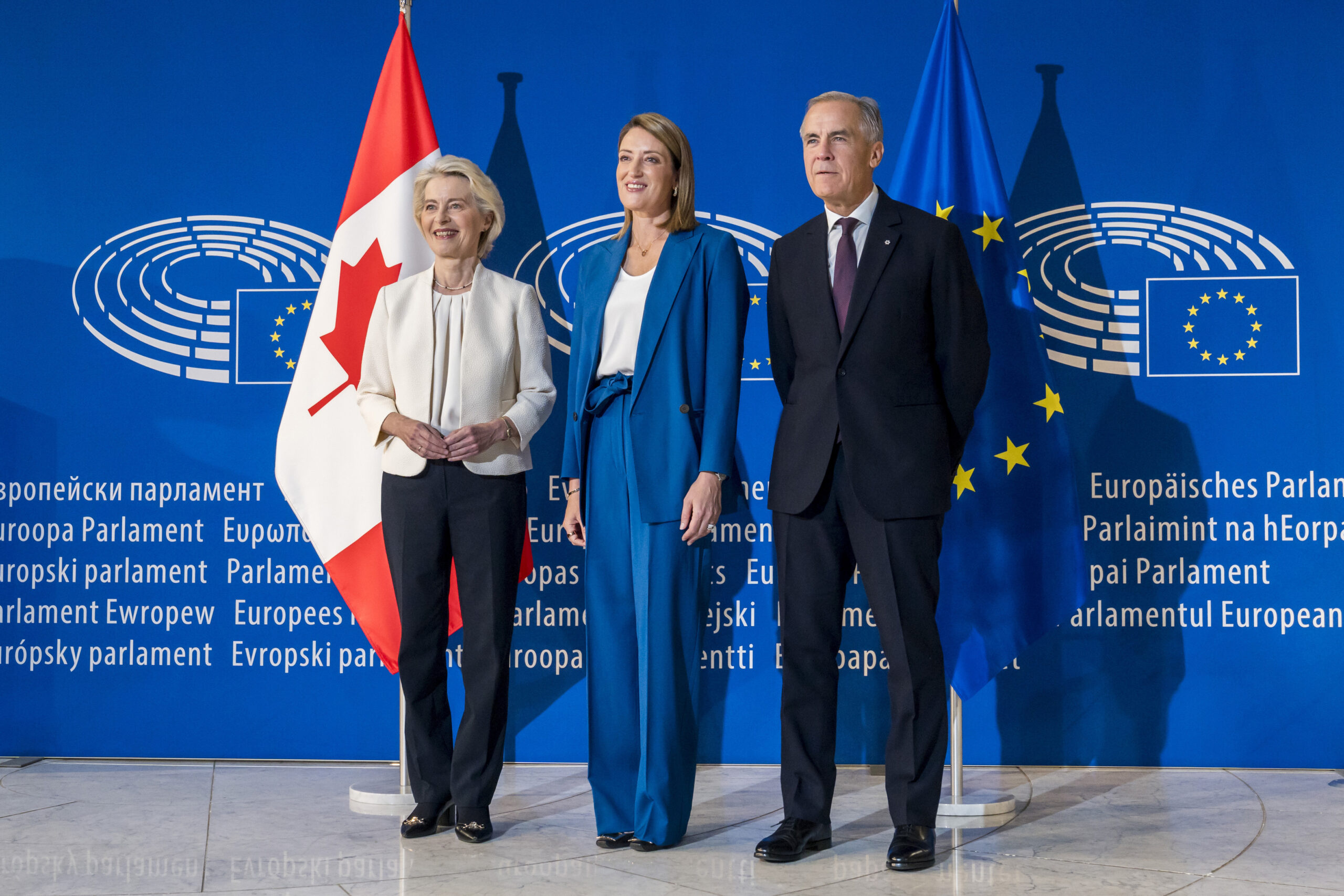
Canada. The offer of a strengthened partnership with Ottawa, marked by an embrace of Mark Carney in the chamber, is the most liberal move of the speech: trade openness, a democratic alliance against Trump. From the left, one can only applaud, provided it does not become a pretext for sidestepping the social and environmental clauses that the CETA agreement still carries unresolved.
European security council. An Atlanticist framework, almost Gaullist in its language, von der Leyen-esque in substance. It is objectively hard not to see in this security-led assertiveness an echo of old Christian Democrat Realpolitik, the kind practised by Helmut Kohl, rather than a genuine common foreign policy with a parliamentary base.
EU Kids Act. Here the classic liberal grain gives way to a daring, almost social democratic smile: reversing the burden of proof onto the platforms, treating child protection as a public good. It is the point most consistent with the 1980s CDU-style social market economy, the kind that was not afraid of regulation when it served to protect the individual, or the family.
Ceuta and migration. The figures on reduced arrivals are recalled and cited as a success, but the new emergency mechanism risks being just another security shortcut dressed up as technical management. From a strictly rights-based and legal perspective, the question remains the same as ever: where are the legal channels, and what are they?
Artificial intelligence. Measured words, no binding commitment. “Frontier notwithstanding” sounds good at Brussels conferences but, bitte, it leaves Europe’s industrial lag behind Washington and Beijing untouched. The liberalism here looks more rhetorical than regulatory.
China. Tones of a contained trade war, with the figure of a billion-euro daily deficit brandished as a negotiating club ahead of Šefčovič’s mission to Beijing. Consistent with the muscular line already seen at the June G7, less consistent with the idea of a Europe that should compete by opening markets, not merely protecting them. General caution while awaiting the actual outcome of the Xi-Trump meeting.
Israel and Russia. The weakest chapter, almost an admission of impotence. No new sanctions, only a call to close existing loopholes. From a socialist standpoint, this is the speech’s biggest disappointment, yet another proof that on foreign policy, unanimity blocks everything. So much for a common defence policy, and for the drones flying freely over the Union’s skies.
Simplification. Twelve omnibus bills aimed at cutting bureaucracy, seventeen billion euros of promised savings, no operational detail. This is the speech’s most typically ordoliberal point, and also its emptiest: deregulation as mantra stands in for the public investment that the social market economy would otherwise prescribe as a counterweight. A reminder, courtesy of Wikipedia, that ordoliberalism “is an economic and political theory born in Germany that assigns the state the task of setting strict rules to make the free market function and prevent the emergence of monopolies.”
Climate and the “summer of truth”. Thirty-five thousand heat deaths, ruined harvests, six hundred and sixty thousand hectares burned: numbers fit for a war bulletin. The Climate Insurance Alliance and the heatwave plan point in the right direction, but they remain insurance against damage already done, not structural prevention. Here the environmentalist left would have wanted far more: not insurance but a change of model. Others wanted a modernist redesign of climate policy, again with little regard for the internal currents within various countries.
Congress of Europe 2027. A solemn, almost visionary close, marking the Rome anniversary. Evocative but, in general perception, vague: a long-term promise that allows the present’s urgencies to go unanswered.
Whoever followed it alongside me, a distinguished politician and academic, analysed it through the lens of the social market economy, a model we discussed as recoverable for the Union. Consistency with this doctrine is evident only in patches. The chapter on minors is pure Christian Democrat schooling; the one on simplification winks at an ordoliberalism (cited above) close to Erhard, the German economist who was also a leading politician in federal Germany in the early Sixties and Konrad Adenauer’s absolute trustee on the economy for fourteen years. The rest oscillates between geopolitical aspiration and management of the status quo, without the distributive courage that the liberal left would like to see.
Commenting on #SOTEU, the Financial Times dwelt on the steep bill for the summer fires, three billion euros according to its own analysis cited in the speech, reading the Climate Insurance Alliance as an implicit admission that Europe is already paying for past inaction. Le Monde and the German press emphasised the Canada chapter as a sign of the transatlantic crisis triggered by Trump, rather than as a European negotiating win. The Spanish press, mindful of Ceuta, viewed the new migration emergency mechanism with suspicion. From Washington, official silence: the Trump administration made no direct comment, busy in those very days preparing for the summit with Xi Jinping, though some commentators close to the White House read the thrust against China as a belated, almost opportunistic alignment with the protectionist line already imposed by Washington.
Not a historic speech, certainly. Many diplomats judged it a compilation exercise. Journalist and commentator friends found it, in the trade’s own jargon, simply “cover”, with no real hint of political suggestion. On the rest of the world, little; almost no effect at all. While von der Leyen spoke in Strasbourg, the true centre of gravity of world power was already shifting elsewhere: a few days later Trump and Xi exchanged promises of cooperation and “healthy competition”, sketching out a bilateralism in which Europe remains, still, a mere spectator. That is the whole paradox: a speech that wants to be a manifesto of strategic autonomy arrives at the very moment when the two superpowers are redrawing the balance of power without even consulting Brussels. The Union can write the rules on social media for thirteen-year-olds, but it still cannot take a seat at the table where the future of trade and global development is decided.