Brussels – The European Parliament has taken the first step towards the cancer action plan, but deep divisions remain over how best to prevent the disease. The Committee on Public Health (SANT) today (28 September) approved the report on the implementation of the European Beating Cancer Plan (BECA), the European plan launched by the Commission in 2021 to strengthen cancer prevention, diagnosis, and treatment. The text was adopted with 27 votes in favour, 8 against and 5 abstentions and will now be put to a vote in the European Parliament’s plenary session, expected between October and November.
The vote in the SANT Committee revealed a commitment to allocate at least €10.05 billion to health in the EU’s next multiannual budget, of which €2.5 billion would be earmarked for measures to combat cancer. The committee’s approval comes less than two weeks after Parliament approved its strategy for the prevention of cardiovascular diseases by a large majority: 545 votes in favour, 47 against and 75 abstentions. These two dossiers share many of the same risk factors – tobacco, alcohol, diet, and lifestyle – but their formulations do not always overlap. And it is precisely on this issue that, in recent weeks, a debate has flared up between the political groups.
Prevention at the heart of it
In the BECA text, prevention remains the starting point. For the rapporteur and Renew MEP, Vlad Vasile-Voiculescu, “it should be at the heart of the plan” because around 40 per cent of cancers could be prevented by addressing the main risk factors, from vaccination to tobacco, from alcohol to diet and obesity. “Europe treats too much and prevents too little,” explains the MEP in an interview with Eunews, echoing the words of the European Commissioner for Health, Olivér Várhelyi, which today launched the European week dedicated to the prevention and early diagnosis of cardiovascular diseases. “Prevention is the most effective anti-cancer policy we have,” agrees Nicolas González Casares, Socialist MEP, in an interview with Eunews.
The rapporteur’s priorities also include equitable access to care and compliance with the European targets already set. “Regardless of which EU country a child is born in, everyone must have the same chance of survival,” he argues. The report therefore calls for a reduction in inequalities in access to screening, diagnosis, and treatment, and for 90 per cent of patients to have access to National Comprehensive Cancer Centres by 2030.
Food: prices, labelling, and ultra-processed foods
Prevention also depends on the environment in which people make their dietary choices. According to Casares, “people don’t eat unhealthily because they want to. They do so because of prices, availability, and marketing.” Hence the call to use regulation, taxation, and clear labelling to change that environment.
The report calls in particular for harmonised and mandatory nutritional labelling on the front of packaging, based on scientific evidence. Voiculescu also emphasises the issue of ultra-processed foods, for which, he says, “we need a proper European assessment,” looking at the health effects on children and adults.
According to the speaker, public health and economic sustainability “are not opposites, but rather conditions that are necessary for one another.” Casares, on the other hand, emphasises the role of information: “Having information based on scientific evidence does not limit freedom of choice. It protects it.”
Alcohol: educating rather than banning
On the subject of alcohol, the text calls for clearly visible health information on drinks, a review of the European strategy and measures to reduce exposure to marketing, as well as a target of zero consumption for minors. In an interview with Eunews, Green MEP Tilly Metz, who has been involved in the work on the dossier, starts from the scientific evidence: “Every glass of wine contains ethanol, and ethanol is harmful to health.”
In the MEP’s view, alcohol remains an exception compared with other consumer products because it does not provide citizens with sufficiently clear information on the risks. “How is it possible that alcoholic drinks are still the only exception amongst the products we consume for which we lack the necessary information?” she asks. Hence her call: “We simply must introduce this label”.
Metz points out, however, that she does not support a blanket ban on alcohol. “I am not in favour of a ban on alcohol. That is not the solution”, she says. The aim, she explains, is to enable consumers to make informed choices based on scientific evidence.
Casares, on the other hand, frames the issue in terms of the right to information: “There is no safe level of alcohol consumption,” he argues, adding that members of the public have the right to know what the science says about the risks.
Tobacco and nicotine: flavourings are the red line
It is, however, on the issue of nicotine that the debate becomes most heated, particularly regarding flavoured products and their ability to attract younger people. The report calls for the
European tobacco legislation to be updated “urgently” to include e-cigarettes, heated tobacco products, and nicotine pouches, with restrictions on flavourings, plain packaging, mandatory ingredient labelling and a ban on the online sale of nicotine products to minors. MEPs are also calling for higher minimum excise duties on tobacco and nicotine.
Voiculescu advocates for regulation to be extended to new products: “The EU should regulate them for what they are: nicotine products designed to create and maintain addiction.” Risk differentiation, he adds, “is a legitimate concept in policies designed to help people quit smoking; it is not a licence to create a new generation of nicotine-dependent people.”
Metz is calling for greater harmonisation of European rules on taxation, marketing, age limits, pricing, and permitted flavours. On the subject of high-concentration nicotine pouches, she goes so far as to say: “I think they are clearly very dangerous” and that she would prefer “a European ban on them.”
Casares is even more forthright on the issue of flavourings: “Flavourings are designed to attract children. Only a Europe-wide ban can stop them.” According to the MEP, the fragmented rules across Member States are not enough to counter marketing aimed at young people.
Two approaches to prevention?
It is here that the comparison with the cardiovascular dossier becomes most apparent. For Voiculescu, however, the two reports are not contradictory but “complementary”: “We started from the same conviction: Europe treats too much and prevents too little.” The difference lies in how risk is assessed: “In cardiovascular risk, dose and gradient are key. When it comes to carcinogens, science is less lenient: no nicotine product has been shown to be safe over a lifetime.”
Metz, on the other hand, refers to a different degree of impact: “The impact of these risk factors on cancer is more direct,” while emphasising that both reports identify the same main risk factors. According to Voiculescu, prevention, regulation, and information must go hand in hand. “We must regulate the product and the environment to reduce harmful exposure and limit its availability. We must make healthier alternatives more readily available, accessible, and appealing. And we must ensure that consumers are informed and educated.”
Finally, the report also addresses the quality of life of patients and survivors, calling for more rehabilitation, psychosocial support, integration into the labour market, and full implementation of the “right to be forgotten”. For Voiculescu, however, the crucial point remains the continuity of the plan: “A plan that ends when its funding runs out is not a plan, it’s marketing.”
The matter now passes to the European Parliament’s plenary session, where the text could reignite the debate amongst the political groups, particularly on tobacco, nicotine, alcohol, and nutrition. The vote in the SANT committee showed that differences on prevention are not confined to the majority and the opposition, but run across the political groups themselves. Within the EPP, in particular, the debate on the report had already brought different positions to the fore. It will therefore be up to the plenary to decide whether the balance achieved in committee will hold up before the entire Parliament.
English version by the Translation Service of Withub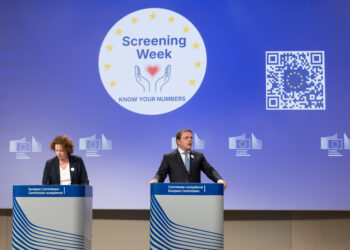


![Da sinistra: il presidente del Consiglio europeo, Antonio Costa; il presidente dell'Ucraina, Volodymir Zelensky: la presidente della Commissione europea, Ursula von der Leyen [Bruxelles, 18 giugno 2024. Foto: European Council]](https://www.eunews.it/wp-content/uploads/2026/06/euco_ua260618-120x86.jpg)
![[foto: Saverio De Giglio/imagoeconomica]](https://www.eunews.it/wp-content/uploads/2026/10/cpt-120x86.png)