Twenty minutes to leave the Rond-point Schuman at rush hour, inside a gullet of asphalt and exhaust fumes where electric cars remain a timid minority and everything else ruminates in a single column. The building site that has transformed the square facing the Berlaymont, seat of the EU Commission, opened in November 2023 and is due to close by the end of the year. It hands the European quarter back an almost pedestrian square. Buses will no longer pass through; the lines stay diverted for good to the nearby little valley of Maelbeek. The auvent, the canopy of metal and greenery that was meant to crown the centre, has not even been ordered: thirteen million in cost overruns, and the budget went to the roads. One ends up with less than was promised. And the traffic has found a way to clog all the same, as only Brussels can manage.
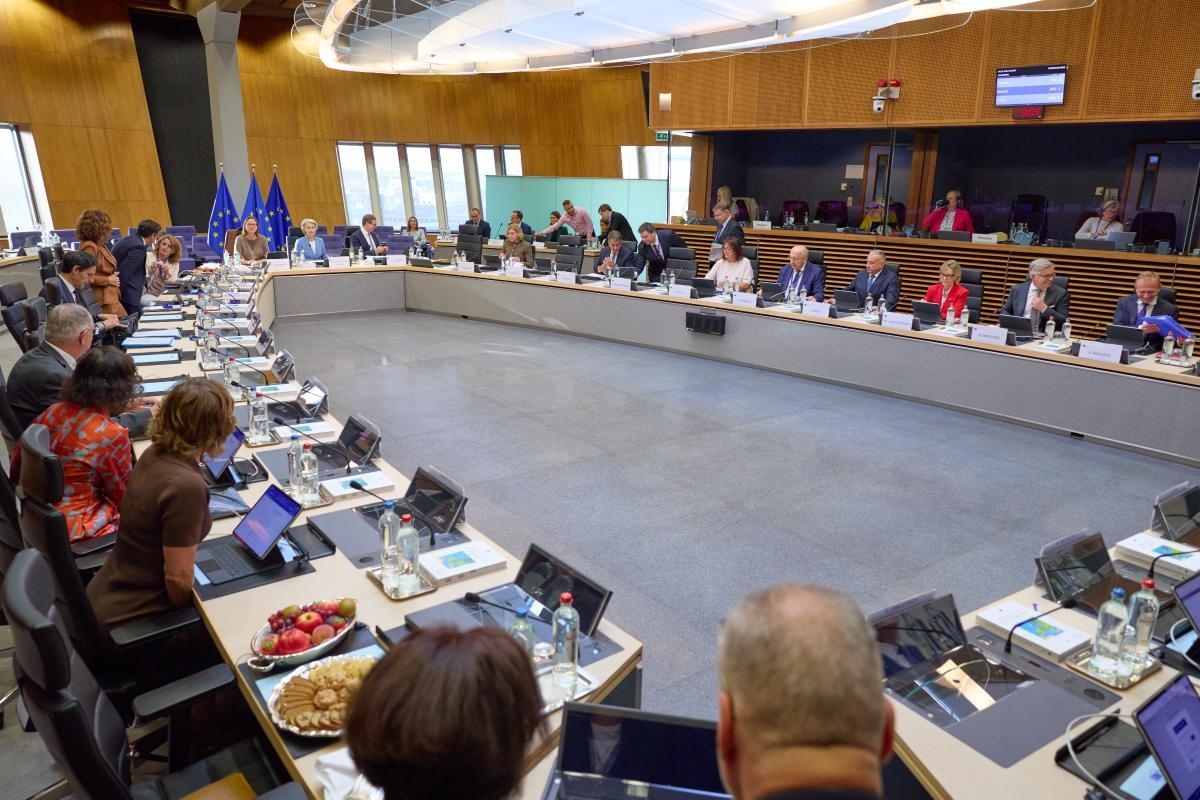
A metaphor for a Europe that moves too slowly? Possibly. But anyone looking at the College’s calendar between now and the end of November is asking something else: whether the trouble is slowness or caution, a body of legislation held on a leash by a pragmatism that at every junction demands an assessment of expediency, an impact assessment, the opinion of the Scrutiny Board, an eye on the arithmetic of the next majority in Parliament. The document is dated 20 October: the list of items the Commission expects to bring to its meetings from 27 October to 24 November. It warns that it is indicative, that it is subject to Better Regulation, and that the president may change everything whenever she likes. Thirteen items, five meetings, not a single adjective. One has to read the names at the end of each line. So what follows is a piece of compilation and a little dull, but I hope it conveys the difficulties, real and imagined, that trap the fluency, the timeliness and the fine hopes of the lawmakers of Europe.
The column names the president or executive vice-president responsible, who does not always coincide with the commissioner carrying the file. On 4 November three of the six items, the 2027 work programme, the report on simplification and the enlargement package, have the president as lead: Ursula von der Leyen keeps her files close to her chest. Henna Virkkunen, a Finn from the EPP and a former MEP, has four in three weeks: migration, the asylum report, consumers, quantum technologies. Stéphane Séjourné, a liberal, a close associate of Macron and a former foreign minister, has three. Teresa Ribera, Spanish, a socialist, a former minister for the ecological transition, has two, one of them shared with Séjourné. When a name comes back so often the question is not about efficiency. It is about who, in the College, has the last word.
It begins on 27 October, and the mood is already plain. Ribera brings the climate resilience framework: according to the previews, a first obligation on national authorities to take rising heat into account when planning infrastructure, and to say who answers for the risks. The Spanish press describes two schools inside the president’s team, mitigation, closer to the groups on the right, and adaptation, defended by progressive positions and by Ribera. Who pays for adaptation is a question that goes straight to the capitals, in the weeks when the budget is being negotiated. The same day comes the package on borders and migration, with more powers for Frontex and the digitalisation of returns, which is the territory of Magnus Brunner, an Austrian from the EPP and a former finance minister; in the agenda line, however, it is Virkkunen who appears. Here the Commission arrives after the ministers: on 1 October the Justice and Home Affairs Council approved the European return order, the return hubs outside the Union and a stronger role for Frontex, while Denmark, Germany, Greece, Austria and the Netherlands press to open the first centres in 2027. Arrivals on the central Mediterranean route are down by 55 per cent, irregular crossings at the external borders by almost 40 in the first half of the year, and humanitarian organisations ask why now. Frontex is already under examination over pushbacks, Greece first among them. Inside the College the contest is between those who want to close the doors and those who recall that the rule of law keeps watch over doors, a portfolio held by Michael McGrath.
The 4th of November is the most crowded day, with six items. The 2027 work programme comes after the letter of intent signed on 16 September by von der Leyen and Maroš Šefčovič, and after the College’s discussion of 20 October in Strasbourg. The 2026 programme counted 47 legislative initiatives, 25 with a strong simplification component, and 25 proposals to withdraw. The annual report on simplification and enforcement of the rules has as its custodian Valdis Dombrovskis, a Latvian, a former prime minister, commissioner for the economy and simplification. The paradox lies here: simplifying takes votes, and in Parliament votes are no longer guaranteed. The sustainability Omnibus stumbled in the chamber on 22 October 2025 and was later unblocked with the decisive weight of the right, at the expense of the centrist majority that holds up the president. A leash, indeed.
Enlargement is the item with the most future and the most rust. Marta Kos, a Slovenian diplomat, had promised an enlargement autumn. The package, already slipped from 28 October, contains roadmaps for Albania, Moldova, Montenegro and Ukraine: reforms required of the candidates, milestones, indicative timings for closing chapters, and commitments from the member states too, because unanimity applies at every step. The announcement was the president’s, on 16 September, in her State of the Union speech. The internal review ahead of new accessions, covering safeguards, gradual integration and passerelle clauses, sat still for almost a year before emerging on 6 October. The summit of 15 and 16 October left enlargement and reforms without a strategy, the specialist press writes, and Zagreb’s list of eight points derailed Montenegro’s calendar.
Then there’s the money: the Irish presidency’s new draft budget cuts External Action by an average of 17.4 percent, as reported by this online newspaper on October 12, citing, among other things, Social Democratic MEP Tavares, as well as funds for enlargement. Promises of entry and cash cuts in the same month. And in any case, a cut of 26 billion out of 183, which is equivalent to a 14% cut. Who pays? is the question that crosses the college from one line of the agenda to the other.
On 11 November it is the consumers’ turn, and here the tension is one of principle. The Digital Fairness Act, with the initiative on enforcement, is a file for Virkkunen and for the Irishman Michael McGrath, a former finance minister. It was due in the middle of 2026, then in the third quarter, then by the end of the year: it has slipped several times. In March business associations wrote asking for a pause, citing the reservations of the Regulatory Scrutiny Board itself and of several member states. McGrath replies that the law will serve consumers and businesses alike and will neither duplicate nor reopen existing rules. Dark patterns, addictive design, influencers, profiling: the new rule arrives a week after the Commission claimed to have scrapped some. The College will have to decide how far to trust its own rhetoric.
On 18 November there are three industrial acts in one go. The Circular Economy Act, from Ribera and Séjourné, wants a single market for secondary materials and aims to double the circularity rate by 2030. Environmentalists, beginning with the European Environmental Bureau, fear an approach confined to recycling, leaving overproduction and product design untouched; industry fears that recycled material will cost more than virgin, above all in plastics. Behind it stands Jessika Roswall, a Swede from the EPP and the environment commissioner, who has pointed out that the European economy is still almost 90 per cent linear. Where Ribera’s green ends and Séjourné’s competitiveness begins is a line nobody has yet drawn. The same day Virkkunen presents the Quantum Act and Séjourné the Advanced Materials Act: two laws that ask for pilot plants, production capacity, money. The money sits in a European Competitiveness Fund that the twenty seven are still carving up.
On 24 November comes the autumn package of the European Semester, with Séjourné on the agenda, in the thick of the Strasbourg plenary, which runs from 23 to 26. On 26 and 27 the leaders meet on the multiannual budget for 2028 to 2034, with the aim, set last December, of an agreement by the end of the year, so that the acts can be adopted in 2027 and take effect on 1 January 2028. Parliament opposes the cuts to Global Europe, and some think it optimistic to close with the Assembly by December. The budget was proposed by the Commission on 16 July 2025: it is von der Leyen’s biggest wager, and everything else revolves around it. Every million taken from a heading is somebody’s file in the College.
Ursula looks out, often and from a distance, from the windows of her office: today, alongside her thoughts, she sees a square finished without its canopy, buses in exile, a single way out for the cars. Between one assessment and the next, Europe nearly always produces something, less than it had drawn up and late for the traffic that has piled up in the meantime. Twenty minutes to leave the roundabout. To leave November, von der Leyen has barely a month and, for as long as the majority holds, so will she, in a single lane.
______________________________
Online resources were used to validate sequences of dates, names and attributions, to check figures against public and corporate sources, to verify acts and the people and companies concerned, and to ensure the formal correctness and format of the text. The starting point is a set of personal notes and a narrative written originally and exclusively by the author.