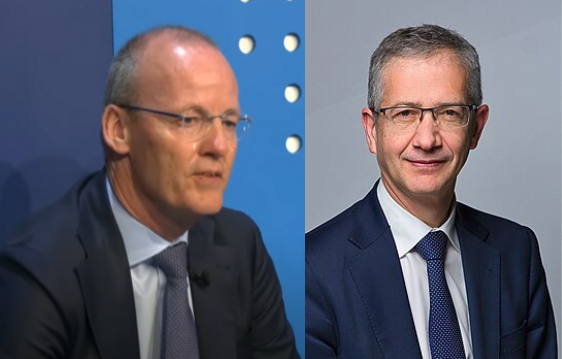
Brussels – There will be a two-candidate race for the presidency of the European Central Bank, between the Netherlands and Spain. By the deadline for submitting nominations to replace Christine Lagarde, who is stepping down, only Klaas Knot and Pablo Hernández de Cos had expressed their interest. The Eurogroup will now have to reach an initial agreement on one of these two names to launch the appointment process officially.
The President of the Eurogroup, Kyriakos Pierrakakis, remains tight-lipped: “We’ll see” whether it will be possible to reach a consensus on one of the two names as early as today (9 November). In any case, “this afternoon I will meet the President of the European Council, António Costa”, as the view remains that the decision on the new ECB President must be “taken at the leader level”.
Although there are only two candidates, the problem is that “they are both strong contenders”, Pierrakakis points out, referring to their CVs: Klaas Knot was the long-serving president of the Dutch Central Bank (July 2011 – June 2025), a role that ensured he maintained a continuous presence within the ECB Governing Council for 14 years. He therefore knows the institution and how it operates very well. He also served as head of the Financial Stability Board (December 2021 – July 2025).
Pablo Hernández de Cos is the current Director-General of the Bank for International Settlements, a post he took up following his term as Governor of the Bank of Spain (June 2018 – June 2024), which led to his appointment to the Governing Council of the European Central Bank. He, too, is a highly qualified economist with a profile that commands broad support. There is one difference, however: Hernández de Cos’s candidacy is backed by the outgoing government of the socialist Pedro Sánchez. Within the Eurogroup, as within the Ecofin Council and at the level of heads of state and government, the influence of the People’s Party (EPP) is considerably greater. Centre-right forces will likely be more inclined to support the challenger, Knoot, given the Dutch position favouring fiscal discipline and spending restraint.
The timetable “is tight”, Pierrakakis admitted. The aim remains to find a successor to Lagarde by the end of the year, but the elections in Spain on 29 November will determine whether the country will remain led by Sánchez or power will return to the People’s Party. The outcome of the vote could tip the balance: a Sánchez victory at the polls would leave him in a stronger position, and the EU, by endorsing Madrid’s candidate, would give him even greater political clout. A victory for the People’s Party, on the other hand, could provide Spain with an anti-socialist “gift”. Even though Spain already holds the presidency of the European Investment Bank.
“An agreement (on the appointment, ed.) could be reached as early as next month“, suggested Simon Harris, Finance Minister of Ireland, whose country currently holds the rotating presidency of the Council of the EU and is therefore the current chair of the Ecofin Council. “We are confident that Spain will, for the first time, hold the presidency of the ECB“, says Spain’s Finance Minister, Carlos Cuerpo, who assured that “we are receiving a positive assessment from our partners”. All the more reason why “we are working to secure as many votes in favour as possible. We are optimistic”.
The candidate’s CV and his political stance explain the Spanish optimism. In Madrid, there is an awareness that some governments, such as the Italian one, are ideologically closer to the Dutch candidate than to the Spanish one. However, for countries such as Italy, with high public debt levels, Klaas Knot risks being the least viable choice due to the rigidity of his approach.
English version by the Translation Service of Withub