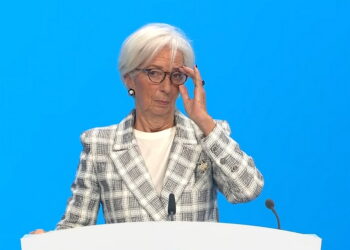

Brussels – Who will lead the ECB now that Lagarde has announced her resignation? The question has already been raised, and the Eurogroup meeting scheduled for next week (9 November) will have to seek an initial answer to a question that is far from straightforward. There is, of course, a procedure whereby candidates for the top post at the European Central Bank put themselves forward. One, the Dutch Klaas Knot, has already been officially nominated by the Dutch government. The other names being bandied about – Joachim Nagel (Germany) and Pablo Hernández de Cos (Spain) – have yet to be confirmed, and there may well be others besides them.
There is time until the end of Friday to put oneself forward, and the Eurogroup will inevitably begin an initial round of discussions aimed at building a consensus to fill, by the end of the year, the post that will be vacant from the start of February, thereby ensuring the operational continuity of the European Central Bank. Well-informed European sources state that the general intention is to try to formally appoint Lagarde’s successor at the summit of heads of state and government in December.
The procedure and timetable
The procedure requires the Council (the ministers, in this case the euro and then the economic ministers of the Ecofin) to issue a recommendation to the European Council (the Heads of State or Government), so that the latter may formally appoint the candidate after informing the Commission and the Parliament. The timetable is tight: for the leaders to reach a possible agreement on the name of Lagarde’s successor, an agreement at the Ecofin meeting on 11 December will be needed, so as to give the leaders the opportunity to give the go-ahead on 18 December. What is beyond doubt, as emphasised in Brussels, is that, “given the importance of the post, this is a matter of the highest political significance. An agreement among the leaders is required.”
ECB: early EU talks on the post‑Lagarde era, with power balances and negotiations tougher than ever
Of course, if it were not possible to resolve the issue by the end of the year, “it wouldn’t be the end of the world,” the same sources assure us. That said, efforts are being made to resolve the appointment of the new ECB President as soon as possible.
Shuffling the cards
The appointment process will not be that straightforward. On 7 February, Lagarde will step down as Chair, but two other seats on the Executive Board will need to be filled: that of Isabel Schnabel (German, whose term expires on 4 January 2027) and that of Chief Economist Philip Lane (Irish, whose term expires at the end of May). “Viewing these three seats as a package could help,” sources in Brussels acknowledge. Of course, the same sources admit, there is no obligation to negotiate them individually or as a package, and it will therefore be up to the political sphere to find a way forward.
The “musical chairs” game, however, is not confined to the ECB. On the one hand, there is the issue of the political balance between countries: with Lagarde’s departure, France loses a prestigious role. French President Emmanuel Macron has succeeded in securing the appointment of his compatriot François-Louis Michaud at the helm of the European Banking Authority (EBA), ensuring that the République retains a leading role at least until March 2031. This does not spell the end of other ambitions for top positions, but it allows France to buy time and wait until January, when the EU will be called upon to decide whether or not to confirm Roberta Metsola (EPP) as President of the European Parliament.
That is likely to be the first real test for the new 12-star organisation, as the election of the President of the Parliament coincides with that of the President of the European Council: António Costa has a two-and-a-half-year term expiring in mid-2027, and the appointment of the new ECB President is intertwined with the top posts in the Parliament and the Council for purely political reasons. The Socialists would like to see Costa’s term in the Council extended, while the EPP would like to retain control of the Parliament and perhaps even take over the Council, not least because of the influence of EPP leaders within the institution.
English version by the Translation Service of Withub