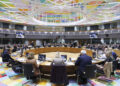

Brussels –The list of Russian individuals and entities sanctioned by the European Union is growing: now it is the turn of those who have carried out cyberattacks. At a meeting in Brussels today (16 November), the Foreign Affairs Council decided to add 30 individuals and two entities to the list of those subject to EU restrictive measures.
Firstly, the Social Design Agency (SDA), a Moscow-based public relations firm and technology developer, has been included. According to a press release from the Council, the Agency “carries out large-scale information manipulation and interference projects”, which are “funded, directed and supervised by the Russian Presidential Administration.” In its activities, it “systematically manipulates the media and social media environment, spreads pro-Russian propaganda and disinformation and foreign information manipulation and interference campaigns.” According to the EU Council, the SDA “ disinformation campaigns specifically targeting EU countries, EU institutions and European public support for Ukraine.” This includes operations carried out during the 2024 European Parliament elections, as well as “dedicated operations against EU member states such as Germany and France.” Among those added to the list today are therefore 24 individuals working for the Agency, who contribute “in various capacities to developing and running the so-called European counter-campaign and Ukrainian counter-campaign.”
The Council also added those it described as “various propagandists”, including: the Russian television personalities Vitaly Eliseev and Petr Marchenko, the Ukrainian-born blogger Yurii Podoliaka, and the military commentator for the international broadcaster RT, Chay Bowes, for having participated “in information manipulation and dissemination of narratives that legitimise and sustain the ongoing Russian war of aggression against Ukraine.” The Council stressed that this decision “comes in the context of increasing Russian hybrid activities aimed at destabilising EU societies.”
The Council has added the pro-Russian hacker group “NoName057(16)”, which emerged in March 2022 following the Russian invasion of Ukraine. In the past, the group claimed “responsibility for cyber-attacks on government bodies, critical infrastructure, and private companies of Ukraine, the United States of America and EU member states.” Within the EU, too, it has targeted websites and portals across various sectors, using Denial of Service (DDoS) attacks – these are malicious attempts to disrupt the normal functioning of a website, server or network by flooding it with an excessive amount of traffic or requests. The targets include “The energy, financial and transport sectors, water supply facilities, as well as political parties and candidates during electoral processes.”
On leaving the meeting, the Italian Foreign Minister, Antonio Tajani, stressed that “Italy called for debate” on hybrid warfare, and that among the ministers, “there is a shared view and desire to be ever more united to respond to and prevent attacks of various kinds, whether via email, cyber attacks or hacking.” Regarding the recent bomb threats in schools across Italy, Tajani received “a great deal of solidarity from all the ministers.” He added that “we will work increasingly closely together, with greater coordination, and results are already visible today.” Tajani noted that recently “another email attack in Italy, aimed at forcing schools to close, was thwarted.” However, “no schools were closed because it was clearly a false threat”. The Deputy Prime Minister reiterated that “if the aim was to continue causing chaos, the response has been more than positive,” but issued a warning: these events “risk interfering with the elections due to take place in many European countries, from Spain to France to Italy.” Now, “Europeans must stand united and respond together, to prevent being influenced or divided,” he concluded.
As of today, those subject to these EU restrictive measures are subject to an asset freeze and travel bans that prevent them from entering or transiting through EU Member States. Furthermore, EU citizens and businesses have been prohibited from making funds available to them, either directly or indirectly.
English version by the Translation Service of Withub