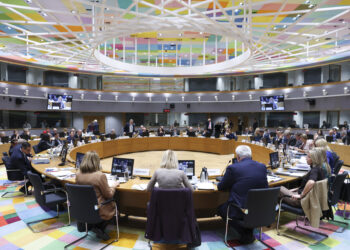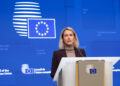
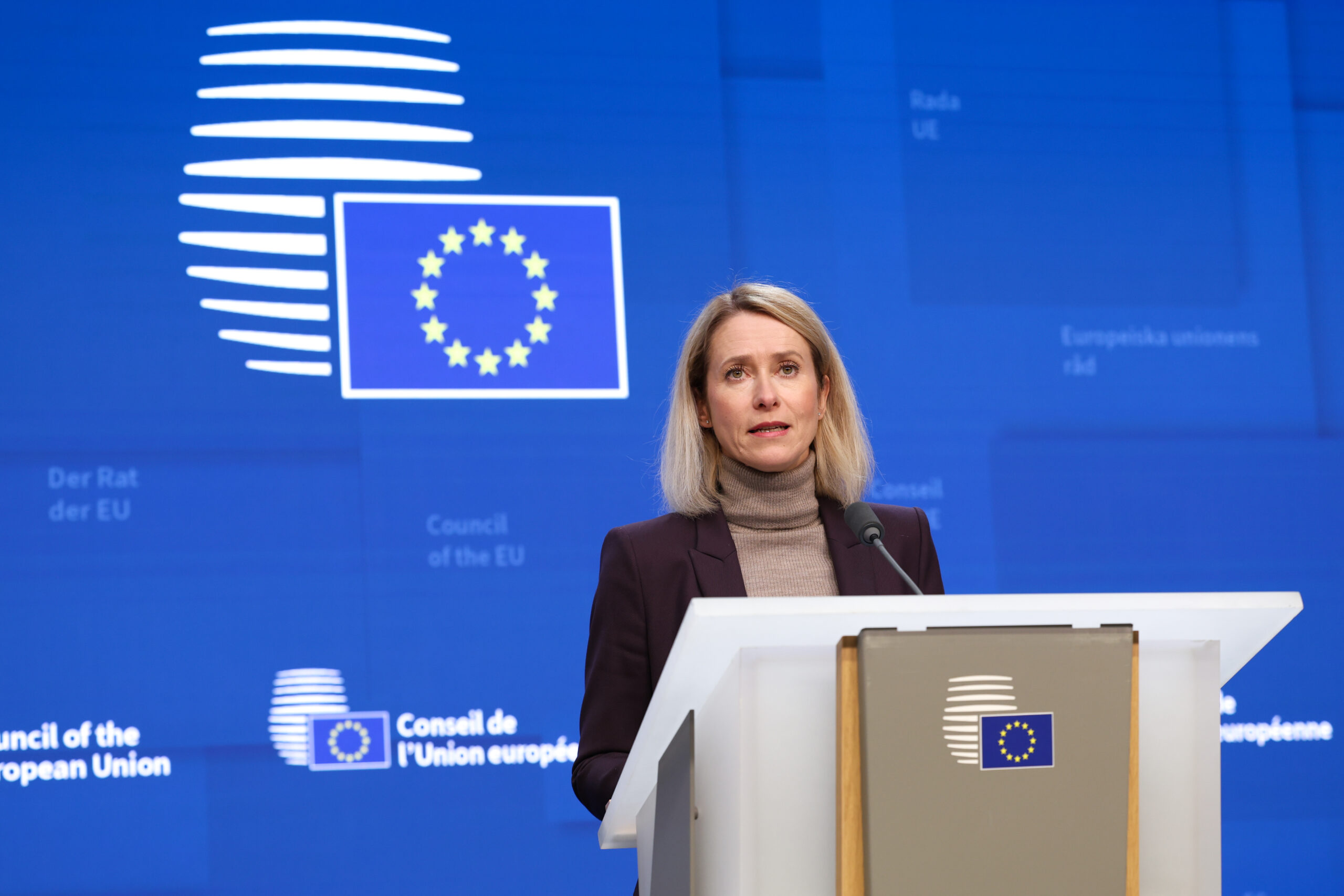
Brussels – The EU’s demands on Russia are “clear” and do not include a new security architecture for Europe, because the aim is not to create a new one but to restore the one that already existed and which Russia has violated. More specifically, any discussion on this subject would be a distraction from the main objective at present: the ceasefire in Ukraine. This is the notice announced today (16 November) by the High Representative of the European Union for Foreign Affairs and Security Policy, Kaja Kallas, during the press conference following the Foreign Affairs Council meeting. “Today, the ministers were very clear. We do not need a new security architecture. We must restore the one we already have. Russia has violated all the treaties,” she emphasised.
Europe is calling on Russia to respect “Ukraine’s sovereignty, independence, and territorial integrity, and its right to choose its own alliances.” Furthermore, “there can be no legal recognition of the occupied Ukrainian territories” and “Russia must be held to account for war crimes and pay for the destruction it has caused,” while “children deported from Ukraine must return home” and “Russian acts of sabotage and cyber-attacks across Europe must cease.” However, according to Kallas, the path forward involves a ceasefire, which “must be the priority,” “followed by a peace agreement”, and “only then can we discuss anything else.” Meanwhile, “Moscow wants to break up Ukraine, push NATO back, and secure a veto over European security: all of which are unacceptable from the outset. In 2021, Russia’s demands were a pretext for war. In 2026, they are a pretext for continuing it.”
At this stage, therefore, according to Kallas, “discussions with Russia on the security architecture” should be avoided, while “the priority, first and foremost, is to reach a ceasefire” because “Russia is simply trying to muddy the waters, pretending that this is merely an exchange of ideas. But that is not the case.” Whatever “emerges from these discussions would be exploited against us, diverting attention from the fact that, in reality, there is no ceasefire and that Russia continues to weaken Ukraine and kill people every single day,” she warned. In particular, the High Representative recalled that the agreements that formed the basis of security on the continent “included Russia as a signatory, such as the Helsinki Final Act, the Paris Agreements or the Budapest Memorandum.” Therefore, the problem “does not lie in the agreements themselves, nor in the position taken by Ukraine,” she observed, but “the point is that Russia is violating these agreements, failing to honour the commitments it has made.”
Last Friday (13 November) – at the informal European Council meeting in Dublin – the heads of state and government of the EU countries have begun to reach an agreement on who should represent the European Union in the peace negotiations between Russia and Ukraine. Now that the EU has chosen who will “represent it at the peace talks,” Kallas believes it is time to “focus on the substance.” As part of these discussions amongst the 27, the leaders appear to have already put forward some demands. Kallas emphasised that “many ministers from Member States do not simply want to receive a brief update on these matters,” but “to be actively involved in the negotiations.” On how to do this: “Foreign ministers meet every month. Perhaps that isn’t often enough. But then we also have the ambassadors. If anyone has better ideas on how to go about it, we can certainly discuss them. But so far, this is how we’ve been working, and the foreign ministers are ready to carry on in this way from today,” Kallas clarified. As for the modus operandi, however, Kallas certainly has clear ideas. With regard to the negotiations and the definition – which leaves her on the sidelines – of the E5 format (France, the United Kingdom, Germany, Italy, Poland) plus the EU to represent Europeans, the former Estonian prime minister hopes “that this kind of approach does not lead to the creation of structures parallel to the European External Action Service (EEAS), which would end up placing a burden on the budget. This is an issue that is already under discussion.” Kallas defends her team. “I believe there is work for everyone. Within the European External Action Service, I have highly qualified staff. The EEAS has experts who know Russia well, who are familiar with past agreements and with history. I firmly believe that these people’s skills should be utilised,” she emphasised.
In addition to the peace talks, the 27 foreign ministers today agreed to mobilise “500 generators, 200 buses, emergency shelters, undersea power cables, and floating bridges” to bolster Ukraine ahead of winter. “At the same time, we are stepping up the pressure: the ministers have approved 140 new designations – the formal measure by which an individual, a company, an organisation or a country is added to an official list of sanctioned entities – targeting Russian refineries, banks, and e-commerce firms, as well as companies in the Gulf and East Asia that support the Russian shadow fleet,” the High Representative announced. These measures “include the most comprehensive package of sanctions adopted to date against those responsible for Russian cyber-attacks and disinformation operations targeting the European Union,” the Estonian official clarified.
But the work does not stop today: “In the coming days, we will present the 22nd package of sanctions.” Furthermore, “today, ministers issued a strong call to tighten visa policies and prevent Russian athletes from taking part in sporting events held in the European Union,” said Kallas. The intention to impose a total ban on entry to the EU for former combatants and those still fighting had already been considered for the 21st package of sanctions. However, the measure was not included.
English version by the Translation Service of Withub