
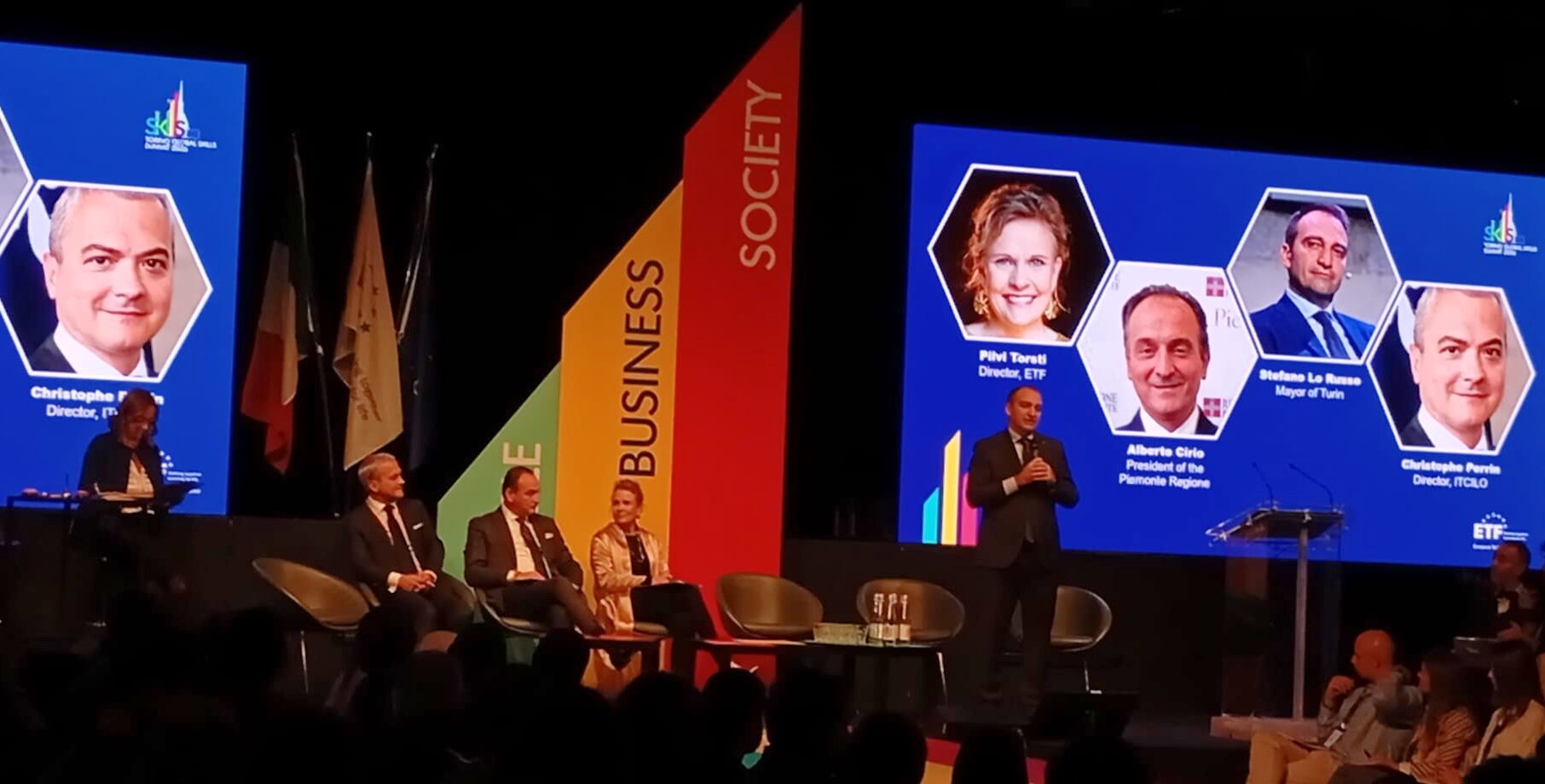
Turin – “We cannot have a competitive economy without investing in what is needed in the workplace today and tomorrow”, and this necessarily implies that “skills must be part of every investment agenda.” The Commissioner for Employment, Roxana Minzatu, is well aware of this and reiterates it in her message to the audience at the Turin Global Skill Summit, organised by the European Training Foundation (ETF), the European Union’s agency for innovation in education, vocational training and human capital development.
“Future prosperity depends on this,” Minzatu insists, in what sounds like a call to defend the resources proposed by the European Commission for competitiveness in the draft multiannual financial framework (MFF 2028–2034), which were instead cut by the President of the European Council, Antonio Costa, in his proposal for a final compromise. The challenge for the future is essentially twofold: on the one hand, the Commissioner insists, “we must modernise our education and skills systems.” On the other hand, resources are needed.
Negotiations on the funding for vocational training are yet to take place, and there is still plenty of scope for action. However, the director of the European Training Foundation, Pilvi Torsti, appears to be taking a dig at the European Commission and the idea of centralising the use of resources when she states that, certainly, “there is no competitiveness without skills”, but in this policy initiative “we must invest globally and act locally”.
The President of the Piedmont Region, Alberto Cirio, agrees: “Skills are just as important as roads: we must continue to invest here, and prepare young people for the jobs of the future,” he said as he addressed the audience. His remarks serve as a reminder but also as an implicit call for the government to work towards putting the country and its leading regions in the best possible position. “Piedmont faces three challenges,” he points out. One challenge is demographic: “There are few births and a small working-age population.” The second challenge is that posed by industrial change: “The automotive sector is changing, and new sectors are emerging, such as the space industry.” The third challenge is that of new technologies: “We must provide new training.”
Resources and determination are therefore needed: “Human capital is at the heart of our competitive strength, and in this regard, skills are of key importance,” stressed the mayor of Turin, Stefano Lo Russo. He pointed out that this is particularly true “at a time when artificial intelligence is advancing”.
Mario Nava, Director-General of the European Commission’s Directorate-General for Employment (DG EMPL), prefers, however, to keep the spotlight on the so-called ‘NEET’, those who are neither in work nor in education, and are not seeking to do either. These are the economically inactive, who need to be reached: “Much more work is needed on the demand side”. Throughout the EU, “we must keep people active” in the interests of competitiveness.
While some focus on resources, others on national or ‘twelve-star’ support, and still others on the drain of potential labour, Christophe Perrin, director of the International Training Centre of the International Labour Organisation (ITCILO), places the emphasis instead on another factor that makes the skills challenge so complex: its multi-dimensional nature: “Real progress comes from understanding how much we depend on one another”, and in this sense, he stressed, “training is not solely a public responsibility or solely that of businesses”. This means that, to promote the skills necessary for competitiveness, “dialogue and partnership between the parties are needed”.
English version by the Translation Service of Withub