Brussels – While European public attention is all on the nominations and election developments in June in Europe and in November in the United States, Taiwan tomorrow (January 13) will hold the most crucial elections for the future balance of a globally sensitive region – politically and economically. The presidential election in the island sees two leading candidates (with a more detached third independent one) on opposing positions vis-à-vis China’s unwieldy neighbor, which–depending on the outcome of the polls–could take a hostile stance toward Taiwan and upset those delicate balances on which global trade currently rests.

The European Union is carefully watching the outcome of the election, but especially China’s reaction. Polls show that the favorite is the current vice president and leading member of the Democratic Progressive Party (DPP), Lai Ching-te. A center-left progressive, Lai is one of the proponents of a policy of greater distancing from Beijing and has openly advocated Taiwan’s independence from China. Due to his pro-Western stance, Brussels sources say the incumbent vice president may be the preferred candidate even though they do not hide “serious concerns” about the risk of a possible upset in the balance between Taipei and Beijing.
Concerns that liberal MEP Nicola Danti (Italia Viva) shares: “Chinese imperialism, which every day casts more and more shadows on Taipei’s independence, is scary.” The Italian MEP told Eunews that the hope is that “Saturday’s elections can be held freely,” but above all “China respects the democratic outcome, even if the winner should be a candidate who sees the West as an opportunity and not a threat.” The relationship between Taiwan and China is particularly complicated since Beijing considers the island its province (after the defeat of nationalists in the civil war with the Chinese Communist Party, a semi-presidential republic was established on the island in 1949), and President Xi Jinping is becoming increasingly threatening about future reunification. At the same time, Taipei has found protection in the United States, which would be ready to defend the island in the event of an invasion by the Chinese military.
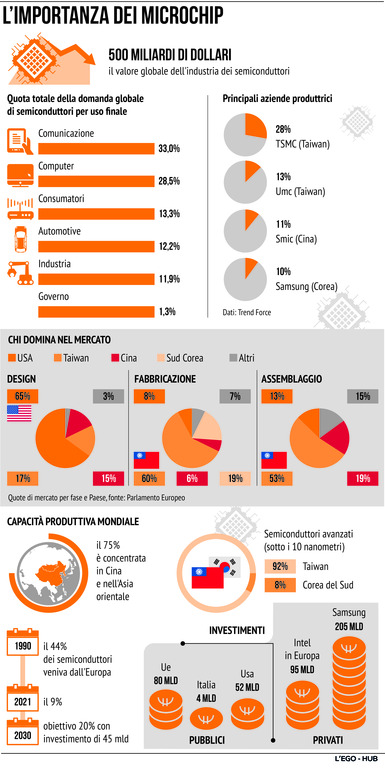
In this precarious stability framework, tomorrow’s single-round presidential election and the eventual Chinese reaction will also directly impact the European Union. Not only politically, but especially commercially: “Taiwan is a key partner for Europe, in particular, for the supply of semiconductors needed for the digital transition,” Danti underlined. “The elections in Taiwan undoubtedly have a planetary relevance, depending on the outcome also relations with the EU will be affected, first and foremost at the trade level,” Democratic Party MEP Patrizia Toia added. Although Taiwan is a country of only 23 million people, its location and highly specialized industry make the island of enormous strategic importance internationally. Taipei is a leading advanced semiconductors producer – with more than 90 percent of global production – and these exports are “one of the few diplomatic levers available in the relationship with Beijing,” she tells Eunews. The European Union, in contrast, has less than 9 percent of the global market and only with the new Chips Act, has it started to try to unshackle itself from “heavy reliance on third-country suppliers, particularly China and Taiwan.”
This is why “economics and geopolitics in this case are intimately linked,” Toia concludes. Although Lai is considered the favorite at the polls, all scenarios are open on the eve of the vote. Challenging him is the candidate of the conservative Kuomintang (KMT) party, Hou Yu-ih, who favors a gradual rapprochement with China, while the former mayor of the capital Taipei, Ko Wen-je, has positioned himself as the third independent. The most pressing issue in the campaign was the relationship with China and the positioning (present and past) of the island’s current vice president. Beijing considers Lai a separatist politician – in other words, a danger to the future reunification of the country according to the aims of the Chinese president – even though in recent years he moderated his position: in recent months, he has explicitly assured that, if elected he would not push for the country’s independence. However, Brussels and Washington are watching closely to see whether an eventual election of Lai as Taiwan’s president will be a sufficient pretext for China to upset the balance in the region and the world.
The EU between China and Taiwan
“We need to preserve the status quo in Taiwan, which cannot be changed by force. It is crucial to maintain peace and trade globally and in the region,” EU Commission Vice-President for Economic Affairs, Valdis Dombrovskis, recently said in a debate at the EU Parliament plenary session on Chinese threats in the Taiwan Strait. A few days earlier, the president of the European Commission, Ursula von der Leyen, and of the head of the European Council, Charles Michel, attended the 24th EU-China summit in Beijing to reiterate the guidelines to rebalance EU-China relations – given the trade imbalance with the partner/competitor – and to address the tensions in Ukraine and Taiwan with the Chinese leader, Xi Jinping, just as French President Emmanuel Macron and von der Leyen had done in early April.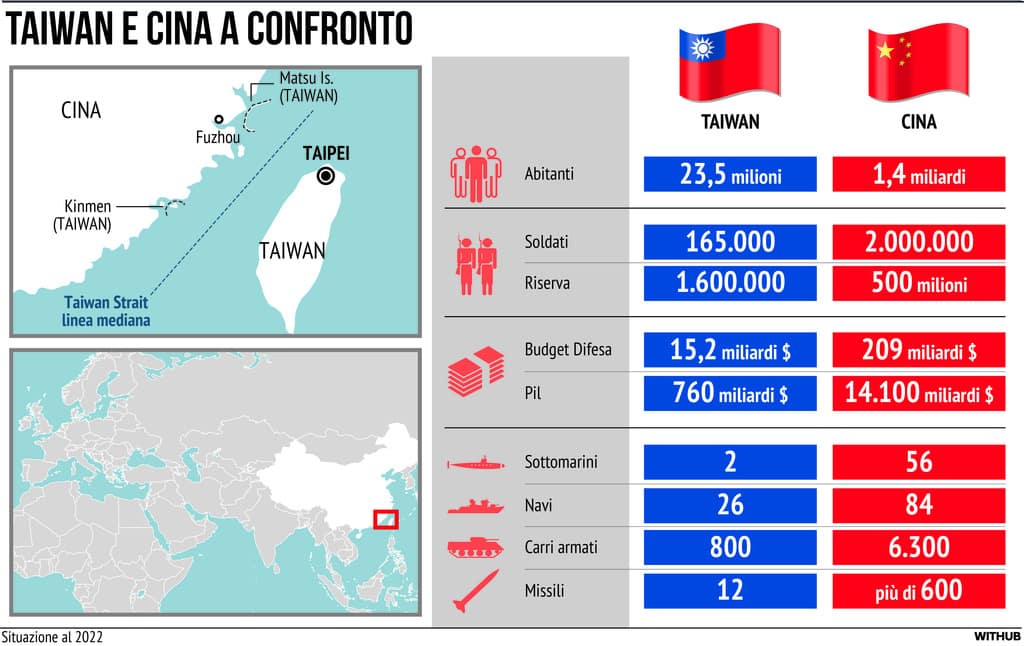 The issue of the relationship between the 27 Member States and Taipei – in the case of escalating tensions with Beijing – had been at the center of a tense internal debate within the Union in the spring of last year due to the words of French President Macron returning from the Beijing trip: “The worst thing would be to think that we Europeans must become followers on this issue and take our cue from the U.S. agenda and a Chinese overreaction,” Macron said at the time, outlining the need for European strategic autonomy (but not an equidistance between Washington and Beijing). The president of the Commission and EU High Representative for Foreign Affairs and Security Policy, Josep Borrell, threw water on the fire, advocating the need for unity against China’s “policy of division and conquest.” In an interview on Le Journal du Dimanche, Borrel urged European navies to “patrol the Taiwan Strait, to demonstrate Europe‘s commitment to freedom of navigation in this absolutely crucial area” for global trade.