- Europe, like you've never read before -
Tuesday, 17 November 2026
No Result
View All Result
  • en ENG
  • it ITA
Eunews
  • Politics
  • World
  • Business
  • News
  • Defence
  • Health
  • Agrifood
  • Other sections
    • Culture
    • Rights
    • Energy
    • Green Economy
    • Finance & Insurance
    • Industry & Markets
    • Media
    • Mobility & Logistics
    • Net & Tech
    • Sports
  • European 2024
    Eunews
    • Politics
    • World
    • Business
    • News
    • Defence
    • Health
    • Agrifood
    • Other sections
      • Culture
      • Rights
      • Energy
      • Green Economy
      • Finance & Insurance
      • Industry & Markets
      • Media
      • Mobility & Logistics
      • Net & Tech
      • Sports
    No Result
    View All Result
    Eunews
    No Result
    View All Result

    Home » Politics » Dutch Rutte to be next NATO secretary general after Romanian Iohannis surrenders

    Dutch Rutte to be next NATO secretary general after Romanian Iohannis surrenders

    All that was missing was the announcement of the withdrawal of Romania's president from the race for all Atlantic Alliance members to give the green light to the nomination of the outgoing premier of the Netherlands. The aim is to finalize the succession to Jens Stoltenberg at the July 9-11 Washington Summit, before he takes office on Oct. 2

    Federico Baccini</a> <a class="social twitter" href="https://twitter.com/@federicobaccini" target="_blank">@federicobaccini</a> by Federico Baccini @federicobaccini
    20 June 2024
    in Politics
    Mark Rutte Jens Stoltenberg Nato

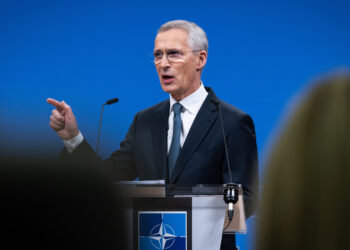
    NATO Secretary General Jens Stoltenberg and Netherlands' Prime Minister Mark Rutte hold a press conference at the NATO headquarters in Brussels, on April 17, 2024. (Photo by KENZO TRIBOUILLARD / AFP)

    Brussels – The plots woven over the past six months or more by the outgoing prime minister of the Netherlands, Mark Rutte, have withstood the test of the risk of a Central and Eastern European break-up, and as of today (June 20) it can be said with almost absolute certainty that the Dutch politician will succeed Norway’s Jens Stoltenberg as the next NATO secretary general. There is no officialdom yet because of a question of how the internal rules of the North Atlantic Treaty Organization work, but the announcement by the president of Romania, Klaus Iohannis, on the definitive withdrawal from the race puts Rutte in a virtually ironclad position ahead of the Washington Summit (scheduled for July 9–11), before he officially takes office next October 2.

    Klaus Iohannis Jens Stoltenberg Nato
    From left: Nato Secretary General Jens Stoltenberg and Romania’s President Klaus Iohannis (credits: Andrei Pungovschi / Afp)

    Iohannis was the last of the 32 Atlantic Alliance leaders who had not yet given his consent to the nomination of the outgoing Dutch premier, as he is also a candidate for secretary general. “The president asked the members of the Supreme Defense Council to pronounce themselves on the candidacy of Mark Rutte for the post of NATO secretary general,” reads a note from the country’s presidency (which is also an EU member), announcing that the same members “declared themselves in favour of Romania’s support for the candidacy of the Dutch Prime Minister.” The selection of the figure of the Alliance’s secretary-general takes place through informal diplomatic consultations among the member countries, which propose candidates for the post (traditionally a senior European political figure): there is no actual vote, but the decision is not confirmed until a consensus is reached on a candidate.

    The decisive moment for the Dutch Premier’s candidacy for Atlantic Alliance secretary general, however, occurred on Tuesday (June 18), when Hungarian Prime Minister Viktor Orbán announced an agreement with outgoing Secretary General Stoltenberg to unblock Rutte’s nomination. “We have agreed that no Hungarian staff members will take part in NATO activities in Ukraine and no Hungarian funds will be used to support them,” is what was written in a post on X by the Budapest strongman, who pointed out how the successor “confirmed his full support for this agreement and will continue to do so” even in his new capacity as head of the Atlantic Alliance and “also assured me that his goal will be to treat all allies with the same level of understanding and respect.” Rutte’s letter to Orbán (attached to the post) emphasizes, however, that “Hungary will not oppose” efforts to support Ukraine, “allowing other allies to move forward.” Parallel to the breakdown of the standoff in Budapest, the reservation was also lifted by the president of Slovakia, Peter Pellegrini, who clarified how his country will support the Dutch premier, albeit in exchange for greater support in defending national airspace. Iohannis thus found himself abandoned even by the last two leaders who might have supported an East-Central European candidacy.

    Mark Rutte Nato
    The outgoing Prime Minister of the Netherlands and next Nato Secretary General, Mark Rutte (credits: Kenzo Tribouillard / Afp)

    Early indications that Rutte was the favourite in the race for NATO secretary had emerged from an editorial of the Atlantic Alliance’s former spokesperson (until September 2023), Oana Lungescu: “Forging consensus among NATO’s 31 allies is the Secretary General’s main
    job. Rutte, sometimes called ‘Teflon Mark’ for his ability to lead
    diverse coalitions and survive political scandals, is a pragmatic
    dealmaker and a master of consensus
    in both NATO and the EU.” In this sense, the Dutch premier has forged ties not only with Stoltenberg but also with other Alliance leaders, from Albania to Lithuania, from Poland to the United States. The issue of ties with Washington is another point in favour of Rutte, who has developed a very good relationship with President Joe Biden and, at the same time, is also one of the few European leaders to have tried to maintain a stable one with his predecessor Trump, who may return to the White House after the November elections. The Dutch prime minister also managed to close the one weak point in his candidacy, namely the Netherlands’ alignment with the minimum defence spending threshold of 2 per cent relative to GDP: in a report published by Nato Monday night (June 17), it emerges that The Hague has reached 2.05 in 2024.
    English version by the Translation Service of Withub
    Tags: atlantic alliancebornclaus iohannisjens stoltenbergmark ruttepeter pellegrini

    Related Posts

    Jens Stoltenberg Nato
    Politics

    Italy is among 8 NATO countries that have not yet reached the 2 percent defense spending threshold

    18 June 2024
    Donald Trump Stati Uniti Nato
    World politics

    Brussels’ outrage at Trump’s threats on NATO: if allies don’t defend each other, everyone is at risk

    12 February 2024
    map visualization
    L’UE aderisce all’impegno globale per l’elettrificazione: elettricità al 35 per cento entro il 2035

    The EU has signed up to the COP31 global commitment on electrification: 35 per cent by 2035

    by Annachiara Magenta annacmag
    17 November 2026

    As early as July 2026, the European Commission committed itself to making Europe “the first fully electrified continent”

    Hervé Jeannin, co-rapporteur for the EESC opinion on the potential of the sodium battery manufacturing sector. Source: EESC

    Sodium batteries: Europe’s chance to power its own future

    by Redazione eunewsit
    17 November 2026

    Europe must turn its battery research into competitive manufacturing. Sodium technologies can help reduce dependencies and support renewable energy, provided...

    L'università europea attira sempre più studenti dall'estero, ma l'Italia resta indietro - Eurostat

    European universities attract 1.65 million international students, but Italy is struggling to retain its talent

    by Annachiara Magenta annacmag
    17 November 2026

    According to Eurostat figures, Germany tops the European rankings, having welcomed 438,300 students from abroad in 2024, accounting for 24...

    La Commissaria per il Mediterraneo, Dubravka Šuica, e il ministro degli Esteri siriano, Assaad Al-Shaibani. Crediti: Commissione europea

    Šuica in Damascus: “Rebuilding the country and attracting new investment – Syria is part of the Mediterranean Pact”

    by Iolanda Cuomo
    17 November 2026

    The European Commissioner at the Coordination Forum for the Partnership with Syria: “We are working to ensure that businesses can...

    • Director’s Point of View
    • Opinions
    • About us
    • Contacts
    • Privacy Policy
    • Cookie policy

    Eunews is a registered newspaper
    Press Register of the Court of Turin n° 27

    Copyright © 2025 - WITHUB S.p.a., Via Savona 127/B, 20144 Milano
    VAT number: 10067080969 - ROC registration number n.30628
    Fully paid-up share capital 50.000,00€


    No Result
    View All Result
    • en ENG
    • it ITA
    • Politics
    • Newsletter
    • World politics
    • Business
    • General News
    • Defence & Security
    • Health
    • Agrifood
    • Altre sezioni
      • Culture
      • Rights
      • Energy
      • Green Economy
      • Gallery
      • Finance & Insurance
      • Industry & Markets
      • Media
      • Mobility & Logistics
      • Net & Tech
      • News
      • Opinions
      • Sports
    • Director’s Point of View
    • Draghi Report
    • Eunews Newsletter

    Attention