Brussels — While the Old Continent today (May 8) celebrates the anniversary of the end of World War II in Russia, the celebrations will be tomorrow. However, looming over Moscow’s Red Square is the threat of Ukrainian drones, potentially endangering the safety of the guests of honor invited by Vladimir Putin to attend the grand ceremony for the 80th anniversary of the Soviet victory over Nazi Germany. The high-level politicians are expected to include some Europeans, including an EU member, while a “counter-celebration” will be held in Ukraine.
All of Putin’s men
The public of great occasions is expected tomorrow (May 9) in the capital of the Federation. According to an attendance list released by the Kremlin, nearly thirty world leaders are expected to join Tsar Vladimir Putin on the grandstand. The most important guest is undoubtedly the Chinese leader Xi Jinping, who is in Moscow to reaffirm the “no-limit friendship” proclaimed in February 2022, shortly before the large-scale invasion of Ukraine.
Then, there will be representatives of some countries aligned more or less explicitly with Moscow (or at least misaligned from Washington): from the Brazilian president Luiz Inácio Lula da Silva to his Venezuelan counterpart Nicolás Maduro, passing, of course, through Putin’s other firm ally, Minsk strongman Alexandr Lukashenko. Indian head of state Narendra Modi canceled his visit because of recent tensions with Pakistan, while the North Korean delegation is not expected to include dictator Kim Jong-un.

Together, they will observe the pompous military parade in which, alongside Russian troops, forces from Azerbaijan, Belarus, China, Egypt, Laos, Kazakhstan, Kyrgyzstan, Mongolia, Myanmar, Tajikistan, Turkmenistan, Uzbekistan, and Vietnam will march. A grand display that, on the one hand, celebrates the historic victory of the USSR in the so-called “Great Patriotic War” (as the Second World War is referred to in Russia) and, on the other, serves as a show of strength aimed at confronting Kyiv and its Western allies.
From Europe with fury?
However, the European guests are causing the most considerable stir. The only leader of the 27 member states in Red Square will be Slovakian Prime Minister Robert Fico, one of the Kremlin’s Trojan horses in the EU (the other is his Hungarian ally, Viktor Orbán). The participation of Bratislava’s premier has caused a rift with Estonia, Latvia, and Lithuania. In the past few hours, the three Baltic states have interdicted his airspace to prevent him from reaching Moscow, citing national security “concerns” as the official reason.
The other heavyweight from the Old Continent is Serbian President Aleksandar Vučić, who is also very close to Russia. The decision of Fico and Vučić — in recent days, their participation in Moscow ceremonies remained in doubt due to health problems — clearly contradicts the warnings of EU diplomacy chief Kaja Kallas, who last month had tried to dissuade Old Continent chancelleries, both inside and outside the Union, from paying a visit to Putin’s court. The Kremlin also said that a delegation from Bosnia and Herzegovina, another candidate country, is also expected to attend.

Some MEPs are also expected to be in Moscow: a handful from the ranks of the SMER, the populist party (disbarred from the European Socialists in 2023) of Fico and Trade Commissioner Maroš Šefčovič, and a couple of red-brown MEPs from the BSW, the Sahra Wagenknecht Alliance that has emerged as a pro-Russian spin-off of Germany’s Linke. The latter announced plans to extend their trip to Kyiv once the Red Square celebrations are over. According to media reports, Cypriot independent Fidias Panayiotou could also travel to the Federation capital.
The EU stands by Ukraine
On the other side of the fence, Ukraine rejected April’s proposal from the Russian president for a 72-hour truce to protect the Moscow parade. Volodymyr Zelensky stated that he cannot guarantee the security of the celebrations in Red Square, and the two belligerents have exchanged drone and missile attacks in recent days.
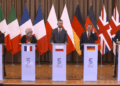
A group of EU foreign ministers will arrive in Lviv tomorrow directly from Warsaw (where an informal Council was held yesterday and today) to attend the “counter-celebration” organized by Kyiv. The leaders of France, Germany, Poland, and the UK had previously declined an invitation to a high-level event in the Ukrainian capital.

Member states representatives will arrive empty-handed, however, because the two-day event did not lead to any agreement on new aid to Ukrainian resistance or on the 17th package of sanctions against Russia on which there has been so much talk. Kallas, who is expected to lead the ministerial delegation, recently confirmed that two-thirds of the 2 million artillery shells that Brussels wants to supply to Kyiv (i.e., what remains of the High Representative’s ambitious 40 billion plan that chancelleries rejected) are ready.
Instead, foreign ministers should announce the imminent creation by the Council of Europe of the special tribunal for violations committed by the invading army: war crimes, crimes against humanity, and genocide, plus possibly the establishment of a new legal category (“crimes of aggression,” such as the unilateral annexation of territories of a sovereign state), to fill gaps in the mandate of the International Criminal Court.
For the past three years, Kyiv has changed the date to commemorate World War II’s end. Traditionally, it was celebrated on May 9, the date on which the war officially ended in 1945, according to the Moscow Time Zone (the unconditional surrender of the German armies took effect at 11:01 p.m. on May 8 in East-Central Europe, which in the Soviet capital, however, was 00:01 a.m. the next day), while since 2022, it has brought forward the ceremonies to the previous day, to align with its European partners. On May 8, 80 years ago, the Third Reich stipulated capitulation in Berlin, as demanded by the USSR, which did not recognize the legal value of a similar document signed between Nazi commanders and the Allies in Reims the day before.
Eighty years ago, enemies laid down their arms.
Since then, we, Europeans, have built something extraordinary: a Union of peace, democracy, and solidarity. An anchor of stability.
Our Union was born as a peace project, and it remains one today. pic.twitter.com/mbmTBmBpua
– Ursula von der Leyen (@vonderleyen) May 8, 2025
On the other hand, on May 9, the EU celebrates what is known as Europe Day in remembrance of the statement by which, in 1950, French Foreign Minister Robert Schuman proposed the creation of the European Coal and Steel Community (ECSC), the embryo of the European project that later transformed into the Union we know today.
English version by the Translation Service of Withub