Brussels – The EU is abandoning the stick and opting for the carrot with Aleksandar Vučić‘s Serbia, even though the authoritarian leader keeps close ties with Vladimir Putin and runs the country as a personal fiefdom. However, European Council President António Costa, on an official visit to the capital, shows a friendly face, encouraging the candidate state to pursue the path of reform.
António Costa begins his tour of the Western Balkans with Belgrade: three days of meetings in the region’s chancelleries, moving in no particular order (and at different speeds) toward accession to the twelve-star club. This morning (May 13), he was in Serbia. He will move to Bosnia-Herzegovina in the afternoon, then Montenegro, Kosovo, Northern Macedonia, and finally Albania, where on Friday (May 16), the European Political Community will hold its sixth summit.
Adhesion and Reforms
Costa’s main institutional engagement was a bilateral meeting with Aleksandar Vučić, the nationalist head of state in power since 2014, who is transforming Serbian democracy into an authoritarian regime and is moving Belgrade further away from Brussels and closer to Moscow. The respective delegations mainly discussed EU-Serbian relations from the perspective of the enlargement of the Union to the Western Balkans, as well as economic opportunities.
There is a positive momentum for enlargement and a clear opportunity for Serbia to seize it.
During my meetings today in Belgrade with President @avucic, PM Macut @SerbianGov and Parliament speaker @anabrnabic, I stressed the importance of progressing towards EU accession… pic.twitter.com/alm4DhzBGA
– António Costa (@eucopresident) ###§##
During the joint press conference at the presidential palace, the two did not hold back on courtesy and pleasantries. Costa said he was pleased to hear that “EU integration remains a top priority” of the Serbian government. He praised the trajectory of a “stable, peaceful, and prosperous country that has faced the legacy of the past and chosen to embrace its democratic and European future.”
The European Council president stressed that the accession process is not an imposition from Brussels but “a free choice of each state.” The Serbian government must now work hard on reforms to live up to its commitments. The third cluster of negotiations will be opened when Belgrade has made sufficient progress on freedom of the media, combating corruption, and reforming the electoral law.
The Belgrade-Moscow axis (embarrassing Brussels)
However, there were a couple of big elephants in the room that Costa and Vučić shared with reporters. The first is the political closeness of the Serbian president to his Russian counterpart, Vladimir Putin. It is a toxic relationship that, at least theoretically, should create major embarrassments for the leader of a country that is a candidate to enter the EU, but that seems to do little to unsettle the head of state.
More importantly, the participation of the Belgrade strongman at the victory parade on Red Square in Moscow on May 9 did not go unnoticed. It was a real slap in the face to the head of EU diplomacy, Kaja Kallas, who last month exhorted member states and candidate countries not to travel to the czar’s court with a warning both to the Serbian president and the Slovak premier Robert Fico.

Costa threw water on the fire, claiming that Vučić’s visit to the Federation’s capital was to “celebrate an event from the past.” At the same time, “in the present, Serbia is fully engaged in the accession process,” as certified by his interlocutor.
However, the former Portuguese premier noted that for this to occur, Belgrade must ensure “full alignment” with the Union’s Common Foreign and Security Policy (CFSP), which includes condemning the Russian invasion of Ukraine and supporting Kyiv. “We cannot celebrate the liberation 80 years ago and not condemn the invasion of other countries today,” Costa noted. However, he then extended a hand to Vučić: “We do not have the same view on everything,” he admitted, but “the only way to deal with differences is to talk and understand each other.”
Silence on anti-government protests
The second elephant in the room is Vučić’s management of the Serbian state, where corruption is rampant, and impunity stands in the way of real change. For months now, instead of subsiding, there have been what could be the biggest anti-government protests since the ouster of communist leader Slobodan Milošević at the turn of the millennium. Massive demonstrations that the Belgrade security apparatus represses with violence resorting, it seems, even to instruments banned by international conventions such as so-called “sonic cannons.”
Since a bus shelter collapsed in Novi Sad last November, killing 15 people, a wave of popular discontent has shaken the Balkan country, threatening to weaken Vučić’s grip on power. Enlivening the Serbian squares is, above all, a motivated and organized student movement, which just yesterday (May 12)) arrived in Brussels after a 2,000-kilometer maxi-marathon relay to bring their protest — now widely cross-cutting and intergenerational — in front of the Berlaymont Palace. It is the protest of a people who want to build a European future for themselves instead of remaining a satellite of the Kremlin.
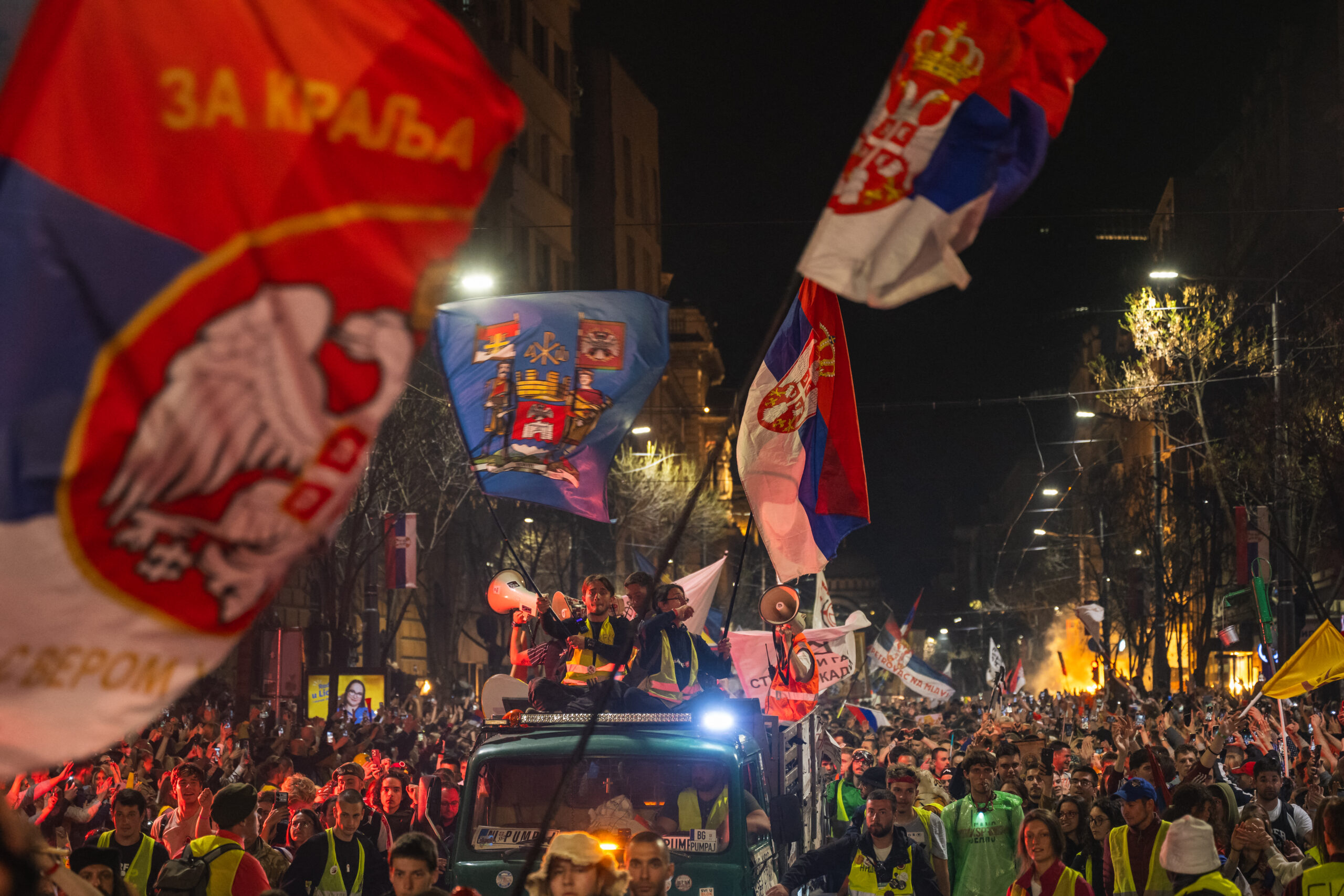
However, the two leaders diplomatically sidestepped the issue (on which the EU Commission started raising its voice recently). There was no word about the erosion of the rule of law or the repression of dissent, two dynamics that do not mesh well with the Copenhagen Criteria that candidate countries must meet to join the Union.
For now, Costa prefers to maintain a conciliatory tone. Since taking office as president of the European Council in December, he has prided himself on putting the Western Balkan partners in the spotlight to enlarge the 12-star club. Before departing for Sarajevo, the former Portuguese premier also met with Prime Minister Duro Macut and Parliament Speaker Ana Brnabić.
English version by the Translation Service of Withub![[foto: Vladimir Yaitskiy/Wikimedia Commons]](https://www.eunews.it/wp-content/uploads/2025/05/Europe-Day-350x250.jpg)