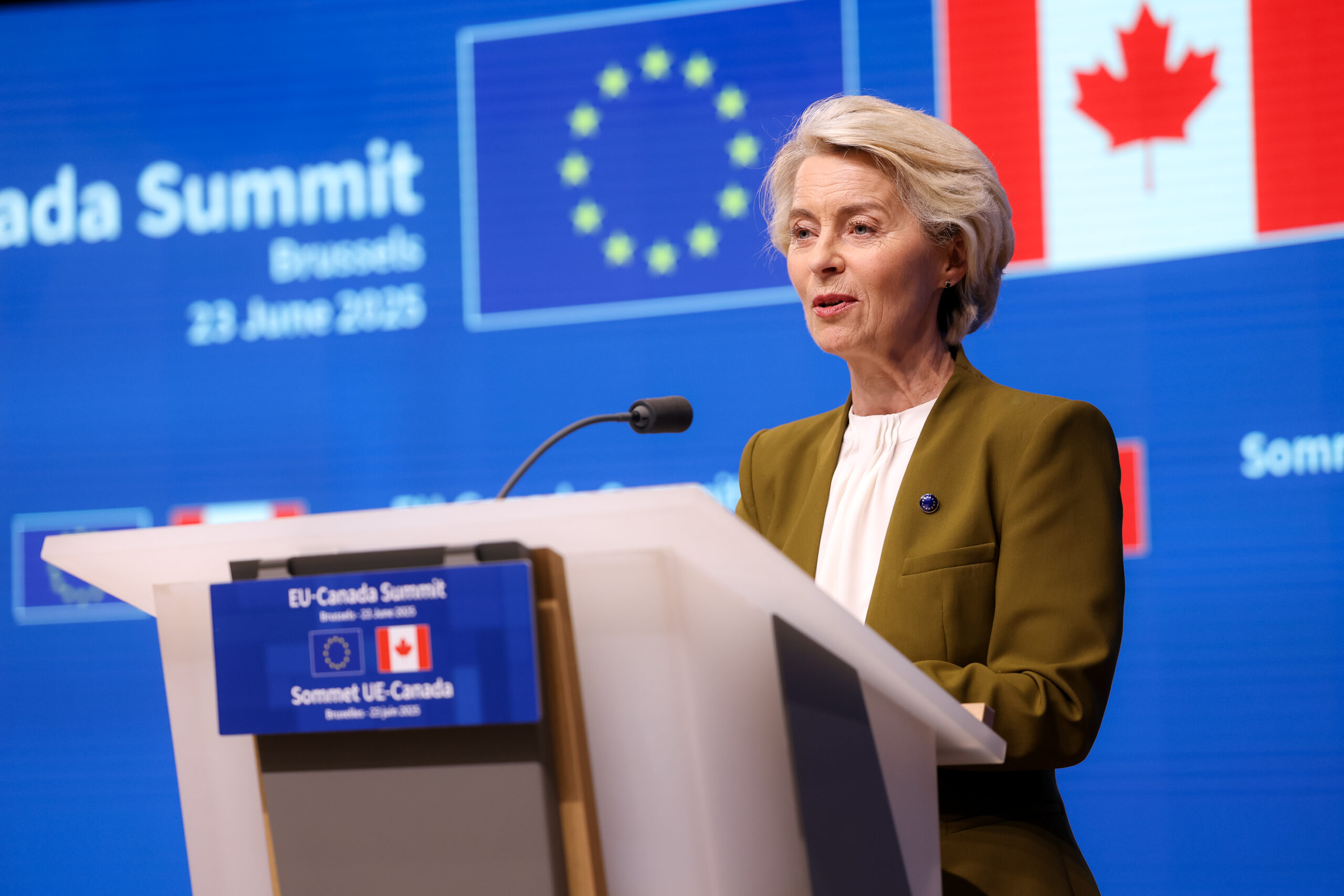
Brussels – If Washington pulls away, Brussels and Ottawa move closer in equal and opposite manner. Swept up by Trump’s trade war and American disengagement – if not outright threats – from collective security, the two transatlantic partners celebrated the 20th EU-Canada summit yesterday (23 June). “Hard times reveal true friends” was the message Ursula von der Leyen dedicated to Canadian Prime Minister Mark Carney. And, at odds with the unrecognizable friend, Donald Trump.
In the summit’s joint statement, the leaders of the EU and Canada reaffirmed the political, economic, and strategic partnership that increasingly binds them. The most meaningful passages regarded the commitment to multilateralism and the international order based on law, support for Ukraine, economic security, and trade. “Much more than just a symbolic milestone,” said the President of the European Council, Antonio Costa, “it is a strong political statement,” which emphasizes that “the European Union and Canada are among the closest allies in the transatlantic space.”
In the wake of those already signed with the UK, Norway, Moldova, South Korea, Japan, Albania, and North Macedonia, Brussels signed with Ottawa a new Security and Defense Partnership (SDP), further shoring up the defense architecture needed in the event of a gradual US disengagement. The partnership will deepen cooperation in several areas, including crisis management, the defense industry, hybrid threats, and military mobility. “We will now quickly start talks on Canada’s access to our joint military procurement instrument, SAFE,” von der Leyen announced during the press conference. The signing of a SDP partnership is, in fact, a requirement for third countries’ access to the new EUR 150 billion joint defense procurement fund.
Canada will send a defense representative to Brussels to structure real defense coordination. Von der Leyen, Costa, and Carney left today for the Atlantic Alliance summit in The Hague and reiterated that NATO “remains the cornerstone of their collective defense.”
The defense partnership is a further building block in the EU-Canada relationship, adding to the one on raw materials and CETA, the Comprehensive Economic and Trade Agreement signed nine years ago. “A shared success story,” von der Leyen emphasized, backed by numbers released by the European Commission last week showing that trade between the two sides of the Atlantic increased by 71 percent since the trade agreement began to be implemented, bringing “98 percent of our tariff lines to zero.” A joint message to Washington, ahead of the 9 July expiration of the suspension of reciprocal tariffs imposed by Trump on the rest of the world. Neither the EU nor Canada have yet reached a deal with the White House.
English version by the Translation Service of Withub


![Da sinistra: il presidente del Consiglio europeo, Antonio Costa; il presidente dell'Ucraina, Volodymir Zelensky: la presidente della Commissione europea, Ursula von der Leyen [Bruxelles, 18 giugno 2024. Foto: European Council]](https://www.eunews.it/wp-content/uploads/2026/06/euco_ua260618-120x86.jpg)
![[foto: Saverio De Giglio/imagoeconomica]](https://www.eunews.it/wp-content/uploads/2026/10/cpt-120x86.png)