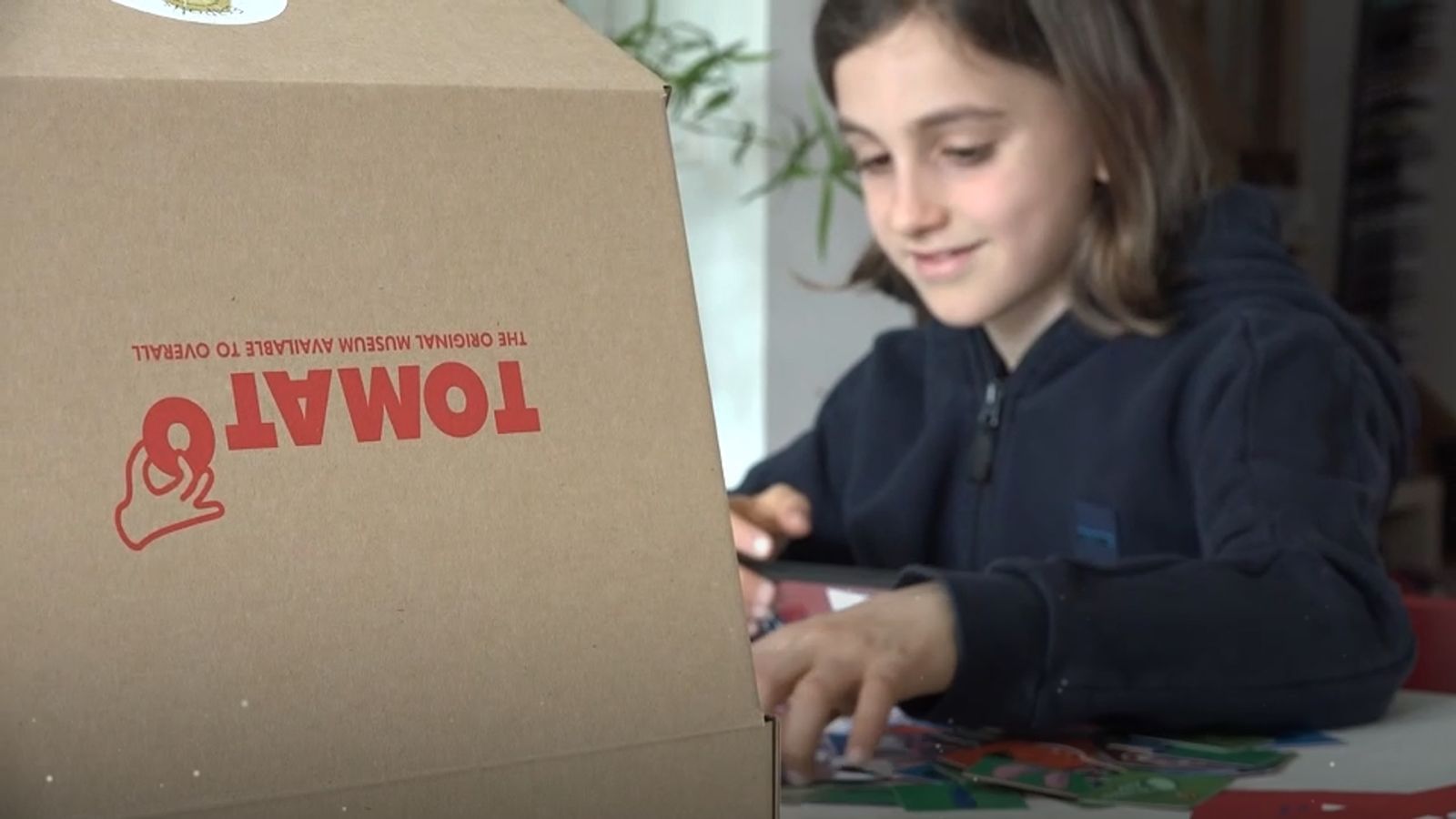
Brussels – An EU-funded project is trying to make cultural venues accessible to all. It’s the TOMATO project – short for The Original Museum Available To Overall – an innovative initiative aimed at breaking down the barriers that prevent people from disadvantaged backgrounds from enjoying exhibitions. Eight museums that have taken up the challenge launched by an Italian association with a simple but powerful idea: enclosing the essence of their collections in a box and in an app and sending them directly to the homes of people who would otherwise never be able to visit them.
The Idea Behind TOMATO
“TOMATO was born at Pleiades when, during the pandemic, we asked ourselves how to make a museum travel without moving the children. The idea of a ‘museum putting itself in a box’ took shape thanks to our collaboration with Venetian Cluster, HandsOn!, and other European partners: together we turned it into a hybrid experience, both digital and analogue, supported by Creative Europe funds,” explains Alessio Scaboro, Scientific and Creative Director of Pleiades and the TOMATO project.
Launched under the EU’s Creative Europe programme, TOMATO has developed a physical kit and a mobile app that allow users to explore the participating museums virtually, in a fun and curiosity-sparking way. The initiative is especially designed for children from disadvantaged backgrounds – whether the disadvantage is physical, cognitive, or economic. A physical barrier might mean a child in a wheelchair can’t enter an old museum without elevators. A cognitive one could be a child on the autism spectrum who finds crowded places overwhelming. An economic barrier might be as simple as a family living too far from a museum to afford the trip. TOMATO offers a free, virtual alternative – through a playful kit and a smartphone app.
Support from the European Parliament
“Culture must be a right, not a privilege. Too often, children and families with fewer opportunities remain on the margins of cultural offerings. Projects like TOMATO show that it is possible to bring everyone closer to museums in a creative, interactive and sustainable way. But a structural commitment is needed: accessibility—physical, digital and economic—must become a central criterion in European cultural policies,” demand Carolina Morace, Italian MEPs of The Left group and members of the Culture committee of the European Parliament. “The fact that the EU supports a project like ‘TOMATO’ is doubly significant: on the one hand, it offers children with disabilities a tool to access something as vital as culture; on the other, it shows how Europe can truly connect with its citizens and their everyday lives,” adds Benedetta Scuderi, MEP of the Greens group, who is also a member of CULT.
Learning Through Play
The kit takes the shape of a board game that transforms the museum experience into something interactive and physical. This is particularly important in light of the hands-on approach, which is central to contemporary pedagogy. This method emphasises that children learn best by doing and touching – by physically engaging with materials – rather than simply listening to explanations or looking at pictures. And this kind of interaction is especially crucial when it comes to young learners. Gruppo Pleiadi designed eight kits, each one customised to the exhibitions of the participating museums: the Esapolis Museum in Padua, the Museum of Oriental Art in Venice (Italy), the Sladovna Gallery in Písek (Czech Republic), the Croatian Ecomuseum Istrian de Dignan, the Slovenian museums Abakkum, Skrateljc, and the Tartini House Museum, and the Frida & Fred Museum in Graz, Austria.
Augmented Reality
But the kit is only the beginning. To enrich the experience, a mobile app – available on Android and iOS – adds immersive features like augmented reality and virtual tours, making exploration even more engaging, especially for children. The app, too, is customised for each of the eight museums, offering personalised guides and games to explain their exhibitions – in their respective national languages. “With TOMATO, we bring culture home: a physical kit delivered by post and an app that completes the experience online. The museum becomes small for the little ones, but the experience remains big—games, challenges, and narratives that invite children to explore the identity of each museum while having fun,” says Scaboro.
From Testing to Refining
Developed through a collaborative effort involving educators, game designers, and cultural mediators, 1,000 kits have been distributed to the partner museums and tested with children and schools. Testing proved crucial, helping the team understand how quickly children grasp the games, how much they learn, and where improvements were needed – from clearer instructions to more durable materials and better localisation.
A Vision for the Future
As the TOMATO project nears its end, all partners have voiced a strong desire to keep the experience alive and growing, even beyond EU funding. The team is now looking for new partners, as well as public and private investors. The aim is not only to preserve what’s been achieved, but to build on it. For Scaboro, the next steps are: “Expanding our network of museums, co-designing new and even stronger kits—without losing the magic of play—and continuing to listen to our little testers who, better than anyone, know how to help TOMATO grow.”
English version by the Translation Service of Withub![La sede del Museo di arte orientale a Venezia [foto: Mao]](https://www.eunews.it/wp-content/uploads/2025/04/ca-pesaro-2-350x250.jpg)

![Da sinistra: il presidente del Consiglio europeo, Antonio Costa; il presidente dell'Ucraina, Volodymir Zelensky: la presidente della Commissione europea, Ursula von der Leyen [Bruxelles, 18 giugno 2024. Foto: European Council]](https://www.eunews.it/wp-content/uploads/2026/06/euco_ua260618-120x86.jpg)
![[foto: Saverio De Giglio/imagoeconomica]](https://www.eunews.it/wp-content/uploads/2026/10/cpt-120x86.png)